Nearly five decades after it first exploded onto the silver screen in 1978, Grease remains an undisputed juggernaut of modern cinema. It didn’t just capture an era; it became an enduring cultural phenomenon. By seamlessly stitching together a idealized, neon-soaked vision of 1950s high school life with a powerhouse soundtrack, electrifying choreography, and the universal ache of youthful romance, the film secured a permanent home in the collective consciousness.
Even for those rare individuals who have never sat through the full feature, the movie’s sonic footprint is inescapable. Tracks like “You’re the One That I Want” and “Summer Nights” have transcended the celluloid itself, surviving as permanent fixtures on global airwaves, theatrical stages, and endless pop-culture pastiches.
At its core, the engine driving this narrative machine is the friction between Danny Zuko and Sandy Olsson. What begins as a fleeting summer romance takes a sharp turn into reality when Sandy unexpectedly transfers to Danny’s high school. It’s a dynamic that beautifully distills the agonizing, universal themes of teenage identity, peer group politics, and social pressure. Danny is caught in the classic adolescent trap: desperately trying to preserve his leather-jacketed, tough-guy persona while secretly grappling with genuine, vulnerable affection. Flanked by the iconic subcultures of the Pink Ladies and the T-Birds, their rollercoaster courtship unfolds through a series of musical set-pieces that have since been etched into cinematic history.
The Travolta Effect and the “Four Corners” Genesis
The meteoric success of Grease did more than fill theater seats; it acted as a career-defining launchpad for its central cast. Most notably, it solidified John Travolta’s status as Hollywood royalty. Striking a rare cinematic lightning with his potent blend of raw charisma, fluid dance capability, and an undeniable screen magnetism, Travolta morphed Danny Zuko into a generational archetype. Because of his performance, Grease evolved from a mere summer blockbuster into a permanent cultural touchstone—one that is still actively celebrated through high-profile reunions, retrospective interviews, and anniversary specials.
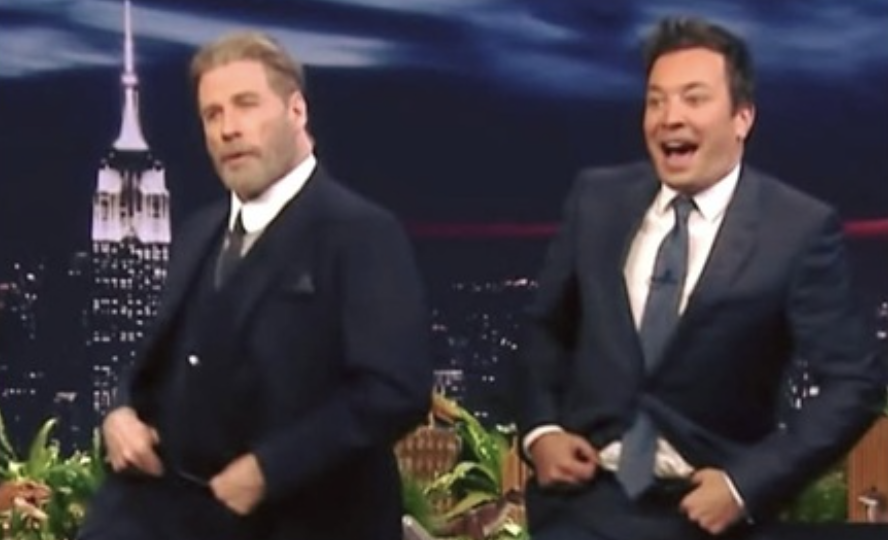
Over the years, the enduring fascination with the film has frequently brought its cast back into the late-night spotlight. A prime example occurred when Travolta joined Jimmy Fallon on The Tonight Show to look back at the legacy that shaped his career. During the broadcast, the actor pulled back the curtain on the production, offering fans a rare glimpse into the highly collaborative—and often beautifully chaotic—nature of the filmmaking process.
"The anecdote highlights how some of the most iconic moments in movie musicals can emerge not only from structured planning but also from spontaneous creativity on set."
Travolta revealed that much of the physical vocabulary he brought to Danny Zuko was actually rooted in his own childhood, heavily influenced by the novelty dances of earlier decades. He recalled a pivotal moment during the shooting of the film’s climactic finale, “You’re the One That I Want.” The creative team found themselves hunting for a step that was simple, yet visually arresting enough to anchor the closing sequence.
Reaching into his own memory bank, Travolta suggested a vintage move known as the “four corners” step. The film’s choreographer, open to the star’s intuition, asked him to demonstrate it on the spot. That brief moment of improvisation was instantly woven into the final cut, providing the infectious, high-energy punctuation mark to one of cinema’s most famous endings.
A Generational Bridge Built on Nostalgia
That late-night television appearance quickly turned from a standard interview into a masterclass in nostalgia. As the house band struck up the familiar chords of the Grease soundtrack, Travolta stepped out from behind the desk to briefly recreate the very steps that had captivated audiences forty-eight years prior. The studio audience’s ecstatic reaction was a testament to the deep, unyielding affection the public still harbors for these characters and performances.
Moments like this illuminate exactly why Grease continues to bridge generational divides. For millions of viewers, it is far more than a vintage movie; it operates as a piece of shared cultural DNA, embodying the timeless spirit of youthful energy, music-driven storytelling, and the golden age of the Hollywood musical. The relentless public appetite for anniversary specials, cast reunions, and viral performance recreations proves that the film’s gravity has lost none of its pull over time.
Ultimately, John Travolta’s permanent association with Danny Zuko speaks volumes about the lasting weight of iconic cinematic performances. Though his expansive filmography has since spanned decades of diverse, critically acclaimed roles across film and television, Grease remains inextricably linked to his public identity. His continued willingness to embrace that legacy—whether through reflective interviews or impromptu dance demonstrations—keeps the film fiercely relevant for the original generation of fans while simultaneously introducing it to fresh audiences.
Grease endures because it successfully bottled a lightning-fast cocktail of nostalgia, music, and emotional truth that simply refuses to age out. Its songs are still the soundtrack to countless lives, its characters remain instantly recognizable archetypes, and its visual beats are still actively quoted across modern media. Decades after the house lights first came up, it stands as a masterclass in how entertainment elevates into art: by fusing emotion, performance, and song into something that echoes long after the final frame fades to black.