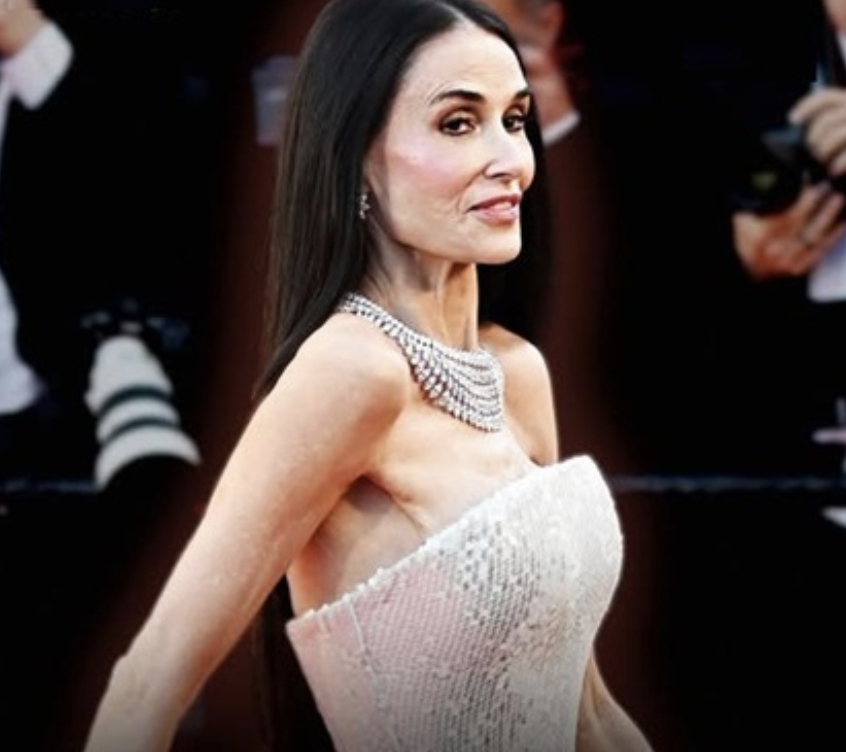
There is a specific kind of alchemy that occurs when true Hollywood royalty steps onto the Croisette. It’s not merely about making an entrance; it is a masterclass in presence, a poised reminder of enduring industry influence. This year, Demi Moore didn’t just attend the Cannes Film Festival—she effectively commanded it, turning the opening ceremony’s high-voltage anticipation into a singular showcase of her lasting star power. As the Riviera sun dipped below the horizon and the world’s media elite lined the barricades, Moore delivered a multi-act wardrobe narrative that proved why she remains one of cinema’s most compelling visual storytellers.
The prelude to her red-carpet triumph began away from the flashing bulbs of the Palais des Festivals. Proving that true style is a 24-hour discipline, Moore was first spotted navigating the city’s elite dining scene in a meticulously curated Gucci ensemble. It was an exercise in relaxed luxury: sharp, structured tailoring effortlessly balanced with casual layering. Complete with a structured shoulder bag and statement footwear, the look whispered rather than shouted, reinforcing her decades-long reputation for thoughtful, context-aware styling.

The Anatomy of a Style Shift: From Photocall to Palais
By the following morning, the casual elegance of the night before gave way to sharp, professional artistry at the official jury photocall. Flanked by industry heavyweights, Moore shifted the narrative from individual glamour to creative collaboration.
-
The Silhouette: A bold, polka-dot Jacquemus dress that instantly broke through the formal monotony of the press backdrop.
-
The Execution: Playful textures and vibrant color accents that subverted traditional daytime formalwear.
-
The Trend: A prime manifestation of a growing Cannes phenomenon, where legacy actresses reject safe choices in favor of fierce individuality and avant-garde tailoring.
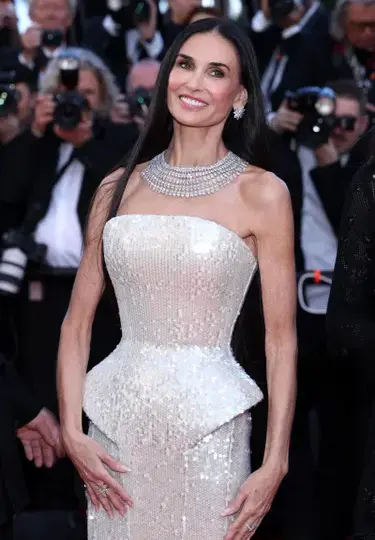
The true crescendo, however, arrived that evening. For the opening ceremony, Moore emerged in a custom, structured Jacquemus gown heavily embellished with intricate sequins. It was a garment built for the unique geometry of Cannes—designed to catch the unpredictable Riviera light and translate beautifully into motion. Paired with high-jewelry accents, the look was a deliberate nod to the golden age of cinema, positioning Moore squarely in the lineage of Cannes icons who understand that fashion is an extension of the theatrical craft.
The Digital Panopticon: Scrutiny in the Modern Age
Yet, in 2026, a red carpet appearance no longer ends when the star walks through the theater doors. As high-resolution images flashed across global feeds, the public discourse shifted instantly from fashion critique into a wider, more complicated commentary on celebrity culture, aging, and the relentless gaze of the internet.
On social media platforms, real-time reactions fractured into two distinct camps. While legions of supporters celebrated Moore’s uncanny ability to maintain absolute relevance across decades of industry upheaval, others engaged in hyper-analytical scrutiny of her physical appearance. Images captured from every conceivable lens angle were dissected, proving once again that high-profile women in entertainment navigate a uniquely intense visual gauntlet.
“Moore’s presence at Cannes naturally became a lightning rod for an ongoing cultural conversation—one that extends far beyond a single event, reflecting how legacy female celebrities are perceived, judged, and valued over time.”
Fashion analysts observing the festival noted that Moore’s strategy was highly sophisticated. Rather than relying on a singular aesthetic note, she offered a layered public image that evolved with every appearance. It is a veteran tactic required for the grueling Cannes schedule, where an actor must effortlessly transition between institutional gravity and high-fashion theater.
Legacy in the Digital Age
Ultimately, Moore’s French Riviera campaign was about much more than fabric and tailoring; it was a potent reminder of her sustained connection to the global entertainment landscape. Festivals like Cannes serve as crucial cultural intersections where cinematic history meets contemporary innovation. By occupying this space with such undeniable authority, Moore bridged the gap between Hollywood’s rich history and its rapidly evolving future.
When the digital dust settles, the prevailing narrative of Moore’s latest Cannes chapter is one of triumph in a hyper-competitive, visually saturated environment. In an era where online attention spans fracture in seconds, she managed to hold the world’s gaze through consistency, precision, and an innate understanding of her own mythos. It was real-time proof that while the tools of public perception continue to change, true star power remains entirely timeless.