
The Indian Ocean has always traded on its postcard perfection: turquoise shallows, pristine coral atolls, and the gentle lulling of luxury liveaboards. But fifty meters beneath the surface, where the light of the tropical sun dies, the ocean changes. Down here, the water pressure is five times greater than at the surface, the darkness is absolute, and the margin for human error evaporates.
What began as a routine dawn excursion aboard a high-end Maldivian cruiser has devolved into one of the most complex, politically sensitive, and tragic diving disasters in the history of the archipelago. Five Italian nationals—a tight-knit group of elite marine scientists, researchers, and technical divers—descended into a notorious, unmapped underwater cave system. They never came back up.
The subsequent frantic rescue effort did not just reveal the grim fate of the missing scientists; it claimed the life of a highly trained Maldivian military diver, injured several others, and exposed a web of bureaucratic irregularities, unauthorized deep-water exploration, and a catastrophic breakdown in safety protocols. Today, the luxury vessel sits impounded in port, its license suspended, while international investigators from Malé to Rome attempt to piece together the final, suffocating moments of the expedition.
The Departure of the Duke of York
The timeline began with deceptive normalcy on May 10. The Duke of York, a luxury liveaboard catering to affluent divers and specialized expeditions, weighed anchor from the capital city of Malé. On paper, the week-long itinerary was billed as a hybrid of high-end tourism and scientific marine research.
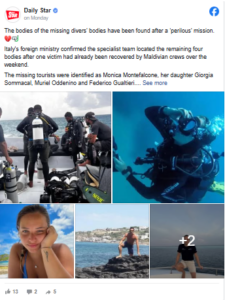
Among the passengers was a formidable roster of Italian academic talent, heavy on expertise and steeped in thousands of hours of logged bottom time. The team included:
-
A veteran associate professor specializing in marine ecology.
-
Her daughter, a brilliant young biomedical engineering student.
-
A dedicated marine conservation researcher.
-
A recent honors graduate in marine ecology.
-
An elite diving instructor who double-hatted as the expedition’s logistics coordinator.
These were not casual tourists taking photos of reef sharks; these were individuals who understood the mechanics of the ocean. Yet, during a scheduled morning dive, the five-person team bypassed the vibrant, shallow reefs and descended into the twilight zone of the ocean floor. Their target was an uncharted, labyrinthine cave network carved into the submerged bedrock, its mouth yawning open between 47 and 50 meters below the surface.
They slipped beneath the waves, and then the silence set in.

The 30-Meter Line: Law vs. The Deep
To understand the legal and physical crisis that unfolded, one must understand the strict regulatory architecture of Maldivian diving. By local law, recreational diving is strictly capped at a maximum depth of 30 meters. To push beyond that boundary requires a completely different tier of human endeavor: technical diving certifications, specialized gas mixtures (such as Trimix to mitigate the dangers of breathing regular air at depth), heavy redundant equipment, and explicit, formal authorization from the Maldivian government.
According to preliminary investigative reports, the Italian team crossed that 30-meter line and kept going.
The entrance to the cave system they targeted sits at the absolute outer edge of survivable air diving. Investigators are now aggressively pursuing two theories: Did the dive team knowingly violate the country’s depth restrictions in the name of scientific discovery, or was there a catastrophic miscommunication in the dive planning that led them to misjudge the topography?
The operator of the Duke of York has moved quickly to distance itself from the tragedy. In official statements, the company maintained it was completely blindsided by the team’s deep descent, asserting that the crew had never been informed that the divers intended to exceed recreational limits, and denying any responsibility for what it termed an “unauthorized descent.”

Silt-Outs, Narcosis, and the Psychology of Panic
What went wrong inside that submerged cavern is a nightmare scenario well-known to hyperbaric medical experts and veteran cave divers. At 50 meters, the human body becomes a laboratory of volatile physiological reactions.
The Physiology of the Deep: Breathing standard compressed air at that depth subjects a diver to intense nitrogen narcosis—often called the “rapture of the deep.” The sensation is akin to severe alcohol intoxication, slowing reaction times, impairing judgment, and inducing a dangerous state of euphoria or disorientation. Simultaneously, the elevated partial pressure of oxygen introduces the risk of oxygen toxicity, which can cause sudden, violent seizures underwater.
But physiology is only half the battle; geography is the other. British cave diving specialists consulted on the case emphasize that the structural dangers of these unmapped Maldivian systems are unforgiving.
The floor of an underwater cave is typically covered in a layer of ultra-fine, microscopic sediment. If a diver panics, miscalculates a kick-fin stroke, or even exhales too forcefully against the ceiling, that sediment is stirred into the water column. The result is an instantaneous “silt-out.”
Within seconds, visibility drops from crystal clear to absolute zero. Flashlights become useless, reflecting off a wall of mud. In total darkness, suspended in three-dimensional space, the human brain loses all sense of up and down. Teams become separated. Divers swim deeper into the cave thinking they are heading toward the exit. Panic spikes, breathing rates skyrocket, and life-support gas supplies deplete at an terrifying pace.
A Rescue Mission Turns Fatal
When the Duke of York raised the alarm that the five divers had failed to surface, the Maldivian Coast Guard and military launched an immediate, massive search and recovery operation. Recognizing the extreme technical demands of the site, specialized European diving units were flown in to assist local teams.
But the cave system defended its secrets aggressively. The search parameters were so deep and the passages so narrow that rescue divers were forced to put their own lives on the line with every descent.
The true peril of the site was realized when a senior Maldivian military diver, part of the elite recovery team, suffered severe complications while ascending from the cave mouth. Reports indicate he fell victim to a catastrophic decompression incident—commonly known as “the bends”—where nitrogen bubbles form in the bloodstream and tissue due to rapid pressure changes. Despite emergency interventions, the soldier died. Several of his comrades suffered similar pressure-related injuries and required urgent medical evacuation to hyperbaric chambers.
The rescue mission had now become a double tragedy, underscoring the brutal reality that the environment was hostile even to the most elite military divers in the region.
The Discovery and the Final Note
After days of grueling, low-visibility operations, recovery teams pushed deep into the claustrophobic recesses of the cavern. There, far from the entrance and deep within the subterranean darkness, they discovered what they had feared.
The five Italian divers were found together. Their physical proximity in death suggested a final, desperate act of solidarity—an attempt to pool resources, maintain visual contact, or comfort one another as their gas supplies dwindled to zero.
In a poignant and chilling twist, recovery teams retrieved a waterproof logbook from the scene. Inside was a brief, handwritten note scribbled underwater. It referenced the success of locating all members of the group in the darkness—a final testament to their professionalism and attempts to maintain order amidst an escalating disaster.
The Paper Trail: Inconsistencies and Regulatory Overhaul
With the bodies repatriated to Italy with the assistance of the Italian government, the focus of the joint investigation has shifted from the ocean floor to the bureaucratic paper trail.
Investigators have unraveled significant discrepancies between the scientific research permit granted to the expedition and the reality of who was in the water. Official records confirm that two of the five divers who died were never listed on the original research application. Furthermore, the specific cave system where the tragedy occurred had not been explicitly declared as a target site in the pre-dive paperwork.
The Maldivian Ministry of Tourism and maritime authorities are treating these omissions not merely as administrative errors, but as a potential deliberate bypass of safety oversight. Was the scientific mantle used as a cover for highly experimental, high-risk technical diving that would otherwise have been denied permission?
The Legacy of the Disaster
The grief rippling through the international marine science community is matched only by the urgency of the debates now taking place in government offices. This tragedy has shattered the delicate illusion of safety surrounding high-end marine exploration in remote destinations.
It has forced a critical, uncomfortable examination of the boundaries separating recreational diving, technical exploration, and academic field research. How should developing island nations regulate highly specialized, deep-water scientific missions in remote atolls? Who holds ultimate responsibility when an independent team chooses to push past the legal limits of safety?
For now, the dive community mourns a devastating loss of intellectual talent and diving experience. But as the joint Maldivian and Italian investigation draws to a close, the lesson left behind in the silent caves of the Indian Ocean is as old as seafaring itself: the sea accepts no compromises, and the rules of the deep are written in blood.