For three years, the silence inside the house was absolute. It was the kind of quiet that doesn’t just fill a room, but suffocates it—the heavy, unyielding aftermath of a father’s death.
To watch a child grieve is to watch a slow-motion vanishing act. My twelve-year-old son, Leo, once a boy of boundless curiosity and endless chatter, had effectively retreated behind a fortress of short phrases and a closed bedroom door. Every parental instinct I had was channeled into reaching him, yet every attempt at comfort felt like throwing a lifeline to someone who had already submerged. I feared, with a quiet desperation, that the boy he used to be was gone for good.
Then came the afternoon the silence finally broke, shattered by an injustice that Leo simply refused to accept.
The Boundary of Inclusion
It began with a school hiking trip—a six-mile trek meant to be a shared milestone for Leo’s class. But for Leo’s close friend, Sam, the invitation carried a cruel asterisk. Sam has used a wheelchair since early childhood due to a physical disability. When the school administration reviewed the rugged, six-mile itinerary, they looked at the steep inclines and uneven terrain and made a calculation based on liability and logistics. For Sam’s own safety, they decided, he would have to stay behind.
Where the school saw a prudent safety measure, Leo saw a devastating exclusion. To a twelve-year-old mind uncorrupted by bureaucratic risk management, safety should never be used as a justification for isolation.
The depth of Leo’s defiance didn’t become clear until that Saturday afternoon when the school buses rattled back into the parking lot.
When Leo stepped off the bus, he looked less like a middle schooler returning from a field trip and more like a survivor of a grueling expedition. His clothes were caked in dried mud, his shoes were visibly battered, and his breathing was heavy, labored by an exhaustion that went bone-deep.
Initially, I braced myself for the worst, assuming an accident had occurred on the trail. The reality, however, was far more extraordinary.
The Weight of the Mountain
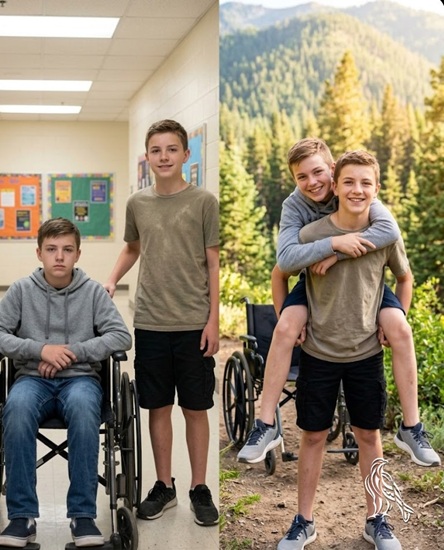
When the terrain became too punishing for the wheelchair, and the adults deemed the path impassable for Sam, Leo made a silent, unilateral decision. He refused to leave his friend at the base camp. If the school infrastructure couldn’t get Sam to the summit, Leo’s own two shoulders would have to do.
He helped Sam onto his back and began to walk.
Step by agonizing step, Leo carried his friend up the narrow paths. He navigated steep, treacherous inclines, altering his route and slowing his pace when the earth threatened to give way beneath them. He deliberately avoided the sightlines of teachers—not out of a childish desire to break the rules, but out of a fierce determination to ensure Sam wouldn’t be ordered back down.
For Leo, the math was simple: if the rest of the class was going to see the top of the mountain, Sam was going to see it too.
"Safety should never be used as a justification for isolation."
The immediate fallout was entirely predictable. Mr. Dunn, the teacher overseeing the trip, met me with a face flushed with frustration. From his perspective as an educator, Leo had committed a massive breach of protocol. He spoke urgently of the immense risks, of how Leo had flagrantly disregarded direct orders, and how easily both boys could have been severely injured.
He wasn’t wrong. As a parent, the thought of what could have happened made my stomach drop. But as I looked at my son, I saw something that bypassed the school rulebook entirely. This wasn’t the reckless rebellion of a troubled kid; it was a profound, visceral manifestation of loyalty and empathy—the first real sign of emotional life I had seen from Leo in three long years.
An Unexpected Tribunal
The true reckoning arrived the following morning. Summoned urgently back to the principal’s office, I walked in expecting the standard administrative hammer to fall: a formal reprimand, a suspension, or worse.
Instead, the hallway outside the administration building was lined with a striking, unexpected presence: several uniformed military officers.
Inside the office, the atmosphere was suffocatingly tense. Leo sat small in his chair, his eyes red and swollen from crying, entirely convinced that his world was about to collapse under the weight of a severe punishment. The school staff hovered nervously, seemingly unsure of how to navigate the situation.
The tension began to thaw when Lieutenant Carlson introduced himself. Moments later, the door opened to admit Sam and his mother, Sally.
Through tears, Sally explained what that mountain meant to her son. For years, Sam had lived on the sidelines, imagining what it felt like to stand at the peak with everyone else. Leo hadn’t just given him a view; he had given him a moment of total, uncompromised inclusion that Sam had long since surrendered to impossibility.
Then came the piece of the puzzle that connected the uniform-clad men in the room: Sam’s late father, Mark, had been a military general who had served directly alongside the officers standing before us.
The Code of the Field
Lieutenant Carlson looked at Leo, not with the stern disapproval of an administrator, but with the profound respect of a soldier. To these men, Leo’s actions on that muddy trail weren’t seen as a disciplinary infraction. They saw a demonstration of the core tenet of military brotherhood: you never leave a man behind.
What the school labeled as disobedience, the officers recognized as rare strength of character.
In a stunning turn of events, Lieutenant Carlson presented Leo with a higher education scholarship, funded entirely by a veterans’ organization, awarded specifically to honor the boy’s courage and integrity.
Then, an officer named Reynolds stepped forward. In a quiet, deliberate gesture, he removed a tactical patch from his own uniform and pressed it into Leo’s hand. It wasn’t a trophy for breaking rules; it was an acknowledgment of the profound, protective intent that drove him up that hill.
Carrying the Weight
In that crowded, emotional office, I watched the armor of grief finally slide off my son’s shoulders. For three years, I had seen him as a victim of loss, a child weighed down by a sorrow he couldn’t articulate. But watching him and Sam embrace, amidst the quiet nods of military officers and emotional school staff, I saw who Leo really was.
He was no longer a boy defined by what he had lost. He was a young man defined by what he was willing to carry.
Leo is still quiet, and he is still deeply thoughtful. The trauma of his father’s death hasn’t vanished. But the paralyzing emotional withdrawal has been replaced by a quiet, decisive compassion. As we walked out of the school gates and into the afternoon sun, I realized I was no longer just watching my son grow up. I was watching him learn how to take the heavy, painful pieces of his life and shape them into a profound sense of responsibility toward others.
He found a way to make his silence speak, one difficult step at a time.