The evening Leo came home, he looked less like a teenager and more like a survivor pulling himself from a wreckage. He stumbled through the front door caked in dried mud, his clothes ruined, his face drawn into a tight mask of pure exhaustion. As a parent, you learn to read the atmospheric pressure of your own home, and the silence Leo brought with him that night was heavier than any physical burden. It wasn’t just the fatigue of a long trail; it was the quiet shock of a boy who had carried the weight of the world on his shoulders and hadn’t yet found the words to lay it down. I asked him what had happened out there. He didn’t answer. He just looked away, staring into the middle distance, still processing the gravity of whatever had unfolded in the wilderness.
By morning, the quiet crisis of the night before had caught up with us.
The phone call from the school came early. The principal’s voice possessed an unusual, brittle tension—the kind that immediately signals trouble. She asked me to come to the administration building immediately, withholding the details. It is the kind of vagueness that makes a parent’s stomach drop. Driving to the school, my mind spun through a Rolodex of worst-case scenarios: suspension, disciplinary hearings, a permanent stain on my son’s record. I braced myself for anger, for disappointment, operating under the assumption that Leo, in his stubborn way, had crossed a line trying to prove a point on that school hike.
But nothing prepares you for the sight that greeted me in the main office.
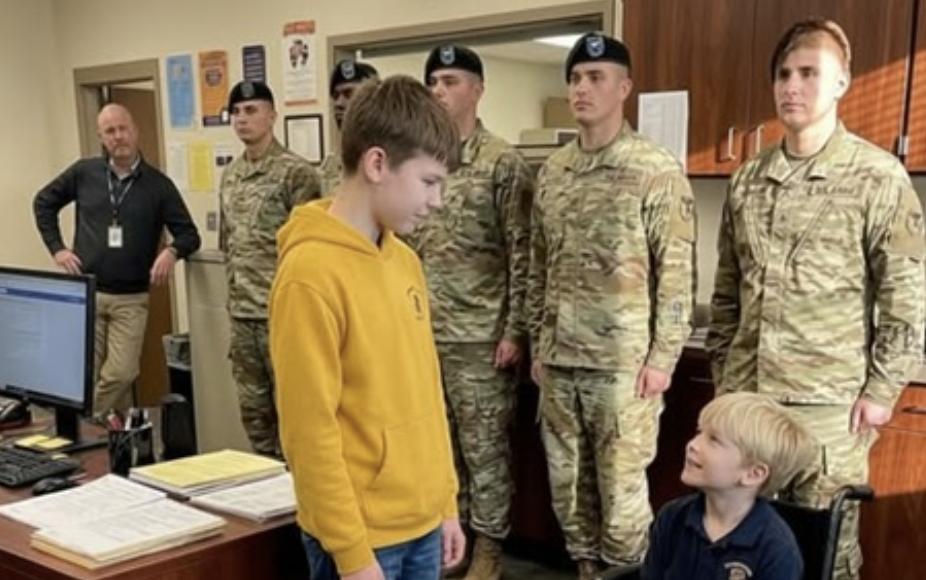
Inside the administration building, the familiar, mundane world of high school bureaucracy had been entirely displaced. Standing in a precise, unyielding line were several uniformed military officers. Their presence shifted the room’s oxygen instantly; this was no longer a principal’s office matter. The principal herself looked pale and unanchored, clearly out of her depth and unsure why the state’s military apparatus had descended upon her hallway. Instructed to wait, I sat in a corridor that felt thick with anticipation, realizing that whatever Leo had done, it had reverberated far beyond the school gates.
When Leo was finally escorted into the room, he looked painfully small. He was a boy caught in the glare of an unfamiliar, overwhelming spotlight. He hadn’t even changed; his clothes still bore the faded mud stains and scuffed fabric of the trail—a living testament to his ordeal. He stood there nervously, bracing for the hammer to fall, expecting punishment.
Instead, the tallest officer in the room stepped forward. He was a veteran, his posture commanding, silver hair catching the fluorescent lights, his chest decorated with the ribbons of a long career in service.
The officer didn’t scold. He spoke with a quiet, deliberate calm, addressing Leo not as a delinquent, but as a peer. He spoke of the grueling six-mile hike. He spoke of the reports that had filtered back to them about how Leo had utterly refused to abandon his friend, Sam, when the trail broke them. The room fell into a dead, reverent silence as the officer explained how the story had reached them. Sam’s late father had been a highly respected military figure, a brother-in-arms to the very men standing in that room. To these soldiers, Leo’s actions weren’t a breach of school field-trip protocol; they were an act of profound loyalty to a fallen comrade’s bloodline.
Leo shifted uncomfortably under the weight of their gaze. He lowered his eyes, his voice barely a whisper as he tried to de-escalate the gravity of what he’d done. To hear him tell it, there was no heroism involved. Sam was his best friend. You don’t leave your best friend behind. It was a matter of simple arithmetic to him—he couldn’t stomach the idea of Sam missing out on the summit, on the shared experience everyone else got to have. To Leo, it wasn’t a choice; it was just what needed to be done.
The officer listened, his expression unreadable, before reaching into his pocket. He produced a military patch—a distinct insignia representing endurance, loyalty, and brotherhood under fire. Bending slightly to meet the boy eye-to-eye, the veteran pinned the patch directly onto Leo’s stained shirt.
“Never leave a comrade behind,” the officer said, his voice softening just enough to let the emotion through. He noted that such a principle is rare in the world today—and rarer still in someone so young.
Then, he spoke the name that changed everything. He mentioned Leo’s own father, remarking that he would have understood exactly why Leo made that choice, and that he would have been deeply proud.
The mention of his father hung in the air like a prayer. In the corner of the room, the teachers who had spent the last twenty-four hours preparing a case for insubordination stood entirely silent. The shift in perspective was total and instantaneous. The rigid rules of a school district had collided with an ancient, unwritten code of human decency, and the rules had lost.
One by one, the officers stepped forward. There were no speeches, just firm, calloused handshakes that carried a weight I could feel from across the room. Watching them, it became clear that this wasn’t an award ceremony or a display of empty praise. It was something far more profound: it was the recognition of character. My son, who had been quietly drowning in grief since losing his father, was being seen. He was being acknowledged for an instinct that was entirely natural to him, even if the rest of the world had forgotten how to practice it.
Later that evening, the house was quiet again. The military patch sat on Leo’s desk, catching the amber light of the setting sun. Leo remained largely silent, still bewildered by the institutional uproar over what he viewed as a basic human decision. He didn’t feel brave. He just saw a friend who needed a hand and refused to walk away.
But looking at him in the quiet of his room, I saw my son clearly for the first time in a very long time.
True strength rarely announces itself with a trumpet flare or a calculated manifesto. It operates in the margins, in the split-second decisions made without an eye for reward, in a stubborn loyalty that doesn’t calculate the cost. Leo hadn’t set out into the woods to become a hero or to prove a point to his school. But in his refusal to leave a friend behind, he displayed a rare, unteachable integrity that no classroom could ever instill. It is a virtue that cannot be taught; it can only be lived.
And as the dusk settled, I realized that Leo was no longer defined by the tragedy of what he had lost, but by the profound grace of what he chose to carry forward.