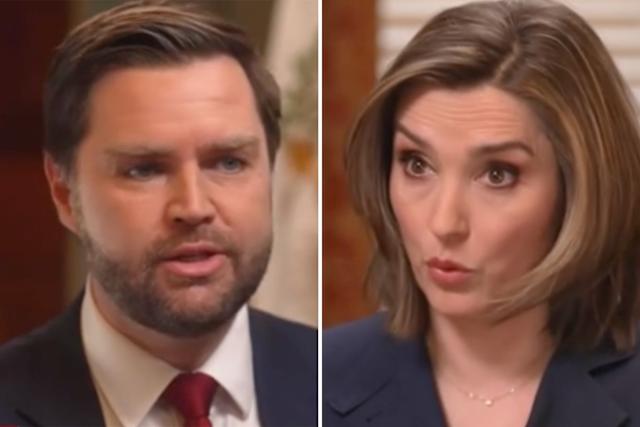
Vance Clashes With CBS Anchor Over Tulsi Gabbard Nomination: “Smears Won’t Work”
In a tense and combative interview on CBS’s Face the Nation, Vice President J.D. Vance fiercely defended Tulsi Gabbard’s nomination to serve as Director of National Intelligence (DNI), calling out host Margaret Brennan for what he described as “smear tactics” rooted in outdated partisan narratives.
The exchange grew heated after Brennan attempted to press Vance on past criticisms of Gabbard from conservative outlets like The Wall Street Journal and National Review, citing their scathing editorials and questioning whether her controversial foreign policy views should disqualify her from leading the nation’s intelligence apparatus.
“Both the Wall Street Journal and the National Review, conservative publications, as you know, have been critical of Tulsi Gabbard,” Brennan said. “The Review called her ‘an atrocious nominee who deserves to be defeated.’ They compared her defense of Edward Snowden… to an attorney general who thinks the mob gets a bad rap. Her refusal to accept U.S. intelligence findings that Assad gassed his own people, they said, was ‘like a nominee for OMB Director not being able to count.’ Does any of this give you pause putting her in charge of the U.S. intelligence community? Yes or no?”
Vance responded firmly, dismissing the critiques and turning the spotlight on the media’s selective framing. “No, Margaret, look—these are publications that attacked Donald J. Trump obsessively,” he said. “But those publications don’t determine who the president is. The American people do. And Donald J. Trump is the person who determines who his cabinet is—not these publications that I think, frankly, have lost relevance.”
Unshaken, Brennan pivoted: “The Senate will ultimately decide.”
Vance nodded but clarified the constitutional process. “The Senate will provide advice and consent, as is its constitutional obligation,” he said. “But I feel confident that Tulsi Gabbard will ultimately get through. There are two things that are important to know about her. First of all, she is a career military servant who’s held high-level security clearances for nearly two decades. She’s not only qualified—she’s battle-tested.”
He continued, “Tulsi has impeccable character and a record of public service. More importantly, she’s one of the few people who can actually help restore trust in the intelligence community. Right now, those bureaucracies are bloated, politicized, and detached from their core mission. Tulsi understands that, and that’s exactly why she was chosen.”
When Brennan pressed again, suggesting Gabbard herself had a deep distrust of the intelligence community she would be tasked with leading, Vance didn’t hesitate to hit back. “She doesn’t distrust national security,” he clarified. “She distrusts how these agencies have been politicized. There’s a difference. She recognizes the bureaucrats have gotten out of control, and we need someone strong enough to rein them in. We need a DNI who is loyal to the Constitution—not to entrenched unelected operatives.”
Confirmation Momentum Building
Despite the intense media scrutiny and efforts to paint her as an extremist or outlier, Gabbard’s nomination appears to be gaining ground in the Senate. Multiple key votes in recent days have signaled that her confirmation is all but secured.
Republican Senators Lisa Murkowski of Alaska and Bill Cassidy of Louisiana—both considered more moderate voices within the GOP—have confirmed they will vote to confirm Gabbard.
“I will vote to confirm Tulsi Gabbard as Director of National Intelligence,” Murkowski wrote in a public post on X (formerly Twitter). “While I continue to have concerns about certain positions she has previously taken, I appreciate her commitment to rein in the outsized scope of the agency, while still enabling the ODNI to continue its essential function in upholding national security.”
Murkowski added that she values Gabbard’s “independent thinking and necessary oversight” and expects her to “ensure the safety and civil liberties of American citizens remain rigorously protected.”
Sen. Cassidy echoed that endorsement in a press release, stating, “President Trump chose Tulsi Gabbard to be his point person on foreign intelligence. I will trust President Trump on this decision and vote for her confirmation.”
A Political Journey Comes Full Circle
Gabbard’s path to this nomination has been anything but conventional. A former Democratic congresswoman from Hawaii, she served from 2013 to 2021 and gained national attention for her maverick stances on foreign policy and civil liberties. In 2022, she made headlines by publicly leaving the Democratic Party, accusing its leadership of embracing “elitism, warmongering, and anti-religious bigotry.”
Her departure from the left marked a broader ideological shift, one that culminated in her endorsement of Donald Trump’s 2024 presidential bid and her formal decision to join the Republican Party in 2023. Since then, she has become a prominent voice within the America First movement, advocating for restrained foreign policy, greater accountability within federal institutions, and a renewed emphasis on civil liberties.
Looking Ahead
If confirmed, Gabbard would become the first woman of color and the first Hindu American to serve as Director of National Intelligence. Her appointment would also represent a significant shift in tone and leadership within the intelligence community—one that prioritizes reform, transparency, and a reassessment of how intelligence is used in both domestic and foreign affairs.
While opposition remains among some Democrats and legacy media outlets, the political tide appears to be in her favor. With support from both conservative populists and key swing-vote Republicans, Tulsi Gabbard may soon be tasked with reshaping one of the most powerful—and controversial—agencies in the U.S. government.
As Vice President Vance made clear in his defense, the nomination is more than a personnel decision—it’s a declaration that the status quo in the intelligence community is no longer acceptable.