For seventeen years, the world was comprised of just two people.
When a mother dies on the day her child is born, the father who remains must become an entire universe. He must be the protector and the provider, the teacher and the chef, the anchor and the sail. For this daughter, her father was all of those things, wrapped in the quiet humility of a man who spent his days sweeping floors.
He was not a man of natural grace, but of relentless effort. When she was small, he spent hours huddled over YouTube tutorials, his thick, calloused fingers clumsily learning how to braid her hair until he finally got it right. Sundays always carried the sharp scent of pancakes scorched slightly at the edges—cooking was never his forte, but love was. Every single morning, he packed her lunchbox with a folded napkin inside. On it, in steady, unassuming handwriting, was a note reminding her that she was valued, especially on the days she felt entirely invisible.
Her father was the school janitor. In the brutal, unforgiving social hierarchy of high school, that fact was a target.
She walked the hallways soundtracked by whispers she was never meant to hear. Cruel names, muffled laughter, and a collective teenage consensus that reduced her father’s entire existence to something small, dirty, and disposable. Early on, she mastered the armor of neutrality, keeping her face blank while the insults stung like salt in an open wound. But at home, behind closed doors, the armor would crumble.
Her father always knew. He never met her tears with the anger she expected. Instead, he would look at her with an unwavering calmness and offer a truth that took her years to fully understand: “People who feel the need to make others feel small,” he would say softly, “are already carrying something terribly heavy inside themselves.”
He was a man who believed, deeply and fundamentally, in the dignity of labor. To him, restoring order to a broken classroom or polishing a hallway floor required no less integrity than any other profession. He returned home each evening exhausted, but never bitter, carrying himself with a quiet, unshakeable pride. Watching him in the evenings, she used to wonder how a man so thoroughly overlooked by the world could remain so steady within his own skin. It was then that she made a silent pact with herself: one day, she would achieve something so great that it would render every cruel comment meaningless. She wanted the world to see him the way she did—as a man of immense importance, a man who was more than enough.
Then came the diagnosis. Cancer.
At first, he wore a mask of normalcy to protect her. He forced himself to work when his limbs rebelled; he cracked jokes in the morning; he insisted he was perfectly fine even as his body withered. But there were moments the mask slipped. She would find him sitting alone at the kitchen table long after dinner had grown cold, staring into the dark, silently gathering whatever microscopic strength he had left to face the next sunrise.
Through the pain and the fading strength, he held onto a single milestone like a lifeline. “I just want to make it to your prom,” he told her, again and again. “I want to see you in a dress. Just one picture to keep forever.”
He never made it. A few months before the dance, the clock ran out.
The Architecture of Absence
Grief does not wait for a proper goodbye. One afternoon she was just a student navigating the mundane geography of school hallways; the next, her tectonic plates had shifted forever.
The days that followed dissolved into a blur of funeral logistics, the hollow condolences of well-meaning strangers, and aluminum trays of food left at the door that nobody had the appetite to touch. The house grew deafeningly quiet, as if the very oxygen had lost its warmth. She packed her life into boxes and moved in with her aunt, but the absence followed her like a shadow. Nothing smelled like him anymore.
When prom season finally arrived, it felt like a broadcast from a distant planet. All around her, classmates gossiped about silk dresses, makeup appointments, and limousine rentals. To her, the event felt entirely hollow—a story missing its main character. Prom had been a dream they built together in the quiet fragments of evening conversations. He was supposed to be the one waiting by the door, pretending he wasn’t crying, embarrassing her with the fierce, protective love of a father.
One night, suffocated by the silence, she opened the cardboard box of belongings the hospital had returned. Inside lay the fragments of his daily life: his wallet, his wristwatch, and a stack of his work uniforms. Faded shirts in shades of slate gray, muted green, and industrial blue.
As she held the fabric, the memories rushed back with suffocating clarity. This green shirt was what he wore when he held the back of her bicycle, cheering as she learned to ride. This blue one was soaked with her tears after her worst heartbreaks. This gray one was pressed against her in a hug every morning before he told her she was stronger than she knew.
The idea arrived without warning, quiet but absolute. If he could not walk her to the dance, she would wear his love into the room.
She approached her aunt with a radical proposition: she wanted to sew her prom dress out of her father’s work shirts. Though she had never held a needle, her aunt didn’t hesitate. For weeks, the kitchen table became a sanctuary of targeted remembrance. They cut fabric, aligned seams, and tore out mistakes. Tears fell frequently, triggered by the sudden, fading scent of him trapped in the fibers of the cloth.
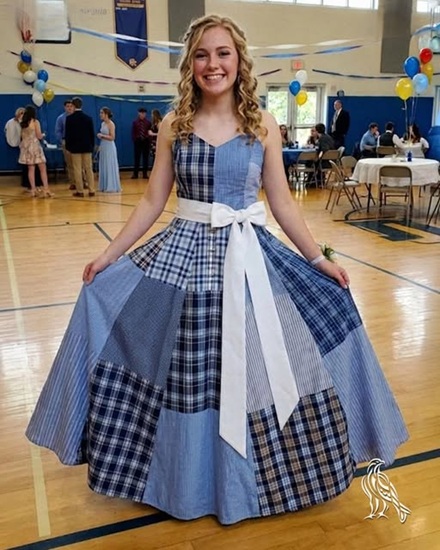
It was never an exercise in high fashion; it was an act of preservation. The green shirt was transformed into the sweeping lines of the skirt; the blue formed the bodice; the gray ran through the center, a physical manifestation of the memories holding her together.
The night before the dance, she stood before the mirror. The reflection didn’t mirror the glossy pages of magazines or the curated feeds of social media. It looked real. For the first time since his passing, the crushing loneliness receded, replaced by the phantom sensation of her father standing behind her, adjusting her hair, telling her she was beautiful. From the doorway, her aunt watched through a veil of tears, whispering, “He would be so incredibly proud.”
The Room Falls Silent
Prom night was a sensory overload of strobe lights and thumping bass—a celebration she felt entirely detached from. The moment she stepped into the ballroom, the atmosphere shifted.
The dress was impossible to ignore. The whispers began like a low hum, traveling across the dance floor. Curiosity turned quickly to judgment, and judgment to outright cruelty. Words like “rags” and “cheap” cut through the music, followed by sharp, mocking laughter. She froze, pinned beneath the collective gaze of the room.
Then, a voice cut through the noise, loud and mocking: “Did you make your dress out of janitor uniforms?”
The question hit with physical force. Trembling, her voice catching in her throat, she tried to explain. She told them her father was gone. She told them the dress was the only way she had left to bring him with her.
For a beat, the room fell dead silent. But high school cruelties die hard. Someone dismissed the explanation as a bid for drama, and the giggles resumed. She felt herself shrinking, pulled back into the old familiar quicksand of shame.
Then, the music stopped completely.
The DJ stepped back, hands raised in confusion, as the school principal walked out onto the center of the floor holding a microphone.
“May I have your attention, please,” the principal’s voice echoed off the gymnasium walls, commanding an immediate hush.
He didn’t talk about the dance, or the theme, or the seniors. He talked about the man who used to clean the floors they were standing on. He spoke of the decades her father had dedicated to the school, a lifetime of labor that had gone completely unacknowledged by the hundreds of students who walked past him every day.
The principal began to share stories the daughter had never heard. He spoke of a man who routinely stayed hours past his shift to help struggling students, who quietly fixed broken things no one ever thanked him for, and who carried out his duties with a silent grace that elevated the entire institution.
The mockery in the room evaporated, replaced by a heavy, profound realization.
Then, the principal looked out at the crowd. “I want anyone in this room whom this man ever helped to please stand up.”
At first, there was hesitation. A lone teacher stood. Then, a student in the front row. Then another. Then three more. Like a wave breaking across the room, dozens of students, faculty members, and staff rose to their feet until nearly half the ballroom was standing in formation. The very teenagers who had been laughing moments before now looked down at the floor, the weight of their own ignorance suddenly too heavy to bear.
The daughter’s tears came freely now, but the isolation was gone. Someone in the back began to clap. Within seconds, the entire room erupted into a deafening, standing ovation. The applause filled the cavernous space, washing away every insult, every whisper, and every ounce of shame that had accumulated over the years.
When the principal gently handed her the microphone, her hands shook, but her voice held. “I only ever wanted to make my father proud,” she whispered to the quieted room. “I just hope, tonight, I did.”
A Promise Kept
The night ended not under the artificial lights of the gymnasium, but under the fading canvas of the evening sky.
Accompanied by her aunt, she walked into the quiet stillness of the cemetery. The air was cool, the world completely silent. Kneeling beside her father’s headstone, the hem of her multi-colored dress resting against the earth, she reached out and touched the stone.
She ran her fingers over the fabric—over the green, the blue, and the gray.
In the quiet twilight, she whispered to him that she had kept her promise. She had carried him into the room, and the world had finally seen him for exactly who he was. And there, standing in the dark, she finally felt the one thing that had eluded her for months.
Not the emptiness of loss, but the profound, unshakeable weight of peace.