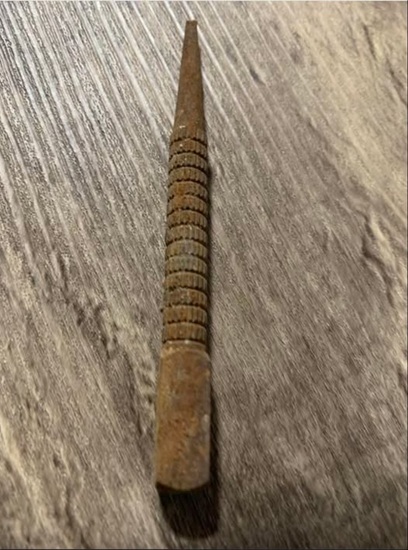
Step into any bustling workshop or peer into a contractor’s well-worn truck bed, and your eyes will naturally gravitate toward the heavy hitters. The imposing miter saws, the high-voltage drills, and the pneumatic nail guns command the room. Yet, tucked away in a quiet corner of the toolbox sits a diminutive, unpretentious cylinder of metal. It looks almost like an afterthought, a stray component rather than a specialized instrument. Novices often pick it up, turn it over, and ask a familiar question: What does this actually do?
Meet the nail punch—alternatively known as a nail set. It boasts no cords, requires no batteries, and makes no noise on its own. Yet, this quiet implement carries a lineage of craftsmanship that stretches back centuries, serving as the definitive line between an amateur DIY project and a flawless, master-level finish.
The Anatomy of an Invisible Finish
At its core, the nail punch is an instrument of redirection. It exists because of a fundamental law of carpentry: a hammer is a blunt instrument. While excellent for rough framing, swinging a heavy steel hammerhead directly onto a delicate piece of trim or a custom cabinet is an invitation to disaster. One slipped strike can mar the wood with an unsightly crescent-shaped dent—a blemish professionals call a “mar” or a “smilin’ jack.”
The nail punch solves this with elegant, physics-defying simplicity. By placing its slender, tapered tip squarely onto the head of a nearly driven nail and striking the blunt back end with a hammer, the carpenter focuses a concentrated, controlled burst of kinetic energy. The nail is driven cleanly beneath the surface of the wood, leaving the surrounding grain completely unblemished. It is a game of millimeters that elevates a rough installation into the realm of fine cabinetry.
From Flint to Factored Steel
This quest for a seamless finish is as old as human architecture. Long before standardized manufacturing, ancient builders realized that exposed fasteners were both an aesthetic eyesore and a structural liability. In the dawn of craftsmanship, primitive woodworkers utilized sharpened flints, makeshift stone chisels, or crude iron wedges to countersink their primitive fasteners. They understood a timeless truth: to build something meant to last, you had to tuck the joinery away.
The industrial revolution turned this artisan secret into a mainstream necessity. As factories began churning out standardized wire nails by the millions, construction scaled at an unprecedented pace. Carpentry split into distinct disciplines, and finishing work emerged as a premium skill. Furniture makers, finish carpenters, and cabinet builders needed a reliable, standardized tool to match this rapid production. The modern nail punch was born out of this necessity, quickly cementing its place as an indispensable staple of the trade.
Engineering in its Purest Form
While the nail punch looks like a simple rod of metal, its construction requires meticulous metallurgical engineering. It is a tool born to take a beating. Typically forged from high-carbon hardened steel or modern titanium alloys, it must withstand thousands of high-impact hammer blows without fracturing or deforming.
The architecture is beautifully utilitarian. It features a solid, impact-resistant struck face at the top, a knurled or textured body in the middle to give greasy or sweaty fingers a secure grip, and a precisely machined, concaved tip. This subtle recess at the point is crucial—it cradles the domed head of the nail, preventing the punch from slipping off mid-strike and gouging the wood.
The Unsung Hero of Modern Craft
In contemporary woodworking, the nail punch is the first step in a disappearing act. Once the tool drives the nail head a fraction of an inch below the wood’s surface, it leaves behind a clean, uniform dimple. This tiny cavity is then filled with wood putty, sanded flush, and treated with stain or paint. The result? A perfectly smooth expanse where the joinery becomes entirely invisible to the naked eye. In high-end finish carpentry, this isn’t just about cosmetics; it is about preservation. Exposed nail heads invite moisture, which leads to rust, wood rot, and catastrophic structural failure over time. By countersinking the fastener, the woodworker seals it away from the elements.
Like all classic tools, the nail punch has adapted to the 21st century without losing its identity. Walk down a hardware aisle today and you will see modern iterations featuring:
-
Ergonomic Rubber Sleeves: Designed to absorb shock and reduce hand fatigue during long days on the job.
-
Color-Coded Bands: Laser-marked measurements that allow a carpenter to grab the exact diameter they need from a pouch at a glance.
-
Spring-Loaded Automatic Sets: Ingenious variations that eliminate the hammer entirely, utilizing an internal spring mechanism to deliver the necessary force with a single push.
The Power of Keeping It Simple
We live in an era captivated by technological disruption. Workshops are increasingly dominated by computerized CNC routers, laser levels, and smart tools connected to smartphone apps. Yet, the nail punch remains entirely insulated from obsolescence.
Its greatest asset is its absolute reliability. It cannot suffer a software glitch, its battery will never die in the middle of a remote job site, and it requires zero maintenance. For trim carpenters detailing a historic restoration or furniture makers crafting an heirloom piece, it remains the ultimate tool of precision.
Ultimately, this unassuming rod of hardened steel stands as a profound reminder of a philosophy often forgotten in the modern world: complexity does not equal capability. Sometimes, the most elegant solution to a complex problem is a simple, perfectly engineered tool that does exactly one thing, flawlessly. The nail punch doesn’t ask for the spotlight, but every time you admire a seamless piece of molding or a pristine wooden table, you are looking at its silent handiwork.