The delivery room in June 2021 was supposed to be a theater of quiet anticipation. Reazjhana Williams arrived at the hospital carrying the universal, fragile blueprint of a first-time mother: a natural birth plan, an expectant family waiting just beyond the threshold, and the singular, consuming desire to feel her newborn daughter’s skin against her chest seconds after delivery. It is a generational ritual, a passage defined by hope.
But in the sterile geography of a modern labor ward, control is an illusion that can dissolve in the space of a single heartbeat.
When the monitors tracking Williams’ baby girl began to sputter, the ambient warmth of the room froze. The rhythmic, reassuring thud of the fetal heart monitor grew erratic, then dangerously faint. Medical staff shifted from routine monitoring to the tense, kinetic choreography of an impending crisis. In a matter of minutes, a milestone birth transformed into a frantic race against the clock.
Doctors delivered the verdict with the stark economy of language reserved for emergencies: the baby was in distress. They needed to perform an emergency Cesarean section immediately to save both lives.
For Williams, the transition from laboring mother to surgical patient was a blur of fluorescent lights, rushed consent forms, and the overwhelming scent of antiseptics. She would later recall the disorienting rush of medications designed to accelerate labor, followed almost instantly by the realization that surgery could no longer be delayed.
“Everything happened so fast,” she would later say, describing a state of profound vulnerability where the world narrowed down to the urgent whispers of surgeons and the paralyzing fear of the unknown.
The Anatomy of an Emergency
To understand what happened next requires an understanding of the brutal physics of an emergency C-section. When a fetal heartbeat vanishes from the monitor, obstetricians operate under a terrifying window of time. Brain damage or stillbirth can occur in minutes. The priority is immediate extraction, a mandate that requires swift, deep incisions through layers of skin, fat, and uterine wall.
But speed carries a premium. In this instance, when baby Kyanni was finally lifted from the womb, the traditional chorus of relief was replaced by a sharp, collective intake of breath.
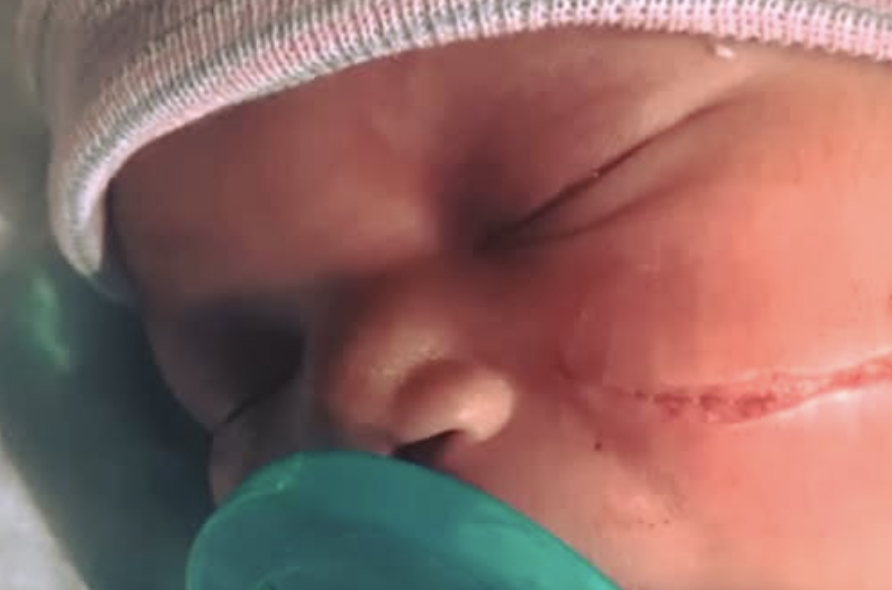
Kyanni was not placed into her mother’s waiting arms. Instead, the newborn was immediately surrounded by a specialized medical team. A deep, jagged laceration cleaved across the infant’s cheek—a stark, crimson wound on a canvas that should have been flawless.
“We expected a celebration, but we were met with absolute horror,” a family member recalled.
The injury was severe enough to require the immediate intervention of a plastic surgeon. The diagnosis from the attending staff was as clinical as it was devastating: during the rapid, blind entry required by the emergency, the surgical scalpel had cut through the uterine wall and sliced deep into the infant’s face. Doctors later explained that the baby’s head had been positioned abnormally close to the placenta wall, leaving virtually no margin of error for the blade.
While fetal lacerations are a documented risk of Cesarean sections—occurring in an estimated 1% to 3% of deliveries—the sheer depth of Kyanni’s wound was a staggering anomaly. It would ultimately take 13 stitches to close the gash on the newborn’s face.
The Stolen Bonding Hours
For any mother, the immediate postpartum period is an essential window for maternal-infant bonding, driven by a delicate cocktail of hormones and physical touch. For Williams, that window was violently shuttered. As she lay on the operating table recovering from major abdominal surgery, her daughter was being stitched back together under a surgeon’s microscope.
| Medical Reality | Emotional Toll |
| Emergency Scalpel Incision | Immediate maternal panic and loss of control |
| 13 Facial Stitches on Newborn | Severe psychological trauma and guilt for the parents |
| Immediate Neonatal Plastic Surgery | Interrupted maternal bonding and delayed physical contact |
| Public Statement on ‘Known Complication’ | Academic alienation of a family’s personal tragedy |
The visual evidence of the ordeal—photographs of a days-old infant with a heavy, black line of surgical thread tracking across her soft cheek—quickly migrated from private family texts to the public square of social media. The images provoked a visceral, international reaction, sparking fierce debates over obstetric safety, medical malpractice, and the thin line between a life-saving intervention and a catastrophic error.
Yet behind the viral outrage stood a family trying to reconcile two conflicting truths: they were profoundly grateful that Kyanni was alive, yet deeply traumatized by the violence of her entry into the world.
A Hospital’s Defense, A Community’s Response
As public scrutiny intensified, Denver Health released a carefully measured statement. The health system defended the actions of its staff by contextualizing the injury within the chaotic framework of emergency medicine.
“A Cesarean section is a complex surgical procedure that is often performed under emergent circumstances to save the lives of both mother and baby,” the hospital stated. “While fetal lacerations are a recognized complication of these high-risk, rapid extractions, our primary focus remains the safety and ultimate well-being of our patients.”
While medically accurate, the clinical detachment of the statement offered cold comfort to a family navigating the psychological aftermath of the birth. Kyanni’s grandmother spoke publicly of the family’s paralysis, noting that while they understood the immense pressure doctors faced to find a heartbeat, the physical reality of the wound felt impossible to accept.
In the wake of the tragedy, the local Denver community and a broader network of online strangers rallied around the Williams family. A GoFundMe campaign launched to offset the impending avalanche of specialized medical bills and psychological counseling quickly raised thousands of dollars. The financial influx provided a safety net, but more importantly, it offered the family a rare sense of validation in a world that often dismisses birth trauma as an acceptable cost of survival.
The Long Scar of Recovery
Infants possess an extraordinary capacity for cellular regeneration; their skin remodels with a speed that adults cannot replicate. Doctors remain optimistic that Kyanni’s youth will allow the severe scar to fade significantly as she grows, turning a deep physical wound into a faint reminder of her survival.
But the emotional scars left on Reazjhana Williams and her family carry a different prognosis. Birth trauma is an invisible injury, one that lingers long after surgical stitches are removed.
The story of baby Kyanni is not merely a cautionary tale about a rare medical mishap. It stands as a profound journalistic testament to the fragile, high-stakes reality of the delivery room—a place where life and tragedy are often separated by a fraction of a millimeter, and where the joy of new life can be permanently altered by the swift, irreversible stroke of a blade.