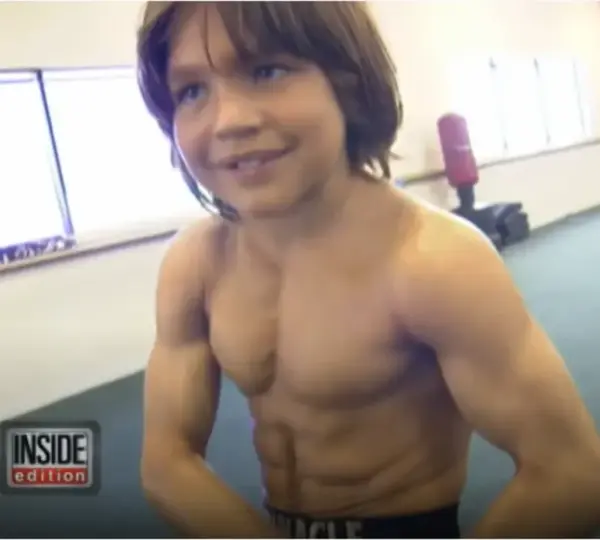
Before the internet possessed the vocabulary for “viral sensations,” the world found itself transfixed by a striking anomaly of human physiology. He was a pint-sized titan, an eight-year-old boy possessing the sculpted, hyper-defined musculature of an elite Olympian. To the public, he was “Little Hercules.” But behind the flashing bulbs and breathless headlines was Richard Sandrak—a child thrust into a global spotlight long before he could comprehend the weight of international fame.
Born in Ukraine in 1992, Sandrak immigrated to the United States with his parents, a couple whose backgrounds seemed uniquely tailored to breed an athletic phenomenon. His father, Pavel, was a martial artist steeped in rigorous training; his mother, a competitor in sports aerobics. By the dawn of the 2000s, this genetic blueprint and an unrelenting regimen converged to create a media firestorm. Before he had even finished primary school, Richard was a fixture on talk shows, the subject of prime-time documentaries, a cover boy for fitness glossies, and the star attraction at national exhibitions.
To look at him then was to experience a profound sense of cognitive dissonance. He was a child, yet his body fat percentage was reportedly near zero, revealing a chiseled physique that defied nature. The public reaction was polarized: audiences marveled at his extraordinary flexibility and strength, yet a growing chorus of child psychologists and medical professionals questioned the ethics and long-term health implications of such an intense, adult-style training schedule.
The Architecture of an Idol
Richard’s early existence was defined by a strict, almost monastic discipline. Long before his peers had even joined local little leagues, he was mastering complex martial arts forms, enduring grueling flexibility routines, and lifting weights under his father’s uncompromising gaze.
As footage of his advanced workouts circulated through global media markets, he earned the unofficial title of “The Strongest Boy in the World.” He became a highly lucrative commodity in the fitness entertainment ecosystem, drawing massive crowds at bodybuilding expos. Yet, beneath the adulation, a quiet debate simmered:
Was this the pinnacle of childhood dedication, or was it a case of immense parental pressure robing a boy of his youth?
The answer came not from a medical study, but from a domestic crisis. The trajectory of Richard’s life shifted fundamentally when his father was arrested and subsequently incarcerated for domestic violence. It was a seismic event that fractured the family and instantly shattered the paradigm of Richard’s daily life.
Stripping Away the Armor
With his father removed from the equation, the teenage Richard made a decisive choice: he stopped lifting. The grueling, multi-hour daily workouts ceased, and he cut off ties with his father. The intense public scrutiny and the artificial environment of child bodybuilding slowly faded into the background. Richard began the arduous process of shedding his public persona to find out who he actually was.
       [ THE EVOLUTION OF RICHARD SANDRAK ]
Childhood (2000s)     -->   Adulthood (Present)
-----------------           -------------------
"Little Hercules"     -->   Hollywood Stuntman
Extreme Bodybuilding  -->   Functional Fitness & Skateboarding
Media Curiosity       -->   Aspiring Scientist/Engineer
As the years rolled on, the hyper-muscular physique naturally softened, replaced by the frame of an average adult. When he occasionally resurfaced in the media, the public was often stunned by his transformation. To many, it seemed impossible that the most famous fitness child in history could simply walk away. But for Richard, the explanation was refreshingly mundane: lifting weights had simply become tedious and boring. He refused to remain an exhibit in a museum of public nostalgia.
Today, Richard has traded the bodybuilding stage for the high-stakes world of Hollywood action. Working as a professional stunt performer, he has spent years as a mainstay in the live “Waterworld” stunt show at Universal Studios Hollywood. It is a profession that demands every ounce of the agility, discipline, and spatial awareness he acquired in his youth, but on his own terms. On any given day, his job description includes plummeting from high towers, dodging explosions, and literally setting himself on fire.
Beyond the Muscle: The Next Chapter
While his career remains intensely physical, Richard’s personal philosophy has shifted toward a more balanced, pressure-free existence. He stays active through skateboarding, gymnastics, and bodyweight exercises, prioritizing movement and enjoyment over muscle hypertrophy.
Yet, perhaps the most compelling revelation from his adult life is his intellectual ambition. Far from the archetype of the one-dimensional athlete, Richard has expressed a deep, abiding passion for science and engineering, noting in interviews that his ultimate dream would be to work as a quantum scientist or an engineer for NASA. It is a revelation that disrupts the public’s neatly boxed narrative of who he is supposed to be, proving his curiosity stretches far beyond the physical realm.
More than two decades after he first shocked the world, Richard Sandrak remains an enduring case study in the dynamics of early childhood fame. The internet still routinely recycles his childhood photos, juxtaposing them against images of the bearded, ordinary-looking man he is today, often accompanied by collective disbelief.
But Richard doesn’t look back with bitterness. He views “Little Hercules” not as a burden, but merely as an early chapter in a much longer book. By refusing to let his past dictate his future, Sandrak has achieved something far more difficult than any feat of strength: he reclaimed his own life, proving that the ability to reinvent oneself is the greatest power of all.