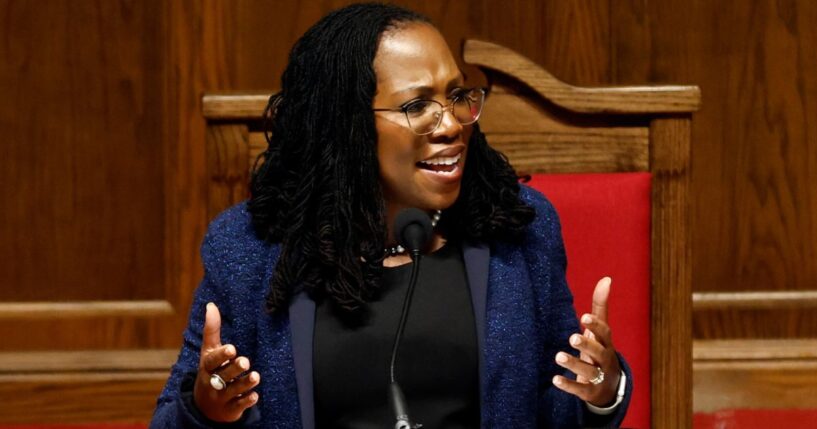
Supreme Court Justice Ketanji Brown Jackson, already the subject of frequent criticism from her conservative colleagues, is now feeling the heat from within her own ideological camp—this time, from fellow liberal Justice Sonia Sotomayor.
The latest judicial jab came in American Federation of Government Employees v. Trump, a case stemming from former President Donald Trump’s efforts to downsize the federal workforce. While the underlying legal dispute centers on whether those workforce reductions must go through the Merit Systems Protection Board—a body designed to shield civil servants from politically motivated firings—the Supreme Court wasn’t ruling on that issue just yet.
Instead, the high court was considering a much narrower question: Should Trump’s administration be allowed to proceed with the layoffs while litigation continues?
In an 8–1 decision, the Court said yes, lifting a lower court’s injunction that had temporarily blocked the administration’s plans. Only one justice dissented.
No surprise: it was Jackson.
In her lone dissent, Justice Jackson slammed the decision, claiming the Trump administration had “sharply departed from settled practice” by initiating a reduction in force, and argued that allowing the layoffs to proceed could cause “harmful upheaval” while the courts determine their legality.
But then came a striking rebuke—not from a conservative, but from Sotomayor herself.
While Sotomayor agreed in principle with Jackson’s concern that the president cannot unilaterally restructure agencies in violation of congressional mandates, she made it crystal clear that Jackson had missed the point.
“The plans themselves are not before this Court, at this stage,” Sotomayor wrote pointedly in her concurring opinion. “We thus have no occasion to consider whether they can and will be carried out consistent with the constraints of law.”
Translation: That’s not what this case is about, and it’s not the job of a justice to litigate imaginary issues.
This isn’t the first time Jackson has raised eyebrows—or drawn fire. Just last month, in Trump v. CASA, the Court ruled 6–3 to limit lower courts’ ability to issue universal injunctions. All three liberal justices dissented, but it was Jackson who authored the minority opinion. That dissent quickly became infamous for its tone and content, featuring lines dripping with sarcasm and phrases like “(wait for it)…” that sounded more like tweets than constitutional analysis.
Legal scholars and commentators across the spectrum pounced. Justice Amy Coney Barrett, writing for the majority, didn’t hold back either. She dismissed Jackson’s argument as being “at odds with more than two centuries worth of precedent,” citing Marbury v. Madison, the foundational case that defined the role of the Supreme Court.
Barrett added that Jackson “decries an imperial Executive while embracing an imperial Judiciary,” a pointed reminder that incoherence isn’t a substitute for legal reasoning.
Coming from Barrett, a conservative appointee, such a rebuke might have been expected. But when Justice Sotomayor—often viewed as the most progressive voice on the Court—feels the need to issue a course correction, it’s a more serious signal.
Even within the Court’s liberal wing, Jackson’s approach appears to be raising concerns.
Her apparent desire to broaden the scope of cases or veer into editorializing has brought criticism that she often focuses less on the case at hand and more on the platform it offers. Legal insiders now ask: Is Jackson writing opinions for the law books or for the headlines?
Whether these moments represent a rough learning curve for the Court’s newest member or signal a deeper philosophical divide even within the left remains to be seen.
But one thing is clear: When your own side starts fact-checking you in footnotes, it’s not just conservatives raising an eyebrow.