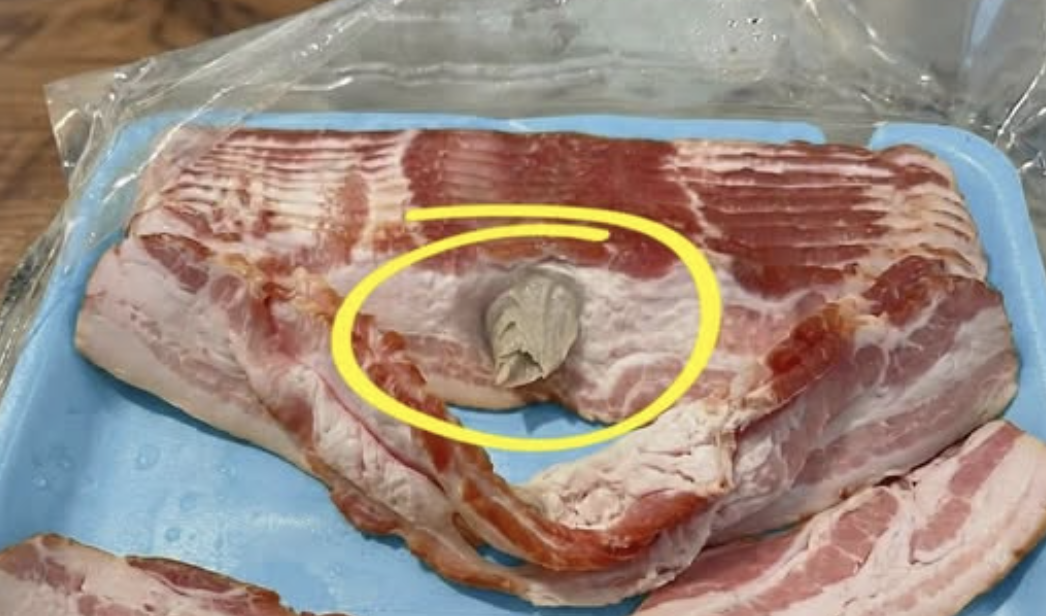
It began as the ultimate mundane ritual. The kitchen was quiet, the coffee maker was likely humming, and the mind was on autopilot. The objective was simple: open the refrigerator, grab a package of bacon, and throw some slices in a pan. But the moment the plastic seal was broken, the morning routine ground to a sudden, jarring halt.
There, nestled among the familiar, orderly ribbons of pink and white, was an anomaly. It didn’t look like muscle. It didn’t look like fat. In fact, it didn’t look like anything that belonged in a standard, mass-produced package of breakfast meat.
At first glance, it was a pale, dense nodule embedded firmly between the strips. But as the eye lingered, the unease set in. The texture was noticeably firmer than the surrounding tissue—rubbery, sterile, and strikingly uniform. It defied the natural grain of the bacon. For a fleeting second, the brain misfired, trapped in that specific brand of cognitive dissonance that happens when a deeply familiar everyday object suddenly morphs into a question mark.
Standing over the counter, curiosity curdled into genuine discomfort. The human mind is a master class in catastrophizing; when confronted with the unknown in our food supply, it bypasses logic and jumps straight to the worst-case scenario. Thoughts raced through a grim Rolodex of possibilities: industrial contamination, catastrophic manufacturing failures, or some bizarre foreign object baked into the assembly line. We live in an era of hyper-regulated food safety, yet the primal instinct to reject the unfamiliar remains incredibly potent.
As the seconds ticked by, the psychological weight of the discovery grew. This wasn’t just a spoiled breakfast anymore; it was a breach of consumer trust. When uncertainty enters the kitchen, logic takes a backseat, and the brain rushes to fill the information void with horror stories. In the span of a few moments, a comfort food staple had been recontextualized as a biohazard.
Once the initial shock subsided, the journalistic instinct—and the modern consumer’s reflex—took over: investigation. A quick dive into the digital ecosystem of forums, community boards, and image-sharing sites revealed a surprisingly crowded room. As it turns out, the internet is filled with dispatches from deeply unsettled shoppers who have unboxed similar mysteries in their pork products.
The Reality of the Assembly Line
Eventually, a grounded, rational explanation began to take shape. In the vast majority of these cases, these pale, stubborn chunks aren’t foreign contaminants at all. They are entirely organic. They are the remnants of cartilage, dense connective tissue, or small structural anomalies that survived the mechanical processing stage.
Industrial meat production is a game of staggering volume and lightning speed. Even with sophisticated quality control systems and optical sorting technology, the system is designed for efficiency, not aesthetic perfection. Sometimes, a piece of the actual animal slips through the filters intact.
The Disconnect on Our Plates
Yet, knowing the science doesn’t immediately erase the psychological squeamishness. This tension highlights a fascinating symptom of modern consumer culture: how profoundly disconnected we are from the biological origins of our food.
We buy meat that has been meticulously trimmed, bleached, shaped, and wrapped in plastic until it resembles a manufactured widget rather than livestock. When a piece of genuine biology—like a stubborn bit of cartilage—breaks through that sterile illusion, it shocks us.
The Takeaway: What we perceive as a defect is often just a rare glimpse of the raw material behind the brand.
Ultimately, the panic dissipated, leaving behind a compelling case study in human perception. The bacon wasn’t toxic; it was just a reminder of the machine behind the menu. It proved that what disturbs us most isn’t necessarily a tangible danger, but the sudden, unexpected disruption of our comfort zones.
When we are forced to look at the raw reality of what we consume, the experience leaves a lasting impression long after the kitchen has cleared.