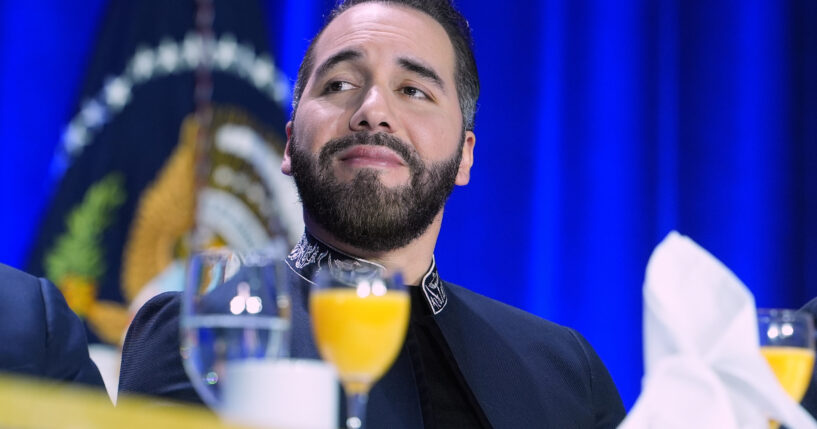
SAN SALVADOR, El Salvador — The data paints a stark, unavoidable picture of a shifting geopolitical landscape: the number of Salvadorans deported from the United States has nearly doubled in the opening months of 2026. This sudden surge arrives as El Salvador’s iron-fisted president, Nayib Bukele, strategically positions himself as the premier regional partner ready—and uniquely willing—to facilitate the Trump administration’s sweeping immigration crackdown.
According to El Salvador migration authority data obtained by the Associated Press on Tuesday, the U.S. repatriated 5,033 Salvadorans in the first quarter of 2026. During the exact same window in 2025, that number stood at 2,547.
A System Hardening in Real Time
This precipitous 98% spike coincides with a massive global expansion of U.S. deportation flights. Data compiled by the Asociación Agenda Migrante El Salvador (AAMES) and allied organizations reveals that worldwide deportation flights from the U.S. soared by roughly 61% between 2024 and 2025.
The dramatic uptick is more than just a bureaucratic shift; it represents a fundamental rewiring of regional dynamics. César Ríos of AAMES observed that the sharp increase in returns “confirms a real hardening of the U.S. immigration system toward the region.”
The Architecture of the ‘Shield’
The rapid escalation of returns is the direct byproduct of a calculated political alliance. Bukele, a leader who built his brand on an uncompromising, tough-on-crime agenda, has actively sought a seamless alignment with President Donald Trump. While the White House has recruited allies across Latin America to execute its border policies, Bukele has stepped forward with far more audacity than his counterparts.
Where nations like Mexico and other Central American neighbors have quietly agreed to receive third-country deportees behind closed doors, Bukele has loudly championed the American agenda.
In March 2025, Bukele made a highly publicized move by accepting 238 Venezuelan deportees—individuals accused of ties to the notorious transnational gang Tren de Aragua—and immediately locked them away inside his administration’s infamous mega-prison, built specifically for gang members.
This brand of cooperation cemented Bukele’s role within a coalition of right-leaning regional leaders. Trump has since dubbed this alliance the “Shield of the Americas,” a bloc explicitly tasked with crushing criminal syndicates across Latin America.
Anxieties on the Ground and in the Courts
As the machinery of deportation accelerates, an atmosphere of deep anxiety has settled over Salvadoran communities inside the United States. Many are watching the U.S. Supreme Court with growing dread, where legal arguments are underway regarding the Trump administration’s efforts to strip humanitarian shields from hundreds of thousands of Haitian and Syrian migrants.
For the more than 200,000 Salvadorans currently living under Temporary Protected Status (TPS), the legal battle feels like a ticking clock, sparking fears that their own protections could be the next to face the chopping block.
A History of Quiet Cooperation
Bukele’s willingness to act as Washington’s regional enforcement mechanism is not entirely new; it predates the current U.S. administration. In 2023, under pressure from the Biden administration to choke off the flow of northbound migration, El Salvador slapped a hefty $1,130 transit fee on travelers hailing from dozens of countries who were using San Salvador’s main airport as a layover hub to reach the U.S. southern border.
Simultaneously, the baseline push factors driving people out of El Salvador have shifted. Historically fueled by relentless poverty and rampant gang violence, outward migration from the country dipped significantly in the wake of Bukele’s domestic, all-out war on the street gangs that once paralyzed the nation.
Now, however, the political calculus has evolved: the very streets migrants left behind are being heavily patrolled by a government actively smoothing the runway for their forced return.
Megan Janetsky reported for this story from Mexico City.
Follow AP’s comprehensive coverage of Latin America and the Caribbean at https://apnews.com/hub/latin-america