Bombshell Shake-Up in U.S. Defense Leadership: Vice Admiral Shoshana Chatfield Removed from NATO Post Amid Trump Administration’s Anti-DEI Campaign
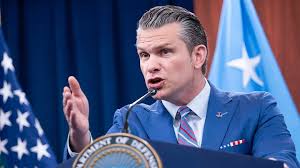
In a move that has sent shockwaves through the Pentagon and across NATO’s corridors, the Trump administration has abruptly dismissed Vice Admiral Shoshana Chatfield, a highly decorated three-star Navy officer and the sole female member of NATO’s Military Committee. The removal, which came without a public explanation, was first reported by Reuters and swiftly confirmed by multiple media outlets. It is widely understood to be part of the administration’s aggressive drive to dismantle Diversity, Equity, and Inclusion (DEI) programs within the U.S. military—a policy shift championed by Defense Secretary Pete Hegseth and closely associated with President Donald Trump’s vision for reshaping the armed forces.
Chatfield’s ouster is striking not just for its suddenness, but for the career it has interrupted. Over nearly four decades of service, she has broken multiple barriers, from becoming the first woman to lead the Naval War College to serving as the United States’ top uniformed voice in NATO’s senior military advisory body. Her leadership style has been praised by both American and allied officers for balancing operational rigor with a forward-looking embrace of strategic innovation.
Yet over the weekend of May 10–11, 2025, her NATO tenure came to an abrupt halt. According to defense sources, the call informing her of the decision came directly from Admiral Christopher Grady, the acting Chairman of the Joint Chiefs of Staff. The message was terse: she was being relieved of her NATO assignment. No further explanation was offered. The Pentagon declined to elaborate, citing a longstanding policy against public comment on individual personnel actions.
From Naval Aviator to NATO Leadership
Chatfield’s military journey began at the U.S. Naval Academy in 1987, where she earned her commission and trained as a naval helicopter pilot. Over her career, she amassed more than 3,000 flight hours in multi-role rotary-wing aircraft and commanded Marine Medium Helicopter Squadron 365 during combat deployments to Afghanistan. Her leadership extended beyond the cockpit; she oversaw joint reconstruction operations in austere environments, honing the skills that would later define her senior commands.
Her 2019 appointment as the first female president of the Naval War College marked another milestone. There, she championed academic programs on maritime security, wargaming, and the professional development of future flag officers. In 2023, she was promoted to vice admiral—a rank that positioned her for her role later that year as the U.S. military representative to NATO’s Military Committee.
In that NATO post, she worked alongside 31 other senior military representatives to guide alliance policy, from nuclear planning to responses to emerging global threats. Allies saw her as a steady hand during a period of heightened geopolitical uncertainty.
An Administration at War with DEI
The Trump administration’s hostility toward DEI initiatives in the armed forces has been no secret. Since early 2024, President Trump and Secretary Hegseth have framed diversity programs as ideological distractions that weaken military readiness. Their campaign has included shuttering the Pentagon’s Office of Diversity Management and Equal Opportunity, ordering the removal of hundreds of library volumes on gender, race, and sexuality from the Naval Academy, and reassigning or retiring officers seen as too closely tied to “woke” policies.
A major driver of these moves has been the American Accountability Foundation (AAF), a conservative watchdog group founded in 2023 to root out what it calls “woke infiltration” in federal institutions. In December 2024, AAF sent Hegseth a list of 20 general and flag officers it deemed overly invested in DEI. Chatfield’s name was on it, flagged for her past congressional testimony that “diversity is our strength” and for citing Defense Equal Opportunity Management Institute research linking gender equality to improved organizational performance.
While the AAF report raised no questions about her operational competence, it framed her public statements as proof of ideological misalignment with the administration’s priorities—a framing that appears to have carried weight in Pentagon decision-making.
Bipartisan Backlash and Strategic Fallout
The reaction from Capitol Hill has been swift and unusually bipartisan. Senator Mark Warner (D-VA) called the removal “reckless” and warned it could undermine NATO cohesion. Senator Jack Reed (D-RI), ranking member on the Armed Services Committee, described it as “disgraceful” and symptomatic of a purge that sacrifices merit for ideology.
Republican lawmakers have been quieter, with most either declining comment or echoing the administration’s readiness-focused rationale. A few, however—particularly those with strong pro-NATO leanings—have privately expressed concern that replacing experienced alliance leaders with ideologically vetted appointees could weaken U.S. influence in Brussels.
Allies, meanwhile, are said to be taking notice. Several NATO officials told reporters, off the record, that the move appears politically motivated and risks signaling that U.S. defense leadership is subject to abrupt political whims rather than strategic continuity.
Implications for the Pentagon’s Future
Chatfield’s dismissal is not an isolated case. She is the tenth general or admiral to be removed since January 2024, joining a list that includes National Security Agency head General Timothy Haugh and Chief of Naval Operations Admiral Lisa Franchetti. The rapid turnover has raised concerns about institutional memory, morale, and the military’s ability to retain senior talent.
Inside the Pentagon, some officials are quietly advocating for Chatfield’s reassignment to a stateside command—both to preserve her expertise and to mitigate perceptions that the administration is sidelining qualified leaders purely over policy disagreements. But others believe the shake-up is just the latest step in a long-term effort to reshape the upper ranks of the military into a cadre more aligned with the president’s ideological vision.
More than One Career at Stake
Ultimately, the removal of Vice Admiral Shoshana Chatfield is about more than one officer’s trajectory. It is a visible flashpoint in a larger struggle over what kind of leaders the U.S. military should cultivate and how it should define readiness in the 21st century.
Supporters of DEI argue that diverse leadership improves adaptability, innovation, and decision-making—critical assets in an era of complex global threats. Critics counter that the focus on diversity dilutes core warfighting skills and politicizes the chain of command.
For now, the immediate question is whether the United States can maintain its credibility as NATO’s keystone military power while conducting high-profile purges of its most senior officers. The longer-term question is whether the military will emerge from this era more effective—or more divided.