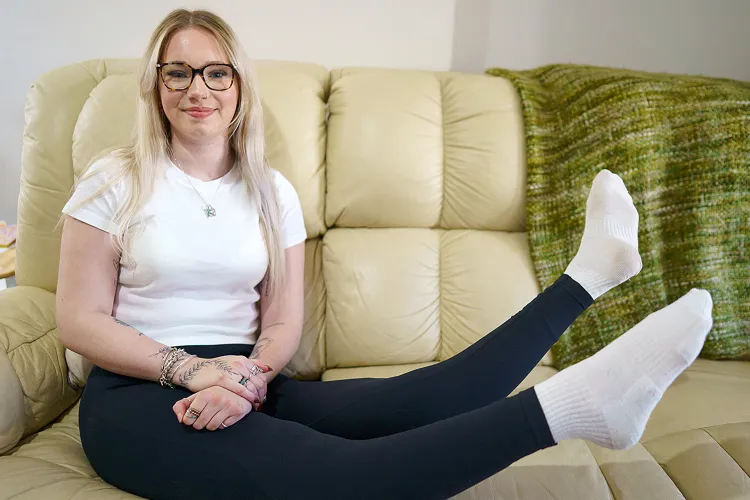
For eight agonizing years, Megan Dixon’s body was a prison, and the medical establishment was her warden. Today, at just 21 years old, she is preparing for an unthinkable resolution to a near-decade of torment: the surgical removal of both of her legs.
Scheduled for this August, the bilateral amputation is not a tragedy to Dixon; it is a hard-won liberation. After years of her lower limbs locking and gradually bending upward at a permanent, unnatural 45-degree angle, science has run out of answers, and time has run out of patience. Doctors have finally delivered the ultimate verdict—amputation is the “best and only option” left.
But to understand how a vibrant young woman arrived at the precipice of such a life-altering procedure, one must look back to where the nightmare began.
From Childhood Illness to a Comatose Cage
The descent was swift and merciless. At age 13, Dixon was a normal teenager when she contracted whooping cough and glandular fever. By 14, she had lost the ability to walk entirely, initially diagnosed with myalgic encephalomyelitis (ME), commonly known as chronic fatigue syndrome.
Then, the floor dropped out.
“From there I got worse and worse,” Dixon recalls. “I started to go into a comatose-like state. When I was 16, I stopped being able to sit up by myself and I started to lose the ability to speak.”
Admitted to Bristol Hospital, her world narrowed to a terrifying void. She lost her speech, her mobility, her physical strength, and eventually, her sight. Yet, as her body collapsed inward, her sensory perception of pain remained horrifyingly intact.
“I could feel my bones in my legs grating together, but I kept being told the pain was in my head and it wasn’t real,” Dixon says, describing a medical gaslighting that left her psychologically marooned. “I was silently screaming for 24 hours a day.”
Even when unconsciousness offered a temporary escape, her body refused to relent. “When I went into a coma-like state, I had no idea what was going on. No one could wake me up,” she says. “My legs were completely locked straight and even under an anesthetic, they couldn’t bend my knees.”
The Anatomy of FND and a Systemic Failure
Eventually, clinicians attached a name to her phantom torment: Functional Neurological Disorder (FND). According to the National Institute of Neurological Disorders and Stroke, FND is a complex condition where the brain struggles to send and receive signals properly, resulting in a devastating spectrum of symptoms including movement problems, debilitating pain, and seizure-like episodes.
For Dixon, those episodes were catastrophic. At her lowest point, she was enduring up to 50 seizures every single day. Her body was actively shutting down.
“I was getting to the point that I nearly died in hospital,” Dixon reflects. “The doctors did have to tell my parents to prepare for the worst — they didn’t think I would make it to 18 and here I am at 20.” (Note: As of April 2025, her seizure count has been painstakingly reduced to between 10 and 15 per day).
When she aged out of the pediatric facility at 18, she was transferred to the Eagle Wood Neurological Care Center. Realizing the standard system was failing her, Dixon’s family fiercely advocated for her care, lodging formal complaints that ultimately secured her transfer to a private nursing home specializing in complex neurological disorders. At the time, she was completely paralyzed from the neck down, forced to undergo the grueling process of retraining her body to perform basic human functions.
Yet, while her upper body fought its way back, her legs were losing the war.
The Irreversible Damage
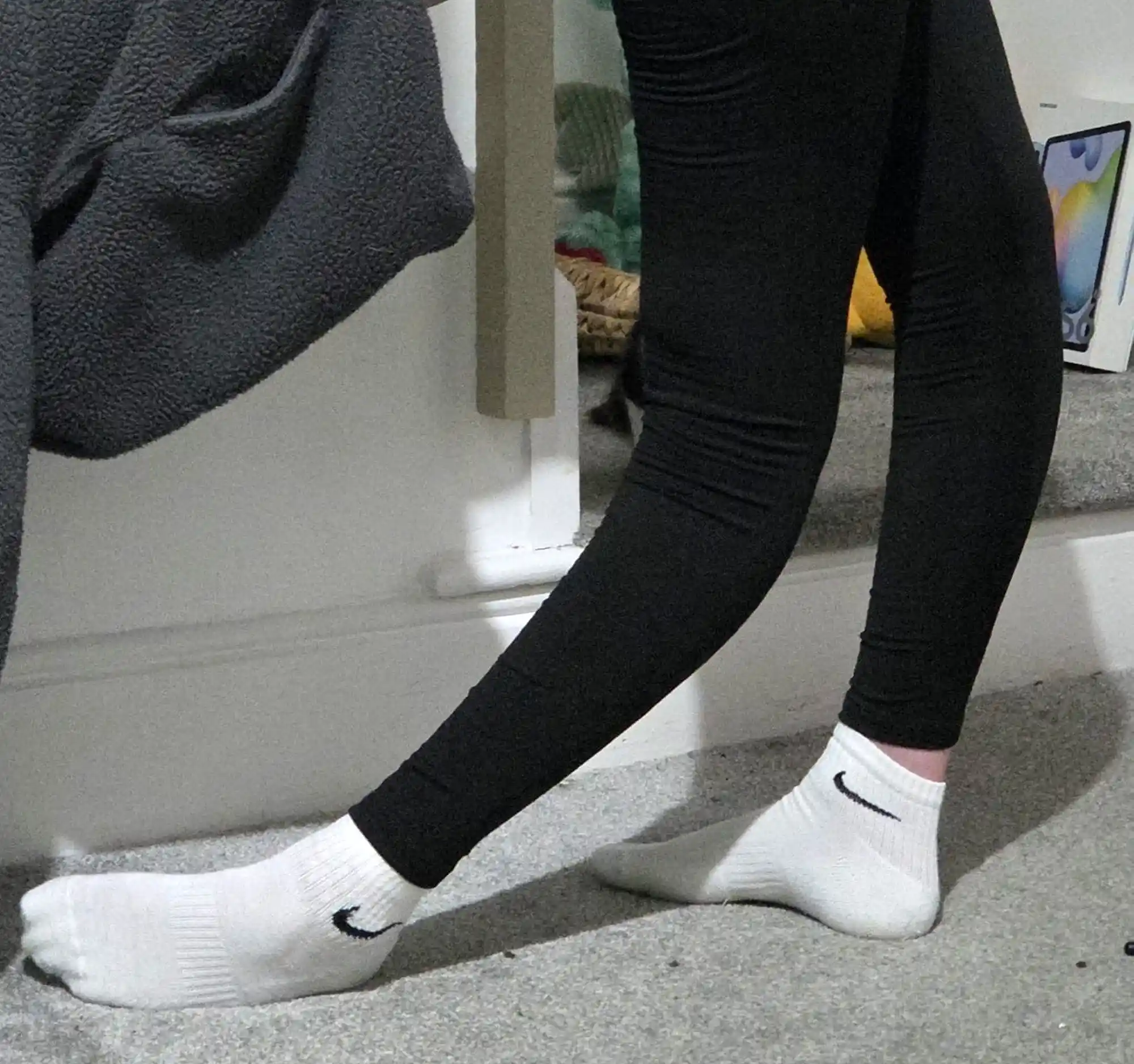
Dixon and her family sought out specialists to intervene before it was too late, but they were met with a wall of rejection. Five different surgeons turned her away. By the time she finally found a surgeon willing to operate, the prolonged neglect had exacted a permanent toll.
“The damage in my knees was irreversible,” Dixon says. “My left knee is bent at a 45-degree angle and my right is close behind. My only option left is amputation.”
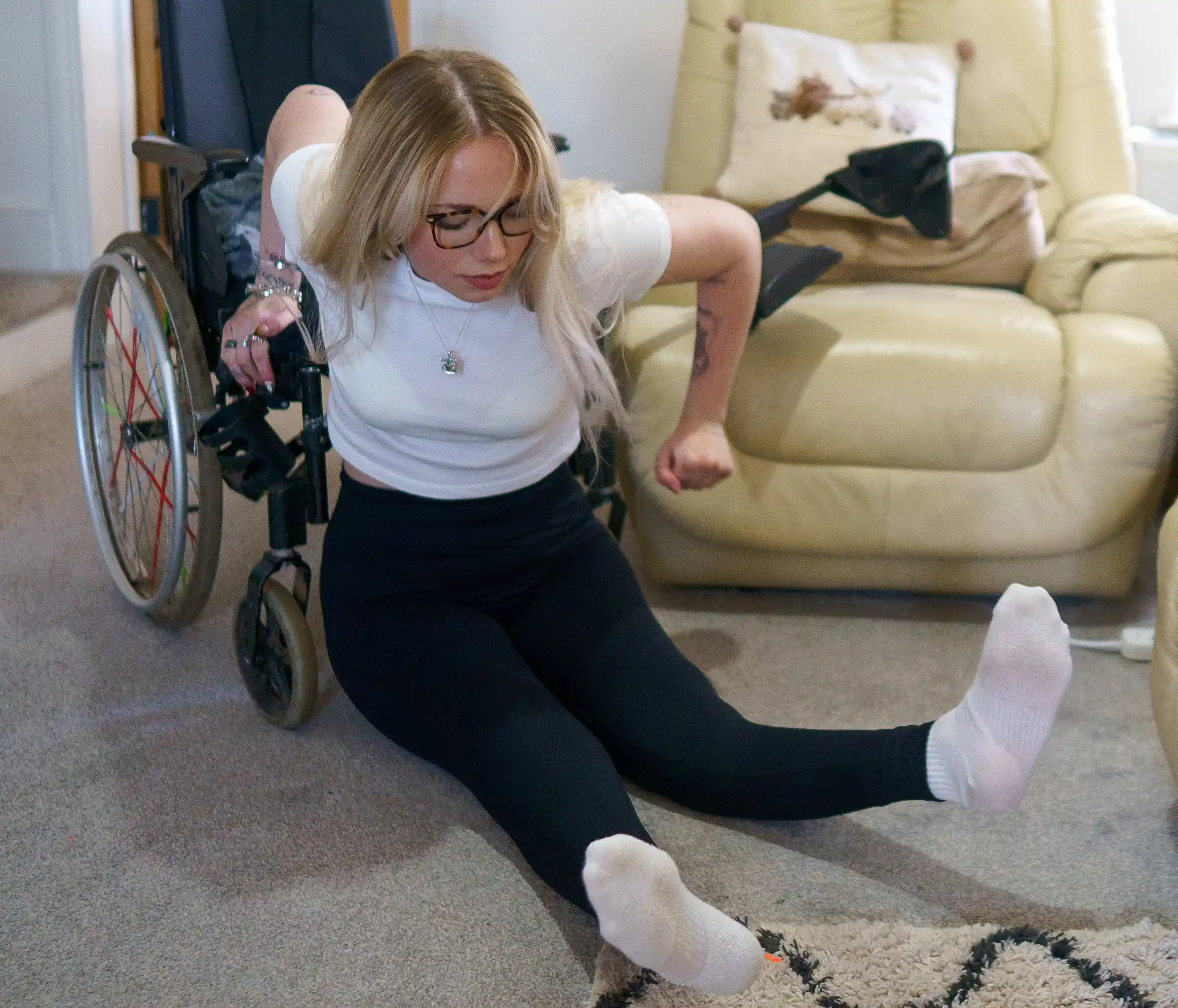
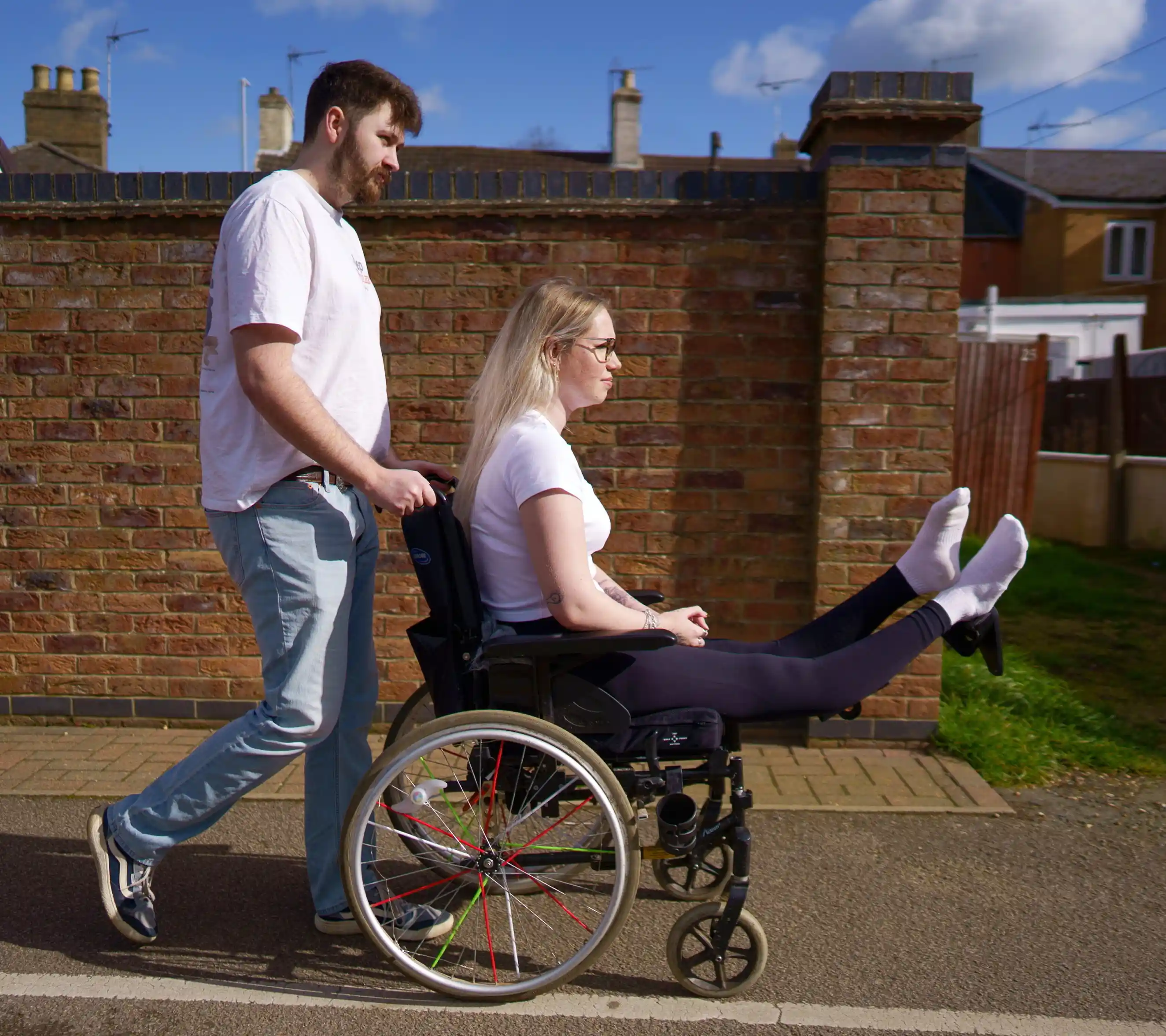
The day-to-day reality of living with legs locked in a perpetual V-shape is a grueling gauntlet of physical pain and logistical hurdles. To move without her wheelchair, Dixon must resort to “bum shuffling” across the floor.
“Getting from the floor to the bed is absolute agony for me because of the weight and pressure through my knees,” she explains. “I have to be carried to the bed or the toilet, and simple tasks take me so much longer.”
Finding Love, Hope, and a Future
Despite the incoming physical storm of an August amputation, Dixon’s gaze is fixed firmly on the horizon. She refuses to let her condition define her capacity for joy.
Recently, her life was illuminated by a flash of romance: an engagement to her partner, Oliver Carrick, celebrated with a Disney-themed proposal. It was a poignant reminder, she notes, that “being disabled doesn’t mean you aren’t lovable.”
The support system around her is tangible. In videos shared with her growing community of followers on TikTok—where she has meticulously documented her journey to raise awareness—she showcased her now-fiancé and soon-to-be father-in-law building a custom wooden ramp, granting her wheelchair access to the backyard garden.
Dixon’s dreams extend beyond survival. She told the BBC she actively hopes to train and become a nail technician once her recovery allows. To fund the specialized wheelchair, adaptive medical treatments, and mounting financial bills that lie ahead, she has launched a GoFundMe campaign.
@megsdixon Bitter sweet #fyp #fnd #disability #rehabilitation #physio #physicaltherapy #wheelchair ♬ suara asli – 𝟑𝟎𝟑 𝐍𝐨𝐚. – Noa.
A Message to the World
Dixon is under no illusions about the trauma that awaits her in the operating room. She offers no platitudes to others facing similar fates, choosing instead the raw, unvarnished truth.
“If you are facing amputation, I want to be honest with you — there are no words that can truly make it easier. It is a devastating and life-changing experience, and something I would never wish on anyone,” she says. “All you can do is take it one day at a time. There will be days when it feels overwhelming, and that’s okay. Allow yourself to feel everything that comes with this journey. Struggling doesn’t mean you are weak — it means you are human.”
It is a profound manifesto of resilience born from a decade of structural and physical neglect. As August approaches, Dixon is choosing to look at the loss of her legs not as a defeat, but as the dawn of her independence.
“Even in the darkest moments, try to hold on to the smallest positives,” she says. “Sometimes hope comes in the smallest forms: a kind word, a moment of strength, or simply getting through another day. Keep fighting for the life that comes after. None of us should have to face something like this, but if it leads to a future where life is a little more bearable, a little less painful, and holds more independence… then all of this will be worth it.”