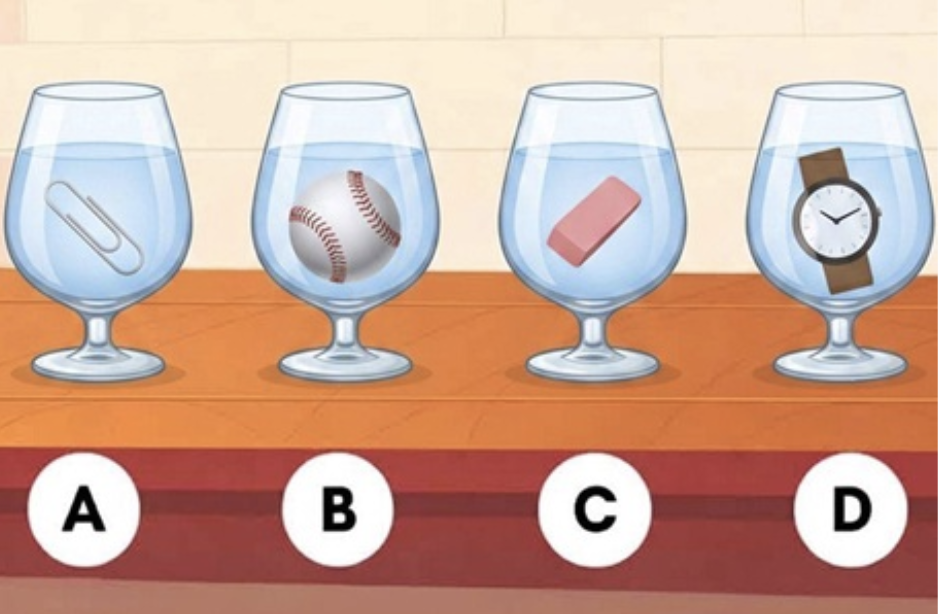
At first glance, it looks like a standard middle-school science diagram—simple, clean, and utterly unremarkable. You’re presented with four identical glasses: A, B, C, and D. Each appears filled to the exact same brim with water. But look closer. Nestled inside each vessel is a different everyday object, and while the setup looks perfectly balanced, that symmetry is a carefully constructed trap.
The question is deceptively straightforward: Which glass contains the most water?
The Deception of the Naked Eye
Most of us are hardwired for visual shortcuts. We see four waterlines sitting at the same latitude and our brains immediately scream, “It’s a tie!” This natural assumption—that equal levels equate to equal volumes—is precisely where the puzzle reveals its clever bite.
While the water levels are uniform, the internal environments are anything but. Glass A holds a delicate paperclip; Glass B houses a baseball; Glass C contains a rectangular eraser; and Glass D features a wristwatch. These aren’t just decorative flair; they are the “hidden” variables that rewrite the physics of the entire scene.
The Science of Displacement: Space vs. Substance
To crack the code, one must look past the water and focus on the intruders. The core principle at play here is displacement.
In the realm of physics, when an object is submerged in liquid, it stakes its claim on space. That volume is no longer available for the water itself. Therefore, even if two glasses look equally full, the one harboring the bulkier guest is actually holding significantly less liquid.
-
Glass B (The Baseball): This is the most dramatic offender. The baseball occupies a massive percentage of the glass’s internal real estate. To maintain that “full” look, it has shoved a huge amount of water out of the way.
-
Glass D (The Wristwatch): Despite its gaps, a watch is a complex, bulky object that displaces far more volume than a simple stationary item.
-
Glass C (The Eraser): Occupying the middle ground, the eraser takes up a solid block of space, reducing the water volume more than a sliver of wire but less than a sports ball.
The Verdict: Why ‘A’ Takes the Crown
The winner, by a landslide of logic, is Glass A.
Because the paperclip is the smallest and thinnest object in the lineup, it displaces the negligible amount of water. To reach that uniform fill line, Glass A requires the most actual liquid to compensate for its tiny inhabitant. It’s a classic case of “less is more”—the smallest object allows for the greatest volume.
The Cognitive Gap: Why We Get It Wrong
Why does this continue to spark debates across social media feeds? It’s a testament to visual assumption. Our brains are optimized for speed, not always for accuracy. We favor the “simplest explanation”—identical fill lines—over the analytical heavy lifting of calculating displacement. This puzzle forces a cognitive gear-shift, dragging the observer from instinctive reaction into the world of cold, hard physics.
The ‘Personality’ Mythos
As is the case with anything that goes viral, the internet has layered a “personality test” onto the solution. While these are about as scientific as a horoscope, they add a layer of engagement to the challenge:
-
Choosing A: Labeled as the analytical perfectionist who looks beneath the surface.
-
Choosing B: Seen as an instinctual thinker who trusts their gut (even when the gut is wrong).
-
Choosing C or D: Often associated with balanced or abstract thinkers.
While these interpretations offer zero psychological insight, they highlight why we love these puzzles: they allow us to categorize how we see the world.
The Takeaway: Looking Beneath the Surface
Beyond the digital “gotcha” moment, the glass puzzle serves as a poignant metaphor for critical thinking. It reminds us that what is visible is rarely the whole truth. Whether in a laboratory or in everyday life, first impressions are often just placeholders for a more complex reality.
In this scenario—as in many others—the smallest detail makes the biggest difference. Glass A wins because, in a world of bulky distractions, it leaves the most room for what actually matters.
Is your first instinct usually right, or do you find yourself overthinking the “paperclips” in your own life?