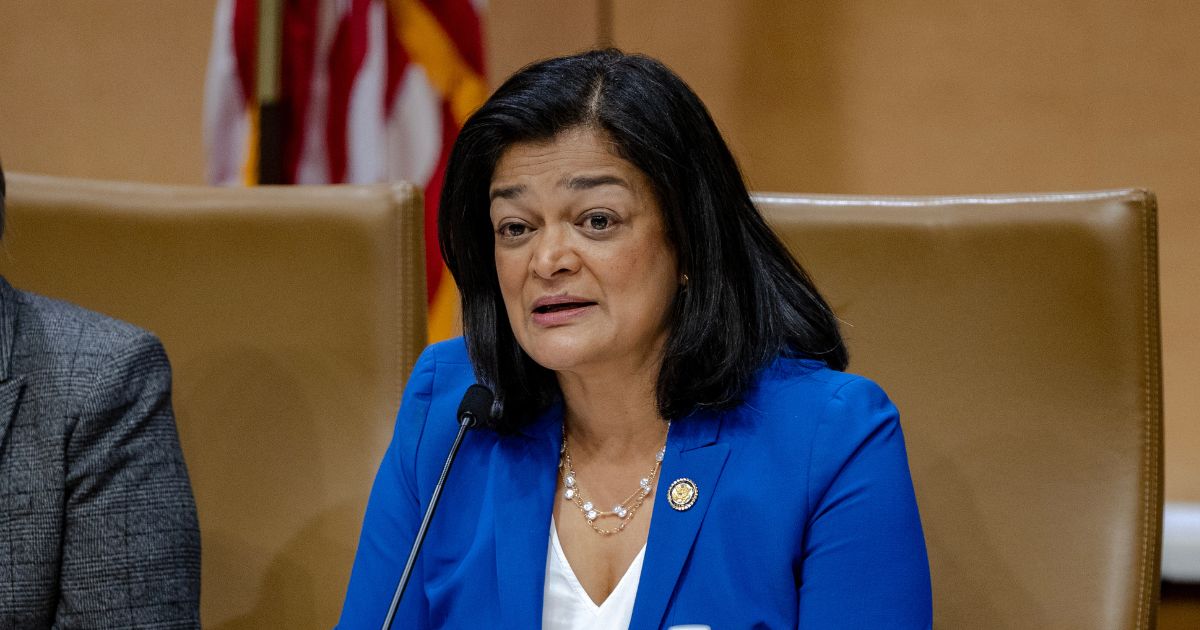
In a bold bid for the title of the Hill’s most baffling messenger, Washington Democratic Representative Pramila Jayapal has raised the stakes for her colleagues. If any member of Congress was coasting on a reputation for questionable optics, they now have stiff competition from the chair of the Progressive Caucus.
As the Democratic platform increasingly leans into an “open-door” philosophy—often appearing to prioritize non-citizens with a zeal usually reserved for a red-carpet gala—Jayapal took to X on Tuesday to showcase what she likely intended to be a heart-wrenching testimonial. The video features Enrique, a young Venezuelan man pleading for the preservation of his Temporary Protected Status (TPS).
However, the narrative veered into the surreal the moment Jayapal provided the timeline. With a straight face, the congresswoman highlighted that Enrique has been legally residing and working in the United States for over 13 years.
“If his TPS is terminated, he could be deported to unsafe conditions immediately,” Jayapal warned, before dropping the rhetorical hammer: “—a limbo that millions are living with under Trump.”
The math, as they say, is not “mathing.” By Jayapal’s own admission, Enrique has spent more than a decade navigating the American system—a tenure that spans the entirety of the Trump administration, the Biden-Harris years, and a significant portion of the Obama era. To frame a 13-year residency exclusively as a “limbo” manufactured by Donald Trump requires a creative relationship with the space-time continuum that even veteran political spin doctors might find ambitious.
In her attempt to skewer the former president, Jayapal instead highlighted a decade-plus of bureaucratic stasis that predates his political career, leaving observers to wonder if the “temporary” in TPS has lost all meaning in the halls of Congress.
Enrique is a TPS holder who has been legally living and working in the United States for over 13 years.
If his TPS is terminated, he could be deported to unsafe conditions immediately — a limbo that millions are living with under Trump. pic.twitter.com/4r1xOa8v1F
— Rep. Pramila Jayapal (@RepJayapal) May 5, 2026
In the realm of federal policy, definitions usually matter. However, Representative Pramila Jayapal’s recent advocacy for a Venezuelan national named Enrique suggests that, in the halls of Congress, the word “temporary” has acquired a level of elasticity that would baffle a linguist.
The crux of the issue is the Temporary Protected Status (TPS) program—a designation that, as the name explicitly states, was never intended to be a permanent bridge to residency. In the video shared by Jayapal, Enrique discusses his professional life and the shifting political landscape in Florida regarding immigration. But while his personal story is the focus, the underlying policy argument remains stubbornly simple: Enrique is holding a status that is, by law, a short-term reprieve, not a long-term solution.
By the Numbers: The 18-Month Reality
According to the American Immigration Council, the administrative framework for TPS is built on narrow windows of time. It isn’t granted in decades; it is dispensed in 6, 12, or 18-month increments. The logic behind this is a constant cycle of re-evaluation:
“At least 60 days prior to the expiration of TPS, the Secretary must decide whether to extend or terminate a designation based on an assessment of whether the conditions in the foreign country have materially improved such that the reason for the initial grant of TPS no longer applies.”
The timeline for Venezuela specifically highlights the disconnect in Jayapal’s narrative. Venezuela’s 2021 TPS designation was terminated in November 2025, and its subsequent 2023 designation was ended in April 2025.
A Chronological Conundrum
The math behind Enrique’s 13-year residency creates a significant logical hurdle. If Enrique has been in the U.S. for over a decade on a “temporary” basis, the system is clearly operating outside its original intent. Furthermore, he could not have held TPS since 2013, as Venezuela did not even have the designation at that time.
Regardless of the specifics of his entry, the optics are jarring: claiming a “temporary” status while remaining in the country for 13 years strikes many observers as an absurdity. In the eyes of critics, this represents one of the most spectacularly ill-conceived pleas to come from a House Democrat in recent memory.
The Court of Public Opinion
The internet was predictably unforgiving. As the video circulated on X, users were quick to point out the glaring contradiction between the congresswoman’s rhetoric and the reality of the calendar. One user summed up the collective skepticism succinctly:
“13 years doesn’t sound very temporary.”
By attempting to use Enrique as a symbol of “Trump-induced limbo,” Jayapal has instead sparked a debate on how a “temporary” program has been allowed to stretch into a semi-permanent fixture of the American immigration landscape.
13 years doesn’t sound very temporary
— The Mel K Show (@MelKShow) May 5, 2026
Another commentator echoed that sentiment, cutting straight to the heart of the personal responsibility argument:
“Seems to me that his decision to not take any steps towards permanent status was a clear indicator he didn’t plan to stay. If he did plan to stay, he didn’t understand the nature of the word, ‘temporary’ in TPS! What exactly is unclear?”
Seems to me that his decision to not take any steps towards permanent status was a clear indicator he didn’t plan to stay. If he did plan to stay, he didn’t understand the nature of the word, “temporary” in TPS! What exactly is unclear?
— Jeremy Stump (@jpstump) May 5, 2026
Beneath the veneer of humanitarian concern, critics argue we are witnessing a calculated play for the Democratic electoral future. This fierce advocacy isn’t necessarily born of altruism or simple kindness; rather, it reflects a strategic understanding that maintaining and expanding a massive immigrant population serves as a vital lifeline for the party. For those watching the long game, it’s a transparent effort to bolster their voter base, ensuring a permanent path to reelection and a consolidated grip on power for years to come.