The message from Washington echoed across the Gulf of Oman on Wednesday with the deafening clarity of a 20mm cannon: the blockade of Iranian ports is no longer a matter of policy, but a physical reality of steel and fire.
U.S. Central Command confirmed via X (formerly Twitter) that American forces intercepted the M/T Hasna, an Iranian-flagged tanker, as it cut through international waters toward a domestic port. While the vessel was riding high in the water—sailing ballast without a cargo of oil—its trajectory alone was enough to trigger a kinetic response from the U.S. Navy.
According to CENTCOM, the encounter began with a series of escalating warnings. American forces informed the Hasna’s crew that their course was a direct violation of the standing U.S. blockade. When those commands were met with silence or defiance, the situation shifted from diplomacy to a precision strike.
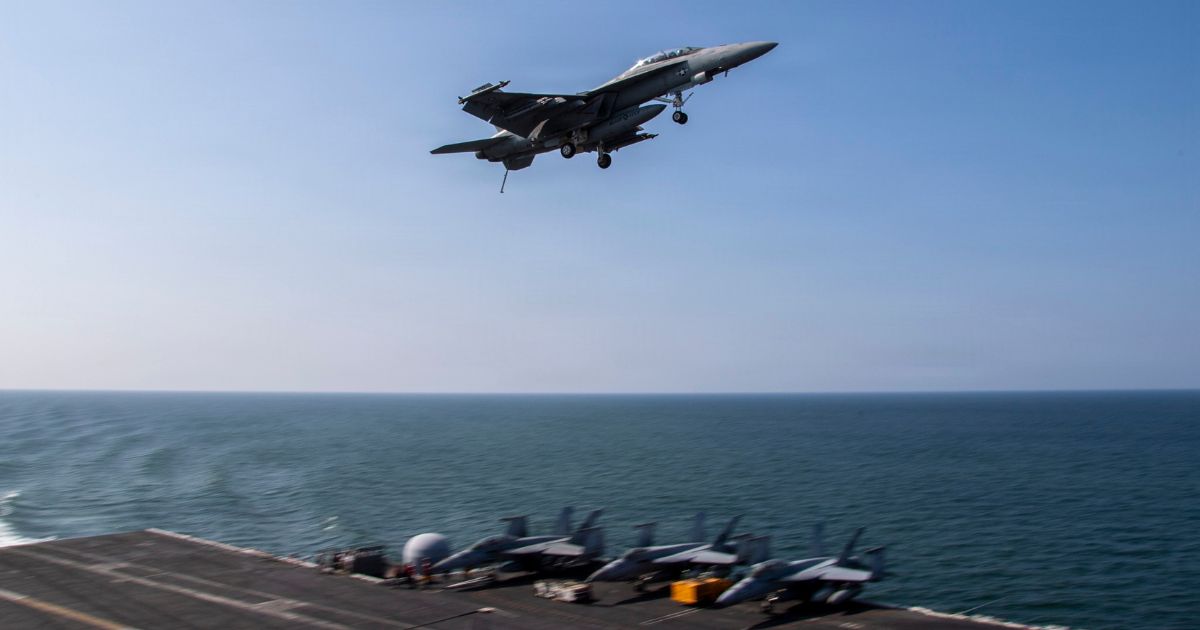
An F/A-18 Super Hornet, launched from the deck of the USS Abraham Lincoln (CVN 72), swooped in to deliver the final word. The strike was surgical; the fighter jet’s 20mm cannon shredded the tanker’s rudder, effectively stripping the vessel of its ability to steer.
The military’s assessment of the aftermath was blunt. “Hasna is no longer transiting to Iran,” Central Command stated, punctuating a mission that saw the tanker neutralized without being sunk.
“The U.S. blockade against ships attempting to enter or depart Iranian ports remains in full effect,” the post continued. “CENTCOM forces continue to act deliberately and professionally to ensure compliance.”
The crippling of the Hasna is not an isolated skirmish but part of a widening net of enforcement. This marks yet another instance where U.S. forces have opened fire to disable blockade-runners. To date, as reported by ABC, American forces have successfully turned back 52 ships attempting to breach Iranian waters.
This uptick in kinetic engagement follows the high-stakes “Project Freedom” operation earlier this week. Designed to force open the Strait of Hormuz, that mission saw U.S. forces engage and fire upon six Iranian boats that were moving to intercept transit through the vital waterway, according to the Navy Times. For the crew of the Hasna, and the 52 vessels before them, the takeaway is the same: the U.S. Navy is no longer just watching the horizon—it is actively holding the line.
JUST IN: President Trump vows to prevent Iran from obtaining a nuclear weapon as a naval blockade remains in place.
“We’re not going to let Iran have a nuclear weapon, and we’re not going to let that happen. And, we won’t let that happen. And so we’re, we’re dealing with people… pic.twitter.com/ZinIH1PP5q
— Fox News (@FoxNews) May 6, 2026
President Donald Trump signaled on Wednesday that a resolution to the conflict with Iran might finally be within reach, though his optimism was tempered by a weary skepticism of Tehran’s track record. Speaking with ABC, the President admitted he felt a deal was possible, while adding a rueful postscript: “I’ve felt that way before with them.”
The Ultimatum: Peace or “The Hell” of War
The rhetoric quickly shifted from diplomatic hope to tactical severity. Trump laid out a stark binary for the coming days, framing the situation as a final fork in the road for the Iranian leadership.
-
On the prospect of peace: “I think it’s got a very good chance of ending,” Trump said during the interview.
-
On the alternative: “If it doesn’t end, we have to go back to bombing the hell out of them.”
The President’s “either/or” philosophy was underscored by a blunt assessment of the current timeline: “It’s getting very close. If they agree, it’s over, and if they don’t agree, we bomb.”
A Two-Week Campaign
Should negotiations collapse, Trump indicated that the subsequent military response would be exhaustive rather than merely surgical. He suggested that a sustained air campaign would be necessary to finish the job.
“It could go in for two more weeks,” Trump remarked, noting that the objective would be to neutralize “every single target.”
The “One-Page” Framework
Reflecting the volatility and uncertainty that has defined U.S.-Iran relations, the President’s comments coincide with new reports regarding the administration’s diplomatic strategy. According to Axios, the U.S. has proposed a deal encapsulated in a one-page memo. This skeletal outline is reportedly intended to secure an immediate cessation of hostilities, with the complex, granular details to be filled in at a later date.
For now, the world watches to see if that single page is enough to stop the bombers.
🚨 DONALD TRUMP JUST VOWED TO GET IRAN’S URANIUM
TRUMP: “Yeah. We’re gonna get it.”
REPORTER: How?
TRUMP: “We’re GONNA GET IT.” 🔥
Don’t underestimate him! pic.twitter.com/E2BoPzhmL8
— Eric Daugherty (@EricLDaugh) May 6, 2026
Under the terms of the proposed framework, the high-stakes architectural shift would hinge on two major concessions: Iran would be required to shutter its nuclear enrichment programs entirely, while simultaneously restoring unrestricted access to the vital global artery of the Strait of Hormuz, according to sources familiar with the Axios report.
In exchange for these seismic geopolitical shifts, the Trump administration has signaled a willingness to dismantle the existing architecture of economic pressure. This would involve the comprehensive lifting of U.S. sanctions and the repatriation of billions in Iranian assets that have long been locked in American-controlled accounts, effectively providing Tehran with the financial lifeline it has sought throughout the conflict.