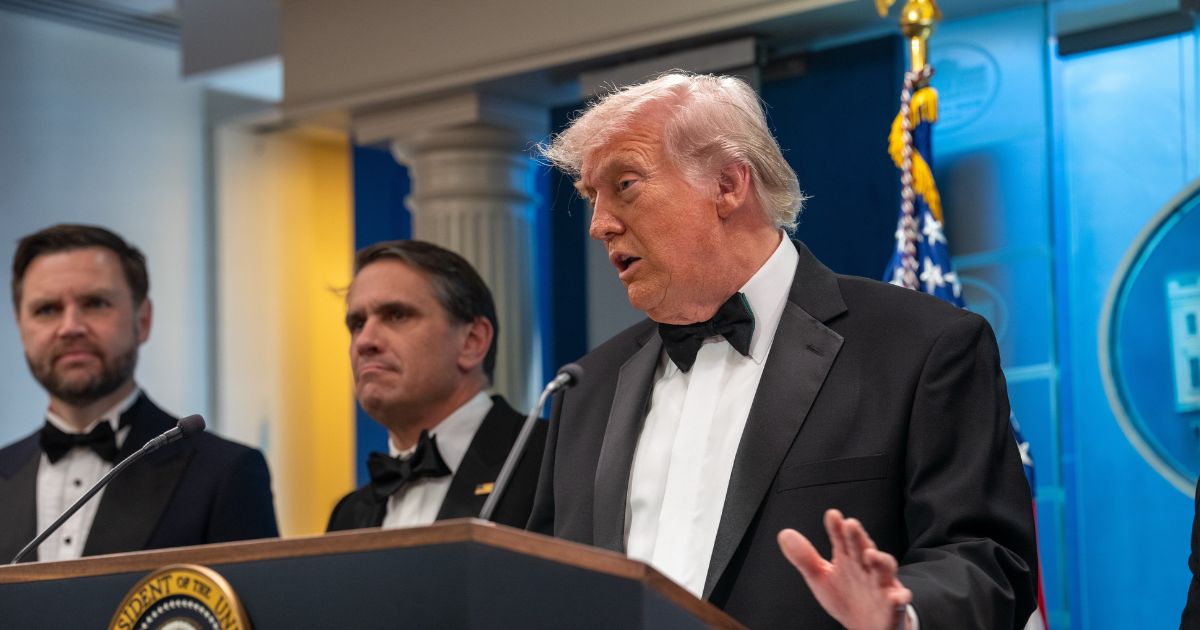
During an Oval Office press briefing on Wednesday, President Donald Trump offered an update on the conflict with Iran, contrasting his assessment with what he labeled as CNN’s “unfavorable coverage.”
The exchange began when CNN’s Kaitlan Collins asked the President to weigh the progress of the wars in Iran and Ukraine, inquiring which he believed would conclude first. Trump, noting the shift from Collins’ typically “barbed” questioning to a more “reasonable” inquiry, suggested both conflicts might be on a similar trajectory toward resolution.
Trump then detailed the extent of the military degradation in Iran:
-
Naval Forces: “They had 159 ships. Every ship is, right now, underwater,” the President stated, noting that a naval recovery would be extremely difficult.
-
Air Power: He claimed their entire air force had been “shot down or decimated.”
-
Arsenal & Infrastructure: Trump estimated that 82% of Iran’s missiles and the majority of their drones had been neutralized, adding that “most of the factories are mostly gone.”
.@POTUS on Iran: “Militarily, they’re defeated. You wouldn’t know that by reading the Fake News… they had 159 ships. Every ship is, right now, underwater… they have an air force — every one of their planes has been shot down or has been decimated.” pic.twitter.com/9a7RTpWZRh
— Rapid Response 47 (@RapidResponse47) April 29, 2026
The President highlighted the deployment of advanced U.S. defensive capabilities, specifically mentioning anti-drone lasers and a “new very special machine gun” designed to down drones efficiently. “We use bullets instead of million-dollar missiles,” he noted, emphasizing the cost-effectiveness of the technology.
Shifting to the economic state of the conflict, Trump claimed Iran’s economy is in a state of collapse, characterized by hyperinflation and “valueless” currency. He punctuated the assessment with a sarcastic remark: “Other than that, they’re doing quite well.”
The President then turned his critique toward the media, accusing The New York Times and CNN of misrepresenting the reality on the ground. Addressing Collins directly, he asked:
“Do you think they’re doing well where they have no navy, no air force, no anti-aircraft apparatus, other than what they may have put there?”
This exchange follows a recent interview Collins conducted with New York Times reporter Maggie Haberman. During that segment, Haberman suggested that Trump is eager to move past the conflict, stating, “My sense is the president would like to just be done with this, and he has other things he’d like to focus on.”
“Don’t rush me,” President Trump says when asked about Iran. “So were in Vietnam for 18 years. Iraq, many, many years….I’ve been doing this for…six weeks.”
— Kaitlan Collins (@kaitlancollins) April 23, 2026
When asked about the duration of the U.S. naval blockade of the Strait of Hormuz, Trump praised the operation as “genius” and “100 percent foolproof.”
He credited the success to the strength of the U.S. Navy, asserting that the blockade serves as a deterrent to any opposition. “Nobody is going to play games,” Trump stated, adding that the country possesses the “greatest military in the world,” much of which he claimed was built or reinforced during his first and current terms.
.@POTUS: “The blockade is genius. The blockade has been 100% foolproof. It shows how good our Navy is, I can tell you that. Nobody is going to play games. We have the greatest military in the world, and I built much of it during my first term—and we’ve been building it since.” pic.twitter.com/T75dRffTTZ
— Rapid Response 47 (@RapidResponse47) April 29, 2026
Trump maintained that the path to ending the conflict requires Iran’s leadership to “cry ‘uncle’” and formally surrender. He characterized their current situation as unsustainable, describing Iran’s financial state as a “dead economy.”
The impact of U.S. pressure was further highlighted by a recent report from The Wall Street Journal, which estimated that the naval blockade is costing Iran approximately $435 million per day. This figure includes $276 million in daily losses from halted exports, primarily affecting the country’s crude oil and petrochemical sectors.