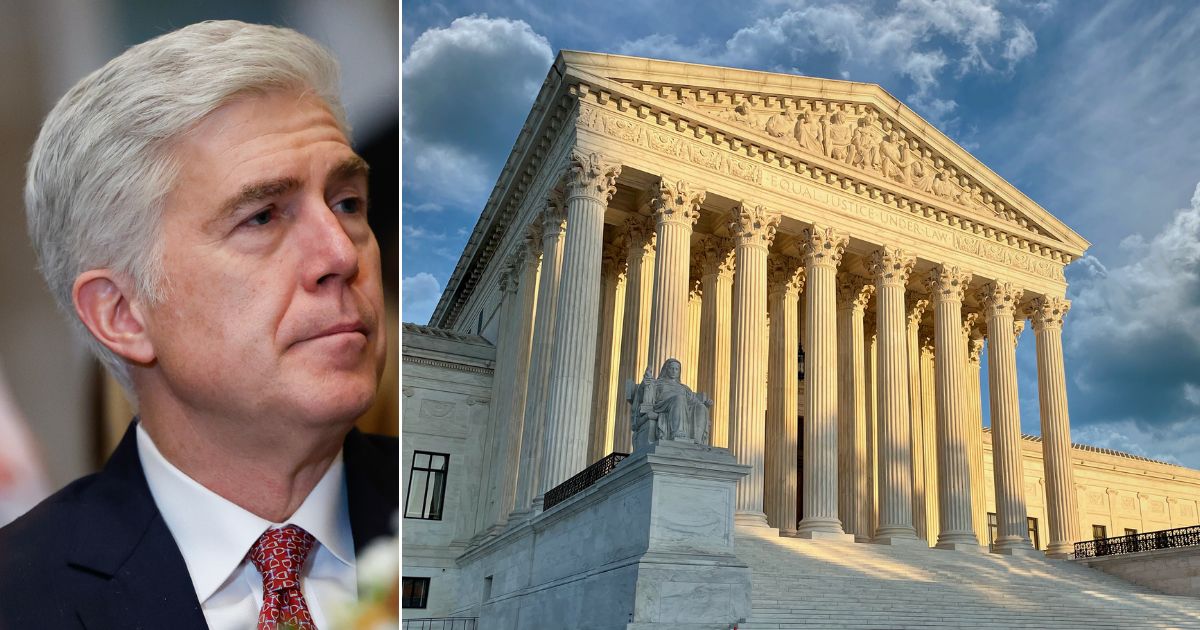
In a resounding defense of constitutional privacy, the Supreme Court delivered a landmark victory to the First Choice pro-life pregnancy center on Wednesday, clearing a path for the organization to challenge a heavy-handed New Jersey investigation into its private donor rolls.
The unanimous 9-0 ruling, authored by Justice Neil Gorsuch, serves as a sharp rebuke to the New Jersey Attorney General’s 2022 subpoena. That demand for records was issued shortly after the state’s formation of a “Reproductive Rights Strike Force”—a move the high court viewed as a direct threat to the “chilling” of First Amendment liberties.
Gorsuch, a Trump appointee, framed the decision as a fundamental shield for all citizens, regardless of their political or social leanings.
“The First Amendment guarantees all Americans the rights to speak, worship, publish, assemble, and petition their government freely,” Gorsuch wrote. “Each of these rights necessarily carries with it ‘a corresponding right to associate with others.’ Associational rights carry special significance for political, social, religious, and other minorities, protecting ‘dissident expression’ from marginalization or outright ‘suppression by the majority.’”
The veteran jurist emphasized that the government’s attempt to peel back the curtain on a group’s membership is often just as damaging as direct censorship. He noted that the Court has long maintained that “compelled disclosure of affiliation with groups engaged in advocacy may constitute as effective a restraint on freedom of association” as more overt forms of suppression. Because of this, the Court subjects any government demand for private donor information to “heightened First Amendment scrutiny.”
Throughout the opinion, Gorsuch returned to the idea that privacy is the lifeblood of free association. He argued that when the state demands a list of contributors, it creates an “inevitable” deterrent effect, scaring off potential supporters and stifling the exercise of constitutional rights.
Concluding the Court’s stance on why First Choice has the right to sue now rather than later, Gorsuch affirmed the center’s legal standing based on the immediate harm caused by the state’s reach.
“Against this backdrop, First Choice has established a present injury to its First Amendment associational rights and therefore has standing,” Gorsuch added. “An injury in fact arises when a defendant burdens a plaintiff’s constitutional rights, and government demands for a charity’s private donor information have just that effect. Such demands inevitably discourage association with groups engaged in protected First Amendment advocacy and encourage groups to cease or modify protected advocacy the government disfavors.”
🚨 The Supreme Court unanimously rules that a crisis pregnancy center can challenge a New Jersey investigation seeking its donor information before enforcement, holding the subpoena itself chills First Amendment associational rights and creates standing. pic.twitter.com/5gyMdankbH
— SCOTUS Wire (@scotus_wire) April 29, 2026
Spearheaded by the legal team at Alliance Defending Freedom (ADF), the case for First Choice Women’s Resource Centers represents the culmination of a multi-year standoff over constitutional boundaries. Since its founding in 1985, the center has dedicated itself to providing women with the “information and resources they need to make life-affirming decisions for themselves and their unborn children,” according to ADF records.
The legal firestorm ignited in November 2023, when New Jersey’s Democratic Attorney General Matt Platkin slapped the organization with an expansive subpoena. The state demanded a decade’s worth of internal records, including donor identities, personnel files, every advertisement or solicitation ever produced, and details regarding the group’s outside partnerships.
ADF quickly characterized the move as a politically motivated fishing expedition.
“Attorney General Platkin did not cite any complaints or evidence that First Choice had violated New Jersey law,” the ADF stated in its case summary. “Rather, he is targeting First Choice because of its religious and pro-life views. Alliance Defending Freedom attorneys challenged the unlawful subpoena.”
The core of the ADF’s argument rests on the principle that the First Amendment serves as a shield, protecting donor identities from “unjustified disclosure” and preventing state officials from weaponizing their office to retaliate against opposing viewpoints.
While First Choice initially cooperated by handing over roughly 2,300 pages of documentation, the organization eventually drew a line in the sand, filing a federal lawsuit to halt further disclosures. Platkin countered with his own suit in state court, seeking to compel the pregnancy center to surrender the remaining protected information.
This tactical maneuver initially worked; lower federal courts ruled that First Choice was required to pursue its federal claims within the state court system first. ADF appealed this procedural roadblock to the Supreme Court, arguing that victims of constitutional overreach should not be forced into state-court detours to defend their civil rights.
In a decisive move, the Supreme Court has now reversed that lower-court ruling, remanding the case for further consideration and effectively affirming that those suffering constitutional injury at the hands of the state have a direct path to federal relief.