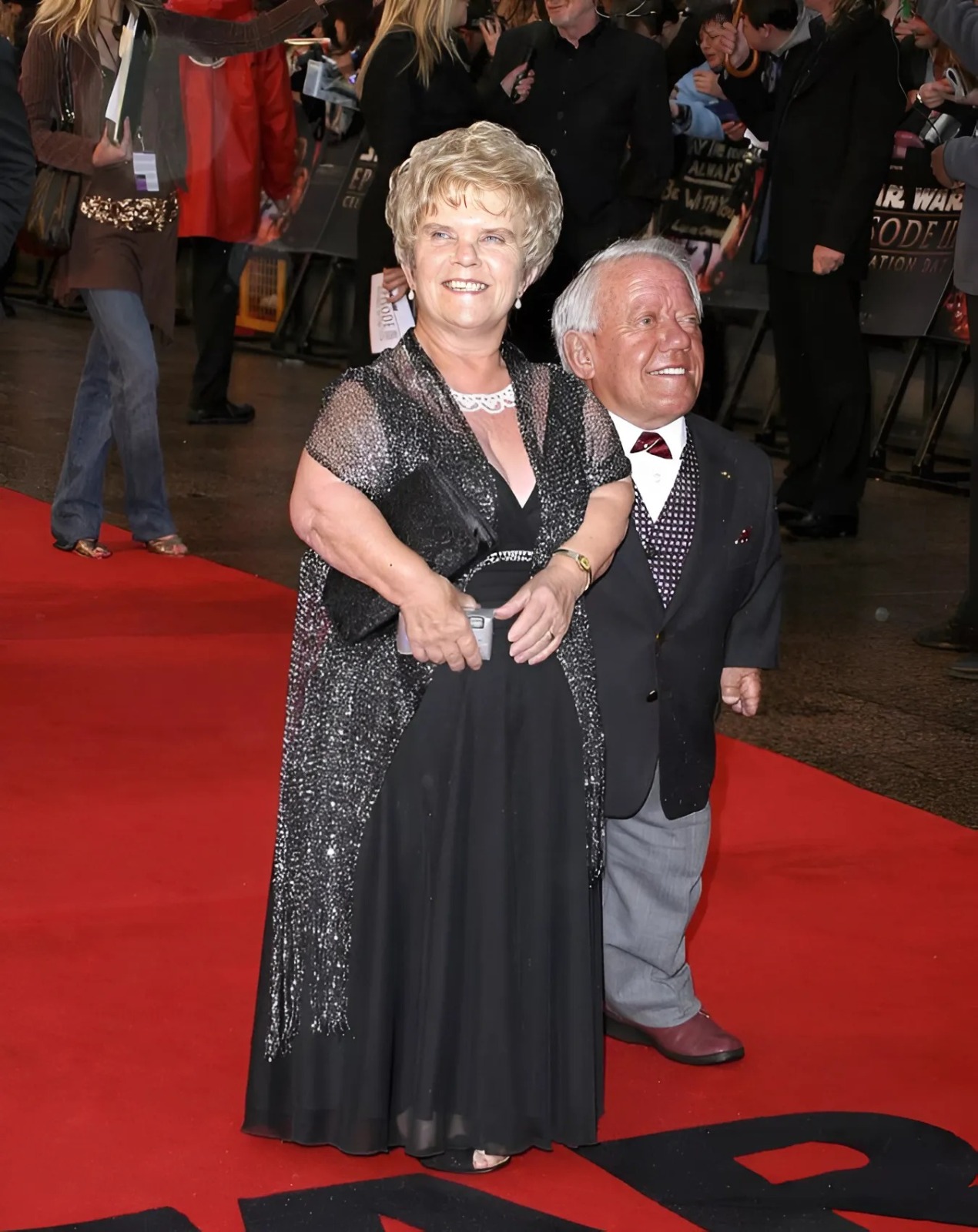
For decades, the most beloved character in the cinematic cosmos didn’t have a face, a voice, or a pulse. It was a utilitarian cylinder of cobalt and white, prone to stubborn bleeps and frantic whistles. But beneath that cold, riveted hull beat a very human heart. Kenny Baker, a man standing just 3 feet, 8 inches tall, proved to the world that you don’t need a sprawling shadow to cast a monumental legacy. He wasn’t just occupying a prop; he was the ghost in the machine, the soul that turned a “trash compactor” into a legend.
From the Sawdust to the Stars
Before the neon glow of lightsabers, Baker’s reality was forged in the grit of the traveling circuit. Long before he was a household name—or rather, a household silhouette—he lived a life far removed from Hollywood’s velvet ropes. He cut his teeth in circuses and live variety shows, a world where survival was a daily negotiation and resilience was the only currency that mattered.
In those early days, every chuckle from the audience was hard-won. Baker refused the cheap grace of sympathy, opting instead to build a stage presence that filled the room. He wasn’t a “small” performer; he was a titan of timing who happened to inhabit a compact frame. It was this iron-clad work ethic that prepared him for the most claustrophobic audition in film history.
The Art of the Wobble
When George Lucas came knocking with a strange script and a metal shell, Baker didn’t just step into a role; he stepped into a furnace. Inside the R2-D2 unit, the conditions were grueling. It was hot, restrictive, and lonely. Deprived of the actor’s primary tools—facial expressions and spoken dialogue—Baker was forced to invent a new physical vocabulary.
That indignant tilt of the dome? That stubborn, side-to-side wobble when confronted by a Sith Lord? That was Baker. He understood that character isn’t found in a script, but in the spaces between the lines. Without his precise movements and rhythmic timing, the droid would have been nothing more than a remote-controlled toy. Baker breathed life into the tin, transforming a prop into a companion.
The Invisible Icon
As Star Wars transitioned from a risky space-opera to a global religion, Baker found himself in a peculiar position. He was the architect of an icon, yet he remained largely anonymous to the millions who cheered for his character. While his castmates became the faces of a generation, Baker remained the hidden engine.
Yet, his off-screen life was perhaps his most impressive performance. In a world literally built for people twice his size, Baker constructed a life of profound normalcy and strength. He married Eileen Baker, who shared his condition, and together they navigated a society that often looked down—both literally and figuratively. They raised children and built a sanctuary of loyalty and grit, proving that his stature never dictated the scale of his ambitions.
A Legacy Beyond the Metal
In his later years, as he finally stepped out from behind the blue panels to greet the fans who adored him, the realization hit home: the man was far more captivating than the machine. He had endured hours of physical discomfort and decades of being “the man inside” because he understood a fundamental truth of storytelling—the narrative is always bigger than the ego.
Kenny Baker passed away as a giant of the industry, leaving behind a blueprint for how to live with dignity and perform with soul. He remains the ultimate proof that in the grand tapestry of the stars, it isn’t the height of the man that matters, but the depth of the mark he leaves behind. R2-D2 may have been a droid, but Kenny Baker was the humanity that made us love him.