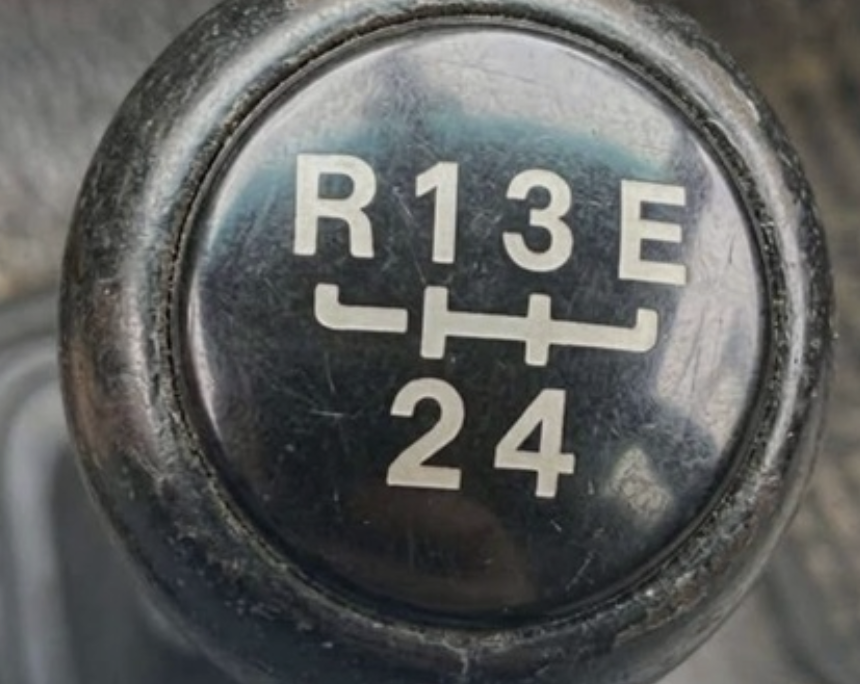
For the modern motorist, the ritual of shifting into gear is an exercise in muscle memory. We glide through the standard PRND alphabet—Park, Reverse, Neutral, Drive—with the subconscious ease of a pianist playing a C-major scale. These markings are the universal language of the asphalt, a standardized shorthand that requires no translation. Yet, peer into the cabin of a well-preserved vintage cruiser, and you might spot a linguistic outlier nestled among the familiar letters: the mysterious “E.”
To the uninitiated, this cryptic vowel often triggers a moment of hesitation. It wasn’t a standard cog in the gearbox, nor was it a vestige of a forgotten mechanical era. Rather, the “E” was a deliberate, functional innovation—a precursor to the high-tech “Eco-Modes” of the 21st century.
The Philosophy of “Economy”
In the vast majority of older automatic transmissions featuring this selector, the “E” stood firmly for Economy. It wasn’t there for decoration; it was a mechanical intervention designed to recalibrate the very DNA of the vehicle’s performance.
When a driver slotted the lever into “E,” they weren’t just choosing a gear; they were opting into a specific driving philosophy. This mode was engineered to squeeze every possible mile out of a gallon of fuel by fundamentally altering how the engine and transmission communicated. The technical trade-offs were clear:
-
Suppressed Revolutions: The transmission would prioritize staying in the highest possible gear to keep engine RPMs low.
-
Muted Throttle Response: Acceleration became more gradual, discouraging “lead-foot” driving and sudden surges of power.
-
Early Upshifting: The car would climb through the gears much sooner than it would in “Power” or standard modes, keeping the engine in its most efficient operating band.
A Product of Its Time
The rise of the “E” mode coincided with a pivotal shift in the global automotive landscape. As fuel costs climbed and environmental consciousness began to seep into the mainstream, manufacturers sought ways to empower drivers without requiring them to master complex fuel-saving techniques.
The “E” mode was the “set it and forget it” solution of its day. It allowed the vehicle’s hardware to do the heavy lifting, automatically moderating the car’s thirst for fuel during the mundane stretches of a daily commute or a cross-country trek.
The Highway Specialist
While “E” mode could be used anywhere, it found its true calling on the open road. In the steady-state environment of highway cruising—where rapid overtaking is secondary to maintaining a consistent velocity—the Economy setting was a revelation. By minimizing hunting between gears and dampening unnecessary engine output, the vehicle could settle into a lean, efficient rhythm.
“The ‘E’ mode represented a bridge between the raw power of the early automotive era and the digital precision of today—a mechanical attempt to solve a financial and environmental puzzle.”
Ultimately, the “E” was more than just a letter; it was a tool for the pragmatic driver. It offered a way to extend the distance between fill-ups and soften the blow at the pump, all while maintaining the smooth, effortless experience that defined the classic automatic transmission. Today, it remains a charming reminder of an era when efficiency was starting to take the driver’s seat.