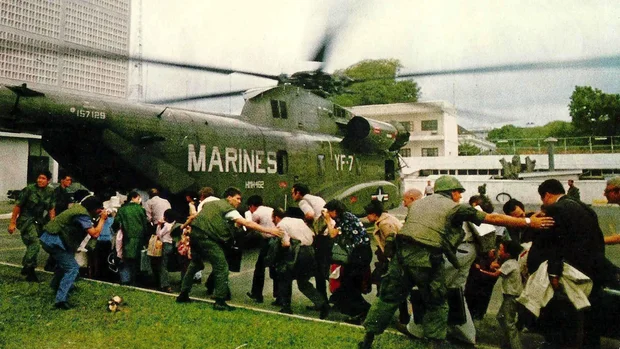
As the Vietnam War reached its final, frantic days, scenes of desperation played out across South Vietnam. With the North Vietnamese army advancing rapidly, terrified South Vietnamese soldiers and civilians fought to escape at any cost.
CBS News correspondent Bruce Dunning, who witnessed the chaos firsthand, recalled one heartbreaking moment: South Vietnamese soldiers stormed a Pan Am airliner, leaving behind wives, children, and elderly parents on the runway. “They forced their way onboard,” Dunning reported, “a rabble of young enlisted men… The plane raced down the taxiway, swerving to avoid abandoned vehicles—perhaps even running over people.”
The entire country was falling apart under the weight of the communist final offensive. “The only question was when they would strike next,” said Stuart Herrington, one of the last remaining U.S. military advisors in Saigon. “The map in my office kept filling with more and more red arrows, all pointing south.”
As South Vietnam’s collapse became inevitable, President Gerald Ford ordered the immediate evacuation of vulnerable groups, beginning with Vietnamese orphans. But even that effort was marred by tragedy: the first evacuation flight crashed just five miles from the airport, killing 78 orphans and 35 Americans. CBS News correspondent Murray Fromson summed up the heartbreak: “When will the misery in this country ever stop?”
With the enemy closing in, Secretary of State Henry Kissinger sent an urgent cable to U.S. Ambassador Graham Martin: We must evacuate now.
At Tan Son Nhat Airport outside Saigon, Americans and desperate Vietnamese thronged for a way out. But shelling soon rendered the airstrip unusable. Two U.S. Marines—Darwin Judge and Charles MacMahon—were killed by enemy fire, becoming the final American combat deaths of the Vietnam War.
Operation Frequent Wind Begins
Helicopters became the last hope.
Marine helicopter pilot Gerry Berry, stationed offshore, recalled: “At 10:45 a.m. on April 29, 1975, we got the order to begin Operation Frequent Wind—the largest helicopter evacuation in history.”
Thousands of Vietnamese civilians flooded toward the U.S. Embassy in Saigon—the last place of hope for evacuation. “It was their final refuge,” Herrington said.
Jerome Thomas, a young Marine guard at the embassy, remembered the desperation at the gates. “Women were handing us their babies, begging us to take them,” he said. “We had to tell them no. It was horrific.”
Berry landed his helicopter inside the embassy compound. “I went in to pick up the ambassador,” he said. “But the Marine guard ran out and said, ‘The ambassador’s not ready.'”
Instead, Berry and dozens of helicopter crews began ferrying out Americans and select Vietnamese evacuees, load by load.
As night fell, Marine guard Thomas was ordered to lower the American flag from the embassy grounds—the final symbol of U.S. presence in Vietnam. “It was the last time the flag would fly over Saigon,” he said, his voice breaking. “It was heartbreaking.”
The Last Flight Out
By early morning, North Vietnamese tanks could be seen approaching. Their headlights cut through the darkness, rolling steadily into the capital.
Inside the embassy compound, Stuart Herrington tried to reassure the terrified crowd. “I told them, ‘Everyone will go. No one will be left behind.’ I repeated it again and again. And I believed it.”
But new orders shattered that promise: All Americans must be evacuated immediately.
Herrington recalled the gut-wrenching moment. “I lied to them,” he admitted. “I told them I had to go to the bathroom—and I slipped away into the embassy. It felt awful.”
At 4:56 a.m. on April 30, 1975, Berry landed on the embassy roof one final time. He told the Marine guard, “This helicopter isn’t leaving until the ambassador is on board.” Though he had no official authority, the urgency was clear. Two minutes later, Ambassador Martin and his entourage boarded.
Flying out, Berry radioed the code words: Tiger, Tiger, Tiger—signaling that the ambassador was out and the evacuation was effectively over.
In Washington, Henry Kissinger announced, “Our ambassador has left. The evacuation can be said to be completed.”
But it wasn’t.
The Forgotten Marines
Back at the embassy, a small group of Marines remained trapped on the roof—forgotten in the chaos.
Marine Sgt. Juan Valdez, now 87 and living in a memory care facility, still remembers those hours vividly. “We thought we were going to be left behind,” he said. “The tanks were rolling by, their lights on.”
Doug Potratz, another Marine stranded there, said it felt like “the Alamo all over again.”
Thomas, another young Marine, remembered the unthinkable choice facing them: surrender or fight. “We all agreed—Marines never surrender,” he said.
For hours, they waited, hearing enemy tanks rumble through the streets below.
Finally, two helicopters returned. One lifted out 22 Marines, the second carried the final 11.
Valdez, the sergeant in charge, was the last man aboard. “I stayed until every one of my men was safe,” he said. “That’s what you do.”
The Fall of Saigon
By the afternoon of April 30, 1975, Saigon had fallen. North Vietnamese troops rolled into the city, ending America’s long and costly involvement in Vietnam.
For the Marines who made it out, and for those they had to leave behind, the memory of that final day remains etched forever—a mix of duty, heartbreak, and loss.