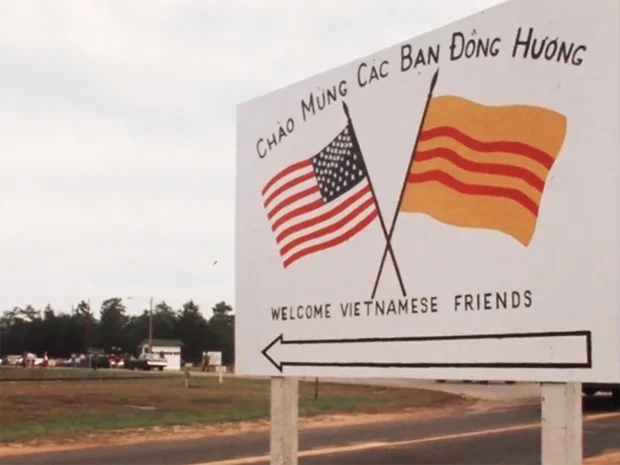
Half a century ago, as Saigon fell and the U.S. military intervention in Southeast Asia drew to a chaotic close, President Gerald Ford faced an agonizing decision. With the North Vietnamese army overtaking the South, countless anti-communist South Vietnamese feared political persecution, imprisonment, or death. They turned to America for salvation.
But back home, public sentiment was bitterly divided. Many Americans, exhausted by the Vietnam War and burdened by a staggering 9% unemployment rate—the highest since World War II—were deeply skeptical of welcoming tens of thousands of destitute refugees.
Correspondent Lesley Stahl reported at the time that Capitol Hill was flooded with “overwhelmingly hostile” letters from constituents. One message from Nebraska captured the mood: “They bring only disease, corruption, and apathy.”
Despite the backlash, President Ford framed the moment not in political calculations, but in profound moral terms. “There are tens of thousands of South Vietnamese intellectuals, professors, teachers, editors, and opinion leaders who supported our alliance. To them, we have a profound moral obligation,” Ford declared.
Determined to act, Ford ordered urgent airlifts, extracting approximately 130,000 South Vietnamese refugees and asylum seekers. He signed legislation securing relocation aid and financial assistance and built an unlikely coalition of support—bringing together religious organizations, Southern Democratic governors, and labor leaders—to help settle the new arrivals across the country.
One iconic image from that era shows President Ford on an Air Force bus, cradling a Vietnamese baby rescued through “Operation Babylift,” a daring mission that relocated orphaned children to American soil.
At first, many refugees faced steep challenges, relying on public assistance and accepting low-wage jobs. But over time, they carved new paths. Government dependency fell. Thousands became business owners, community leaders, and professionals. Their success stories wove new threads into the American tapestry, producing federal judges, Pulitzer Prize-winning authors, and even Oscar-winning actors.
“My journey started on a boat,” said Ke Huy Quan, star of “Everything Everywhere All at Once,” during his Oscar acceptance speech. “I spent a year in a refugee camp, and somehow I ended up here, on Hollywood’s biggest stage.”
Looking back, Ford’s controversial choice wasn’t just the compassionate decision—it was a wise one. In a nation built by immigrants, he recognized that America’s greatest strength often lies in its diversity. His leadership embodied compassion, political courage, and moral clarity—qualities desperately needed in today’s divided political climate.
Fifty years later, the story of the South Vietnamese refugees reminds us that generosity, even when unpopular, can leave an enduring legacy of strength and resilience.