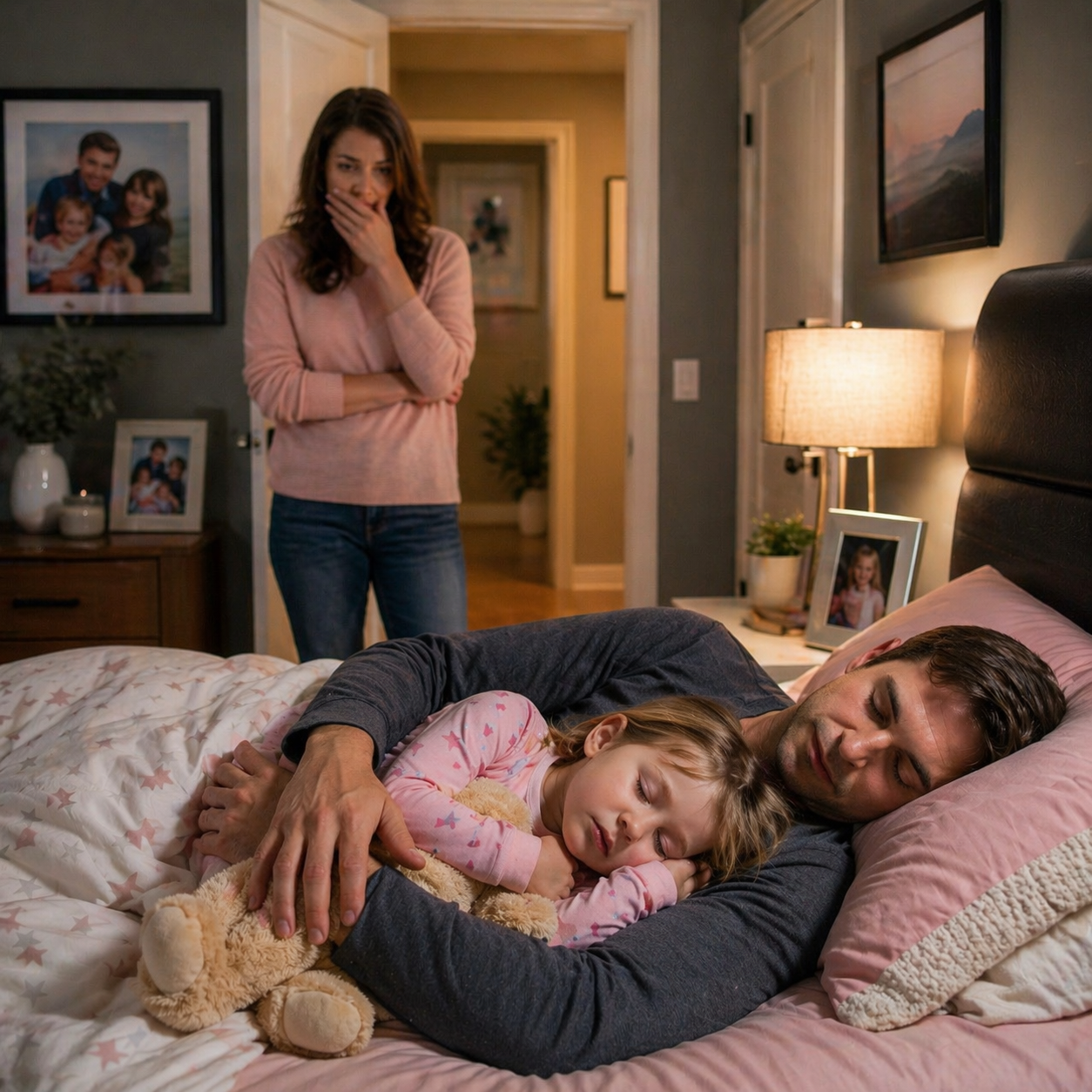
The quietude of the San Jose suburbs is a specific kind of silence. It is expensive, manicured, and designed to imply safety. For years, I lived within that silence like it was a fortress. My husband, Daniel, a veteran of grueling double shifts at the hospital, and I had built a life for our eight-year-old daughter, Emily, that was defined by order and independence. We didn’t just want her to be comfortable; we wanted her to be resilient.
That was the logic behind “The Rule.” From the time she was a toddler, Emily slept in her own room—a sanctuary of high-end domesticity. I had spared no expense on the mattress, a two-meter-wide premium slab of memory foam that cost more than my first car. Her shelves were a library of curated adventures; her stuffed animals were positioned with the tactical precision of a royal guard. A soft amber nightlight bathed the room in a permanent, flickering-free sunset.
The routine was ironclad: The story. The kiss. The click of the lamp. No nightmares, no midnight wanderings. It was a testament to my success as a mother. Until the morning the silence of our home began to feel heavy.
Emily appeared in the kitchen like a ghost, her socks padding softly on the hardwood. A faint smear of peppermint toothpaste clung to the corner of her lip, but it was her eyes that caught me—they were clouded, lacking their usual morning spark. She wrapped her arms around my waist, burying her face in my apron.
“Mommy,” she whispered, the sound muffled by my hip. “I didn’t sleep good.”
I kept my focus on the eggs sizzling in the pan, a practiced smile on my face. “What happened, sweetheart? Bad dream?”
She pulled back, her brow furrowed in a look of profound confusion. “My bed felt… smaller.”
I let out a short, airy laugh. “Smaller? Emily, you sleep alone in a bed bigger than the one Daddy and I share. It’s a literal playground.”
She didn’t laugh back. She just shook her head with a slow, chilling deliberate. “No. I fixed it.”
At the time, I dismissed it. Children are architects of their own strange realities; they live in a world where logic is fluid. But the sentiment didn’t evaporate. It curdled. Every morning for a week, the report was the same.
“I keep waking up.” “It feels squished.” “I get pushed, Mommy.”
The transition from “strange kid talk” to “primal maternal instinct” happened on a Thursday. Emily looked at me with a hollow expression and asked the question that made the blood in my veins turn to ice: “Mom… did you come into my room last night?”
I knelt until I was eye-level with her, my heart hammering against my ribs. “No, honey. I was in my room the whole night. Why would you ask that?”
She hesitated, her lip trembling. “Because… it felt like someone was laying next to me. Right against my back.”
I felt a phantom chill sweep through the kitchen. I laughed—too loud, too fast—the sound of a woman trying to convince herself more than her child. “You were dreaming, Em. Just a very vivid dream. Mommy was with Daddy.”
She nodded, but her eyes remained wide, unconvinced. When Daniel came home that night, smelling of antiseptic and exhaustion, he gave me the logical, weary comfort of a medical professional. “Kids have overactive imaginations, Laura. The house is locked. The alarm is set. She’s just hitting a phase.”
I wanted to believe him. I needed to. But the silence of the house had changed. It no longer felt like a fortress; it felt like a blindfold.
I bought the camera the next day. It was a sleek, unobtrusive puck of black plastic that I mounted high in the corner of her room. I told myself it wasn’t surveillance; it was a diagnostic tool. I just wanted to see the “draft” or the “shifting blankets” that were causing her restless nights.
That night, I sat on the edge of my own bed, watching the grainy infrared feed on my phone. Emily climbed in at 8:30 p.m. She looked small in the vast expanse of that expensive mattress. She stayed in the center, her breathing falling into the rhythmic cadence of deep sleep. I watched for an hour. Nothing moved. The room was a tomb of perfect, suburban peace.
I fell asleep with the phone in my hand.
At 2:00 a.m., the thirst hit me—that dry, scratching sensation that forces you out of bed. I wandered into the living room, the moonlight casting long, distorted shadows across the carpet. Without thinking, I tapped the screen of my phone to wake it.
The app was still open. The feed was live.
I stopped breathing. My lungs simply seized, refusing to draw in the air of my own home.
On the screen, the wide, empty bed I had seen at midnight was gone. Emily was no longer in the center. She was pressed right against the very edge of the mattress, her small body curled into a tight, defensive ball, nearly falling off the side.
And in the massive, vacant space she had been forced to vacate—in the “too tight” spot she had complained about—the covers were depressed. There was a long, heavy indentation in the mattress, trailing from the headboard to the foot, as if a grown man were lying dead-weight beside her.
As I watched, the blanket over the empty space ruffled. It wasn’t a draft. It was the distinct, slow movement of something shifting its weight, settling in, and tucking itself closer to my daughter’s spine.
The bed was full. And I was standing in a house that was no longer silent, but screaming.