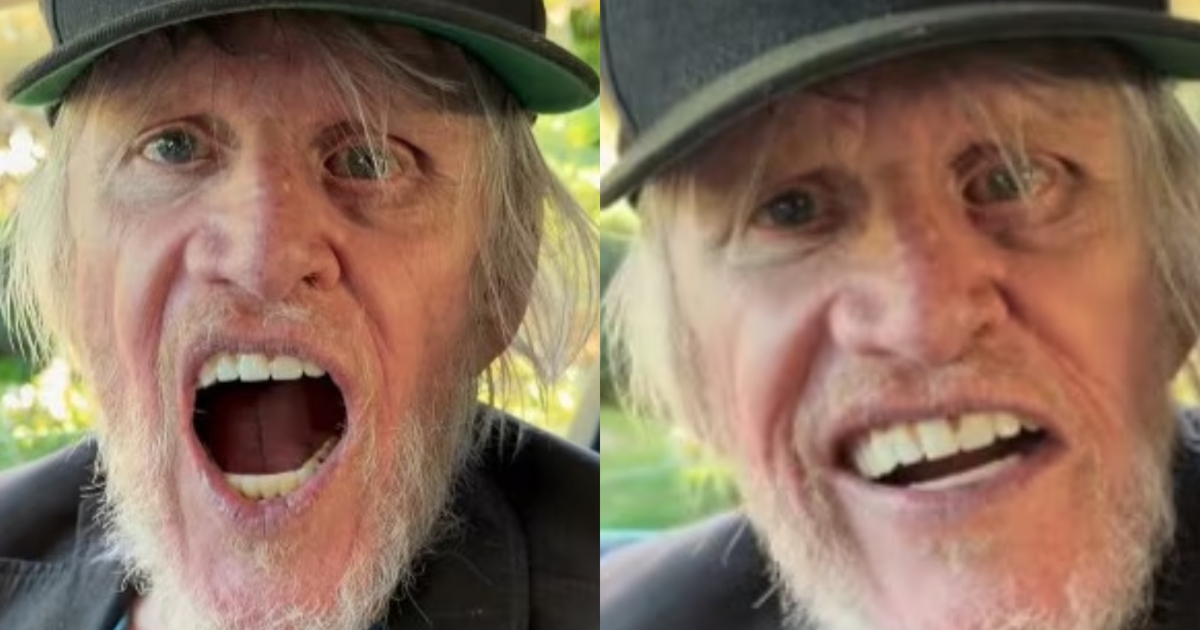
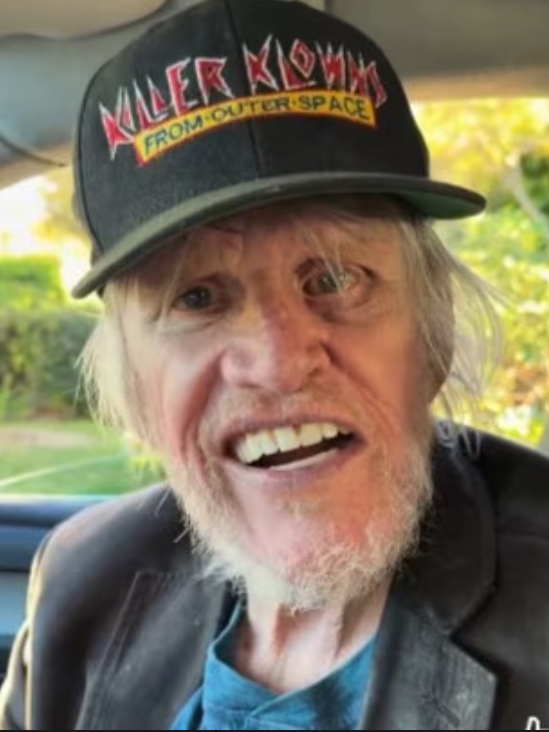
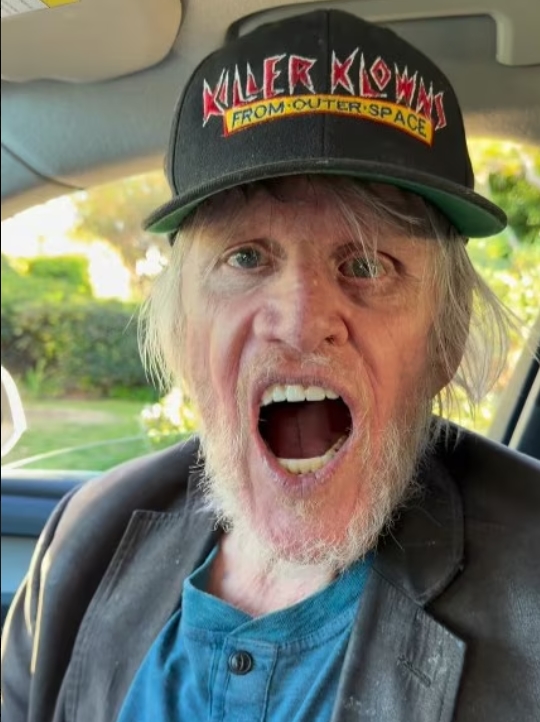
Buckle up. Somewhere on the sun-drenched asphalt of California, tucked into the passenger seat of a nondescript vehicle, sits an 81-year-old man who has long since abandoned the script of conventional celebrity. He stares into the lens with a gaze that hasn’t lost an ounce of its legendary, high-voltage intensity. The message Gary Busey has for the world this holiday season isn’t a sanitized, PR-approved “Merry Christmas” or a calculated promotional pivot. Instead, it is a raw, jarring, and utterly sincere explosion of avian mimicry—a rapid-fire demonstration of goose calls delivered with the gravity of a Shakespearean soliloquy.
For the casual scroller, the clip is a “what did I just watch?” moment—a bizarre blip in the digital noise. But for those who have tracked the trajectory of Busey’s half-century in the spotlight, it is simply the latest transmission from a man whose life has been a masterclass in the unpredictable. It is a portrait of an artist who long ago stepped off the path of social expectation to wander through a landscape of pure, unvarnished self-expression.
From the Pantheon of “New Hollywood” to the Edge of the Frame
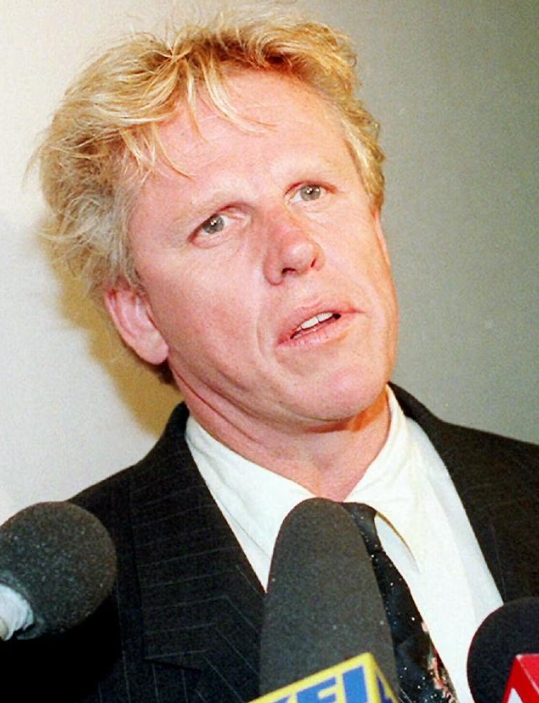
It is a dizzying exercise to reconcile this candid, wild-eyed passenger with the titan of the late 1970s. During that era, Busey didn’t just enter Hollywood; he conquered it. His 1978 turn as the titular rock-and-roll pioneer in The Buddy Holly Story remains a landmark of American cinema. It was a performance of such kinetic energy and soulful depth that it snatched an Academy Award nomination and vaulted him into the elite circle of “New Hollywood” icons. He wasn’t just playing a role; he was channeling a ghost, capturing the very marrow of Holly’s spirit.
Busey emerged as a performer of frightening commitment—a man who could inhabit a character so fully that the line between actor and role seemed to dissolve. Whether he was playing the charismatic musician, the menacing antagonist in Lethal Weapon, or the seasoned surfer-fed in Point Break, he commanded the screen with a physical and psychological presence that felt dangerous, vulnerable, and always, perpetually, alive.
The Fracture Point: 1988
The narrative of Busey’s life, however, has a definitive “before” and “after.” The pivot point came in 1988 on a Los Angeles street, where a catastrophic motorcycle accident left him with a traumatic brain injury that nearly ended his story. The recovery was grueling, and the aftermath permanent.
Medical science tells us that such trauma often strips away the “filters”—those social governors that regulate impulse, emotion, and communication. In the decades since, this neurological reality has become Busey’s public persona. His style grew spontaneous, his metaphors more abstract, and his behavior less tethered to the “polite” norms of the industry. While some viewed this shift through a lens of confusion, others saw the profound honesty of a survivor navigating a world that no longer spoke his internal language.
The Goose and the Message
This recent viral dispatch, seen through that lens, is not an anomaly—it is a manifesto. Busey’s logic is disarmingly simple: geese honk to signal their presence. They make noise so the flock knows where they are. In a world that often prefers its elder statesmen to fade quietly into a dignified, sepia-toned retirement, Busey is choosing to honk.
“Like the geese he imitates, Busey is announcing his arrival—reminding us that he is still here, still vocal, and still vibrating on a frequency entirely his own.”
In an age of hyper-curated “personal brands,” where every celebrity tweet is vetted by a committee of stylists and agents, Busey’s unfiltered approach is a radical act of authenticity. He isn’t presenting a “version” of himself; he is simply being himself, even if that involves honking like a waterfowl to bridge the gap between his mind and yours.
The Complexity of the Viral Gaze
The internet’s reaction to Busey has always been a Rorschach test. To some, he is a source of amusement or a “meme.” To others, he is a tragic figure to be pitied. But both views are reductive. They ignore the layers of a life that has weathered the highest peaks of artistic acclaim and the lowest valleys of physical trauma.
Busey’s journey poses a silent, uncomfortable question to a society obsessed with “graceful aging”: Do we allow our icons the space to evolve into something strange and new? Or do we demand they remain frozen in the amber of their greatest hits?
The Final Act: Pure Presence
Ultimately, a thirty-second clip of animal sounds doesn’t overwrite an Oscar-nominated career, nor does it fully encapsulate the man. It is merely another color on an already chaotic canvas. Gary Busey remains a figure who defies the easy “celebrity” box. He is a reminder that identity is not a fixed point, but a fluid, often messy process of survival and adaptation.
In a landscape where everything is manufactured, there is a strange, jarring beauty in a man who refuses to be anything other than exactly who he is at that moment. For Gary Busey, being present might involve a loud, honking greeting from the passenger seat of a car, but it is a presence that is undeniably, authentically, and spectacularly his own. And perhaps, in the end, that is the most rock-and-roll thing about him.