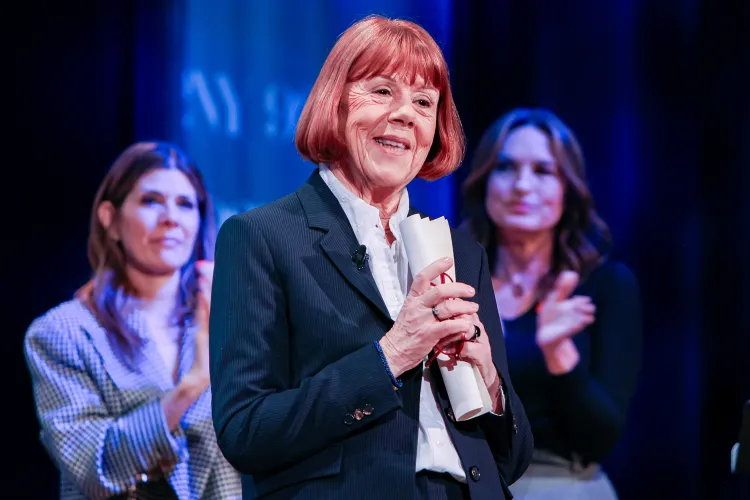
Gisèle Pelicot stands today as the living, breathing embodiment of a paradox: that the most profound love can be unearthed even within the deepest shadows of human experience.
It has been nearly six years since the foundation of her world was decimated by a singular, horrific revelation. Pelicot learned that her husband of nearly half a century had spent over a decade drugging her into unconsciousness, transforming their home into a crime scene by inviting more than 50 men to rape her. Today, with those men found guilty and the silence finally broken, the 73-year-old survivor has emerged not with bitterness, but with a conviction that hope is an essential, non-negotiable lifeline.

“Life is going to give us a lot of challenges and it’s going to put us to the test,” Pelicot reflected during a poignant discussion at the 92NY. The evening featured actors Mariska Hargitay and Marisa Tomei, who lent their voices to excerpts from Pelicot’s newest memoir, A Hymn to Life: Shame Has to Change Sides. “We have these resources within us. It’s in all of us to try to overcome them.”
For Pelicot, her presence on that stage was more than an appearance; it was a manifesto. “The very fact that I’m sitting here in front of you today and talking about this, I’m concrete proof that this is true,” she told the audience.
Her journey has been defined by a grueling, four-month-long public trial that saw her transformed from a private victim into a global icon for survivors of sexual violence. Yet, in the wake of that legal battle, Pelicot revealed she has received what she describes as a “real gift from life.” At 73, she has found the “good fortune to meet and fall in love” once again.
“We are putting our lives forward,” she said, speaking to the resilience of the human spirit. “And I think if I can convey anything, I wanna convey that idea that you need to have this hope, you need to have this idea that it’s there and we have to work towards it and we have to try to find a way to get it.”
Beyond her personal recovery, Pelicot emphasized the transformative power of the collective. Throughout the landmark 2024 trial, she was buoyed by a sea of solidarity—the dozens of women who stood sentinel outside the courthouse and filled the overflow rooms every day.
“I just was so amazed,” she recalled. “They gave me strength, and I really had no idea what the full scope of this trial would be, how long it would be, what it would entail. And they were there all the time to give me support and letters.”

That communal embrace did more than just provide comfort; it forged a new understanding of shared humanity. “It gave me strength and it also made me realize that we are all connected on that level,” Pelicot said. “This is something that was very, very good for me to hear. It was important for me to hear, but I think it’s also important for them to hear too.”
If you or someone you know has been sexually assaulted, please contact the National Sexual Assault Hotline at 1-800-656-HOPE (4673) or visit rainn.org.