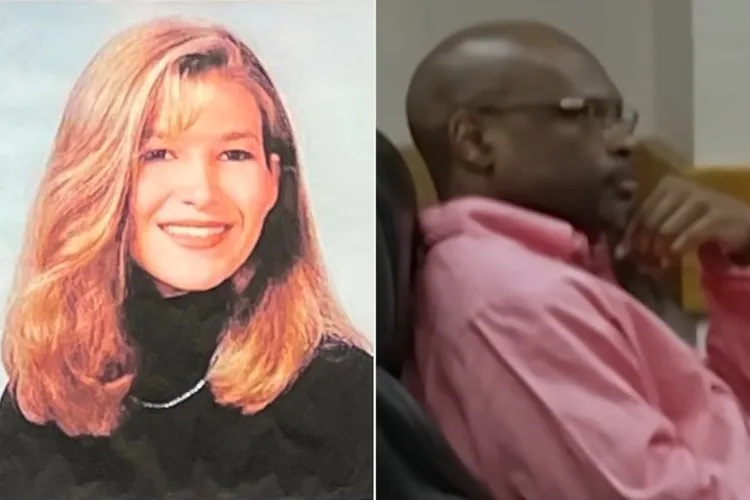
Tara Baker was just 23 years old when her life was violently stolen. In a tragic irony of timing, the quest for justice would ultimately span nearly as many years as she had spent on this earth.
The University of Georgia law student was on the cusp of her 24th birthday in January 2001 when her story became a haunting fixture of Georgia’s unsolved mysteries. For more than twenty years, her family waited through a silence that felt permanent. It wasn’t until a landmark piece of legislation—named in her honor—threw a lifeline to the investigation, finally leading to the 2024 arrest and 2026 conviction of Edrick Lamont Faust.
A Night of Violence and a Trail of Fire
The horror began on the morning of January 19, 2001. Athens-Clarke County firefighters, responding to what appeared to be a routine apartment blaze, made a gruesome discovery inside the smoke-filled residence. There, they found Baker’s body.
The scene was chillingly clinical in its brutality. According to trial testimony from firefighters David Freeman and Doug Whitehead, the apartment showed signs of a calculated attack: a window screen had been tampered with, the stove was left on, and Baker’s bed and home had been intentionally set ablaze. Investigation later revealed that Baker had been sexually assaulted, strangled, and stabbed before the arsonist attempted to incinerate the evidence.
Her laptop, a vital tool for the aspiring lawyer last seen at the UGA Law Library the night before, was missing.
A Frigid Trail and Fractured Trust
For a decade, the investigation stalled, hampered by a crime scene that had been ravaged by fire and water. In 2011, former UGA police detective Alex Morrow admitted to The Augusta Chronicle that the blaze had decimated much of the physical evidence.
The Baker family, however, remained vocal in their criticism of the initial response. “The police, I think, are embarrassed about the way they did their investigation,” her father, Lindsay Baker, said on the 10th anniversary of the murder. He described the initial processing of the scene as a “farce” and a “contamination.”
While investigators initially looked into three men—a fellow law student, an attorney from Baker’s firm, and her boyfriend, Chris Melton—no charges were ever filed. Melton was cleared via polygraph and a verified alibi, and the leads on the others eventually withered.
The Coleman-Baker Act: A Catalyst for Justice
The stalemate finally broke in 2023 with the passage of the Coleman-Baker Act. This Georgia law, championed by Baker’s own family, mandated the establishment of a dedicated cold case unit. It provided the resources and the mandate to look at old evidence through a modern lens.
In May 2024, the breakthrough the family had prayed for arrived. The Georgia Bureau of Investigation (GBI) announced the arrest of Edrick Lamont Faust. GBI Director Chris Hosey confirmed to reporters that there was no known connection between Faust and Baker; it was a random act of predatory violence. The bridge between the 2001 crime and the 2024 arrest was built entirely on “biological evidence and DNA science.”
Faust was no stranger to the justice system. His criminal record was a decades-long litany of cocaine possession, battery, and aggravated assault, including a 2022 arrest for simple battery to which he had pled guilty.
The Verdict: DNA Doesn’t Lie
During the February 2026 trial, the prosecution presented the “smoking gun” provided by modern technology. Forensic experts testified that DNA recovered from Baker’s sexual assault kit—re-tested using advanced technology in April 2024—was a definitive match to Faust.
Though the defense attempted to shift suspicion back toward Baker’s former boyfriend and argued a lack of physical evidence linking Faust directly to the apartment, the jury was unmoved. Faust was found guilty on 12 counts, including felony murder, rape, and arson.
A judge sentenced Faust to two consecutive life sentences, plus an additional 45 years.
A Mother’s Unanswered Question
Despite the closure of a legal chapter, the emotional wound remains open. In a victim impact statement read during the sentencing, Baker’s mother, Virginia Baker, spoke of the “monster” who took her daughter.
“The question that never leaves me is why,” the statement read. “I have asked God this question thousands of times. I still have no complete answer, and the pain remains.”
For the Athens community, the case stands as a grim reminder of the limitations of past forensics—and a testament to the persistence of a family that refused to let a daughter be forgotten.