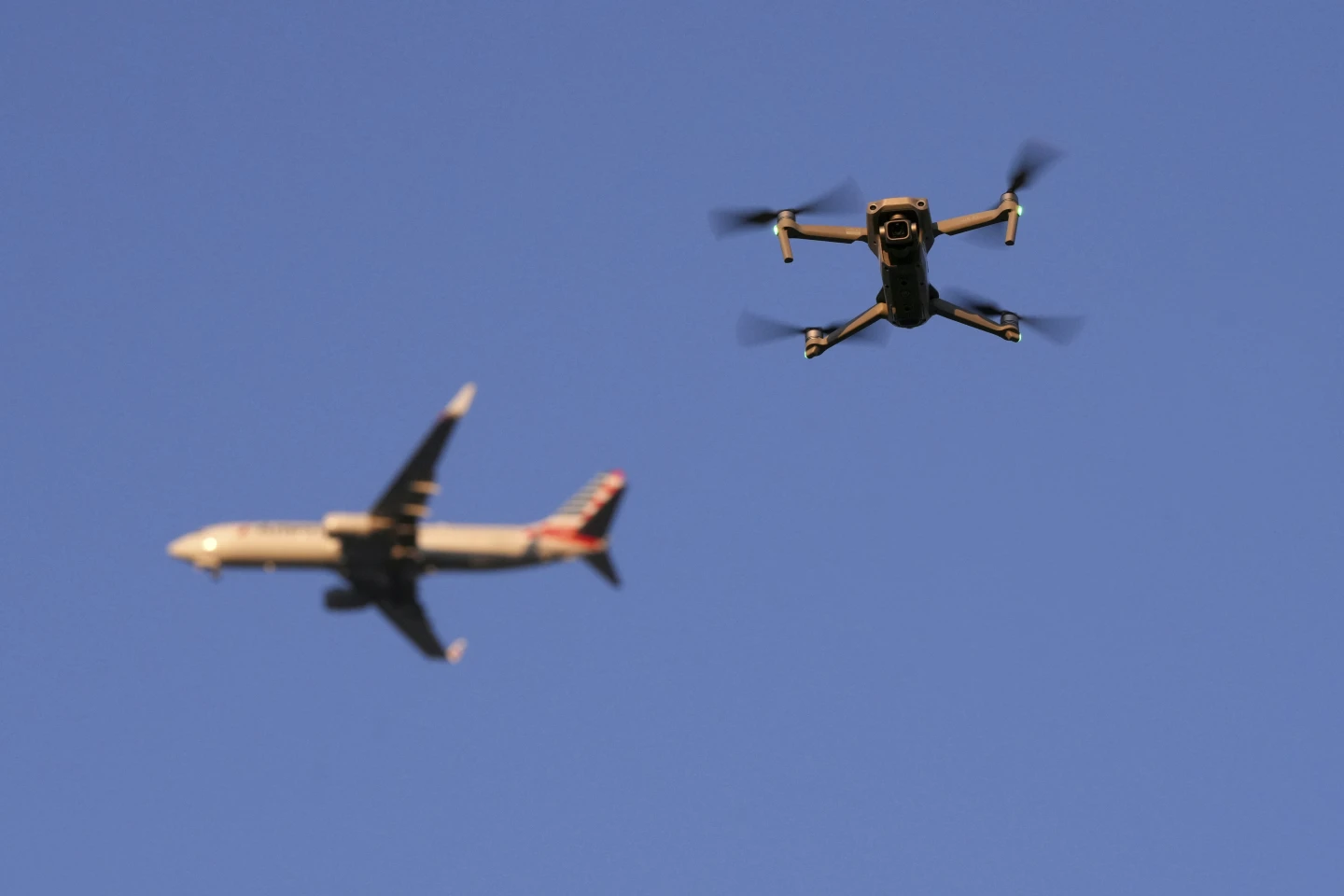
A surge in dangerous close calls between drones and commercial airplanes is raising serious alarm among aviation experts and federal authorities, as drones now account for nearly two-thirds of all reported near midair collisions involving passenger jets at the nation’s busiest airports.
In one chilling incident last November, pilots on final approach to San Francisco International Airport were stunned to see a drone hovering just 300 feet from their cockpit. It was too late to react — the quadcopter zipped past their windshield, narrowly avoiding disaster.
Just a month earlier, a similar scare occurred near Miami’s airport, when a jetliner cruising at 4,000 feet reported a “close encounter” with a drone. And in August, a drone came within 50 feet of clipping the wing of a passenger jet departing from Newark.
Each of these cases was classified as a “near midair collision,” a designation reserved for incidents that pose serious risk to flight safety.
A Growing, Unchecked Threat
An investigation by the Associated Press into NASA’s Aviation Safety Reporting System found that drones were involved in 51% of all reported near-misses with commercial jets over the last decade. At the top 30 busiest U.S. airports in 2023 alone, drones were responsible for nearly two-thirds of these harrowing incidents — the highest rate since air traffic plummeted during the COVID-19 pandemic.
Experts say the problem is only getting worse as the availability and capabilities of drones explode.
“If you’ve got the money, you can buy a drone online today that flies thousands of feet in the air — right where they don’t belong,” said William Waldock, a professor of safety science at Embry-Riddle Aeronautical University.
The FAA estimates there are over one million drones currently in use across the U.S. for recreational and commercial purposes, many of them flying dangerously close to airports.
Enforcement Lags Behind Technology
The FAA has tried to address the problem by requiring drone registration, mandating that heavier drones carry transponders to identify their location and owners, and banning flights near airports without authorization. But enforcement remains challenging.
To make matters worse, DJI, one of the world’s largest drone manufacturers, recently eliminated automatic geofencing — a feature that prevents drones from flying near restricted areas like airports — citing the overwhelming number of requests to override the system. Instead, pilots now simply get a warning.
While some manufacturers still use geofencing voluntarily, the FAA has not yet mandated the practice.
“Like Speed Cameras for the Sky”
Experts are calling on federal regulators to take stronger steps — such as implementing automated systems that detect and fine violators using drone transponder signals, much like speed cameras track speeding vehicles.
Other proposed methods include using radio signals to jam rogue drones or disabling them with high-powered microwaves or lasers. The FAA is currently testing some of these countermeasures at select airports.
Real-World Consequences
The dangers are not theoretical. In California, a drone punched a hole in the wing of a “Super Scooper” firefighting plane, grounding the aircraft for days. The drone pilot, who had flown his quadcopter to observe wildfire damage despite an FAA ban, was tracked and arrested using his drone’s transponder signal. He pleaded guilty to federal charges.
In another case, two men in Boston were arrested in December after their drone flew dangerously close to Logan International Airport.
A Wake-Up Call
“These are not just close calls — they are warnings,” said one FAA official. “It’s only a matter of time before we see a tragic incident if stronger enforcement and safety measures aren’t put in place.”
The FAA says it’s working to modernize detection and mitigation efforts, but with drones now flying in some of the country’s most congested airspace, many believe the response must come faster and more aggressively — before it’s too late.