Climbed Over
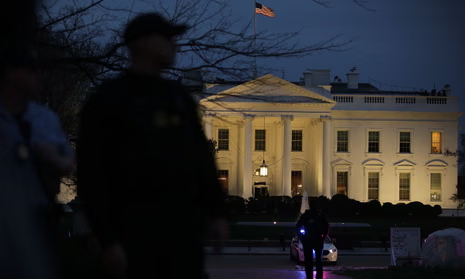
A man was taken into custody by U.S. Secret Service agents on the afternoon of February 3 after scaling an outer fence along the South Grounds of the White House, in what officials are describing as a “serious breach” of the executive mansion’s layered security perimeter.
Eyewitness David Stanley, who recorded the episode on his phone, said he first noticed the man shortly before 4:20 p.m. “He walked right past me,” Stanley recounted, “looked straight ahead, shouted something I won’t repeat, and just went straight for the fence.” According to Stanley, there was no pause, no moment of hesitation—the man reached the barrier, grabbed hold, and began pulling himself up in one quick movement.
The White House fence, rebuilt and reinforced in recent years, is designed specifically to deter such intrusions, with additional height, anti-climb features, and wider security buffers. But as the man reached the top and swung a leg over, Secret Service alarms were already blaring. Within seconds, multiple layers of the agency’s protective apparatus were in motion: uniformed officers sprinting toward the site, rooftop counter-assault teams taking up positions, and K9 units closing in on the point of breach.
The suspect was apprehended almost immediately after touching down on the inside of the fence line. Authorities escorted him away without incident, but have not yet released his name or disclosed whether criminal charges are pending. Officials confirmed that no one inside the White House was ever in danger, and that the president’s schedule was not disrupted.
Still, the breach is far from routine. The 18-acre White House complex is one of the most heavily fortified locations in the United States, with layers of armed personnel, advanced surveillance systems, and electronic detection grids designed to identify and neutralize threats before they reach the building. Incidents of someone successfully breaching even the outer perimeter remain rare, but each one triggers an immediate review of both security response and procedural vulnerabilities.
In a statement, the Secret Service confirmed that such a review is already underway, in line with established protocol. The assessment will focus not only on how quickly and effectively officers responded, but also on whether any physical or procedural safeguards could be strengthened. “Our mission is to protect,” the agency noted, “and that includes adapting our strategies as threats evolve.”
The timing of the breach could hardly be worse for the agency. Just weeks ago, an independent review panel issued a blistering report on the Secret Service’s handling of the July 2024 assassination attempt on former President Donald Trump at a campaign rally in Butler, Pennsylvania. That attempt, which left several people injured and narrowly missed killing Trump, exposed what the panel described as “systemic weaknesses” in the agency’s planning, communication, and leadership structure.
Among the panel’s findings: officers failed to act decisively on credible warning signs, there was confusion over who was responsible for certain security zones, and the agency’s leadership lacked the diversity of experience needed for rapid, adaptive decision-making under pressure. The report urged sweeping reforms, warning that without significant changes, “future attacks are not just possible—they are probable.”
Against that backdrop, the February 3 fence-jumping incident has already drawn renewed attention from lawmakers and security experts who argue that the agency’s problems are not limited to isolated events, but stem from deeper cultural and operational issues.
Meanwhile, in a move that appears directly connected to the fallout from Butler, President Trump has nominated Sean Curran—a veteran agent who physically shielded him during that rally attack—to lead the Secret Service as its new director. Curran, known within the agency for his operational discipline and field experience, is expected to face pointed questions during his Senate confirmation hearings about how he intends to repair public trust and implement the reforms urged by the panel.
For now, the man who climbed the fence remains in custody, and the White House lawn has returned to its usual state of order. But the event has left the Secret Service confronting the same dual challenge it has faced for months: responding decisively to immediate threats while tackling the deeper institutional changes needed to prevent the next one from happening at all.