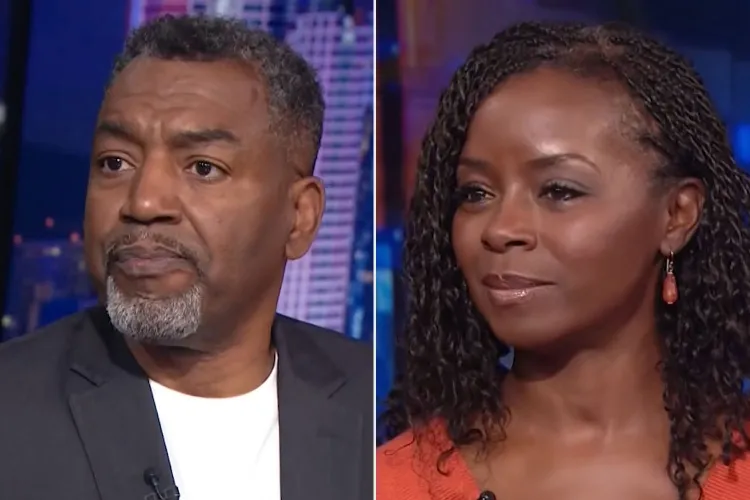
In an industry that thrives on carefully scripted narratives, veteran actor Russell Andrews and his fiancée, actress Erica Tazel, just delivered the rawest performance of their lives. It wasn’t for a premium cable drama or a Hollywood blockbuster, but on a studio set at CNN’s The Story Is with Elex Michaelson. There, seated side-by-side, Andrews shared a devastating reality that no script could prepare him for.
“I am a person living with ALS,” Andrews told Michaelson during the Saturday, May 16 broadcast.
With those nine words, the 64-year-old character actor—recognized for his standout work in Better Call Saul, Straight Outta Compton, and Insecure—went public with a battle he has been fighting in the shadows since late last year.
Amyotrophic lateral sclerosis (ALS), famously known as Lou Gehrig’s disease, is a brutal, relentless neurodegenerative condition. According to the Mayo Clinic, the disease systematically destroys nerve cells in the brain and spinal cord, stripping away muscle control, slurring speech, and eventually inducing total paralysis. The Muscular Dystrophy Association notes there is no cure, with a typical life expectancy of three to five years post-diagnosis—though some patients defy the odds for decades.
For Andrews and Tazel, the diagnosis represents a profound shifting of gears, transforming romantic partners into a patient-and-caregiver duo. Yet, amidst the clinical gravity of the prognosis, the narrative of their bond has only deepened.
The Architecture of a Diagnosis
Like many living with ALS, the road to a definitive diagnosis was paved with subtle, easily dismissed warning signs, compounded by the historic anxieties of the entertainment industry.
“I was diagnosed in the late fall of last year,” Andrews revealed, tracing the origins of his symptoms back to the heightened anxieties of the COVID-19 pandemic and the subsequent 2023 Hollywood strikes that brought the industry to a standstill. “It was a stressful time. We didn’t work for three years, about, and then we had the back-to-back strikes and so a lot was going on.”
Initially, Andrews suspected he might have suffered a stroke or was dealing with a pinched nerve in his neck. The early red flags were deceptively minor: sporadic muscle twitches and a creeping loss of fine motor skills.
“I was not able to do things that I normally do,” Andrews recalled. “I was dropping cups and glasses at night. It felt like things were running up and down my arm at different times—and it was the nerves.”
For Tazel, observing from the closest vantage point, the changes were impossible to ignore, manifesting in the quiet rhythms of their daily life. “It took him longer to clean the pool,” she noted. “The way he walked, there was just the subtle little things like that and I had questions. I was like, ‘Something is definitely wrong.’”
The systemic hurdles facing working actors also delayed their answers. Andrews revealed he lost his health insurance during the prolonged work stoppages of the actors’ strike. The moment coverage was restored, he sought medical attention. The clinical response was swift.
“Within 15 minutes, the primary care [physician] said she would like me to see a neurologist,” Andrews said. “One thing led to another.”
‘I Still Want to Be Your Wife’
Receiving a terminal diagnosis is a shattering moment, but Tazel remembers a distinct, almost transcendent clarity settling over them in the doctor’s office.
“I was uncharacteristically calm and in a way, it was an answer to a lot of questions that we had,” Tazel told Michaelson. She described the moment not as a sigh of relief, but as a sobering arrival at total understanding. “And I looked at him across the room and I said, ‘At least now we know what it is, and I still want to be your wife.’”
It is a vow made ahead of schedule, tested by fate before they have even walked down the aisle. When asked what this harrowing chapter has taught her about the nature of love, Tazel’s answer was unequivocal:
“That there are cases where it is truly unconditional.”
Finding a New Community
While the diagnosis has fundamentally altered the couple’s future, Andrews emphasized that they are not walking this path alone. The actor expressed deep gratitude for the sudden, vital sanctuary they found within the ALS Network, a non-profit organization dedicated to supporting patients and funding research.
“It’s been humbling, but there’s… Elex, there’s also something in the fact that I walked into a family of very caring people I did not know a year ago,” Andrews said, his voice tinged with emotion. “The cliché family, but they have not let us miss a step in terms of care, the attention, the awareness, and the ability to get me here today.”
For decades, Russell Andrews built a career portraying complex characters navigating the human condition. Now, alongside the woman who refuses to leave his side, he is embodying his most profound role yet—proving that while a disease may attack the nervous system, it cannot touch the spirit, nor the unconditional love holding it together.