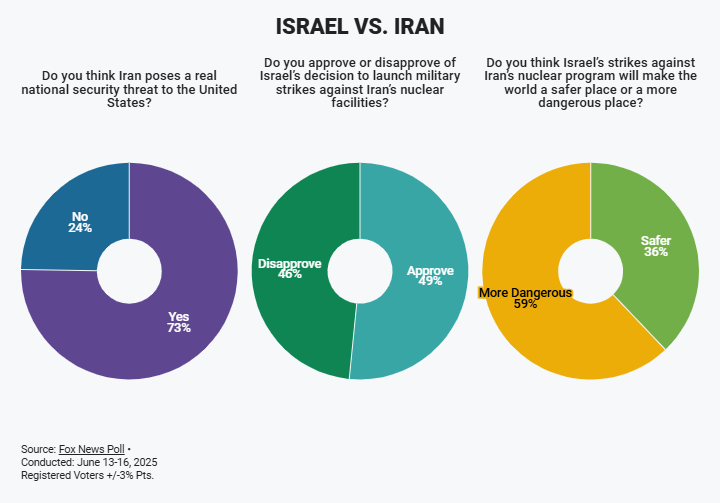
Despite widespread concern over Iran’s nuclear ambitions, Americans remain sharply divided over Israel’s decision to launch preemptive airstrikes on Iranian nuclear facilities.
The poll shows 49% approve of the Israeli military strikes, while 46% disapprove. The partisan divide is stark: 73% of Republicans support the strikes, while only 32% of Democrats and Independents do.
Even among those who back Israel’s decision, voters remain pessimistic about the consequences. A clear majority — 59% — believe the airstrikes will make the world more dangerous, not safer. That view is shared by nearly three-quarters of Democrats and Independents, and even 36% of Republicans.
Still, the threat of a nuclear Iran looms large. A full 78% of voters say they are “extremely” or “very” concerned about Tehran’s nuclear program — up from 66% in April and matching the highest recorded concern since September 2010.
This concern spans all political affiliations and demographics — and yet, when ranked against other national issues, Iran’s nuclear program lands squarely in the middle. Voters are more worried about the future of the U.S. (85%), inflation (84%), and government spending (80%). Issues like antisemitism, immigration, and protests in U.S. cities rank lower.
Despite the deepening concern over Iran, Americans remain wary of U.S. involvement in another Middle East conflict.
While 81% of voters say what happens in the region affects life in the U.S., only 53% support providing military aid to Israel, a 3-point uptick since March but still below the post–October 7 peak of 60%.
That decline is driven largely by Democrats (-14 points) and Independents (-11 points). Republicans, in contrast, have solidified their support (+4 points), underscoring the widening partisan gap over foreign aid.
“Even though most think the stakes are high, there is a reticence to get involved,” said Shaw. “The public isn’t blind to history—and history teaches us that those who get directly involved in these conflicts do so at their peril.”
President Donald Trump, who cut short his G7 summit appearance earlier this week alongside Secretary of State Marco Rubio, cited the escalating Middle East situation as justification for his abrupt departure.
Trump has called for Iran’s “unconditional surrender”, signaling an increasingly hardline stance that resonates with his Republican base.
Still, his foreign policy approval remains underwater, with 42% approving and 57% disapproving (net -15). He fares better on border security (53%) and immigration (46%), but worse on the economy (40%) and inflation (34%).
Overall, 46% of voters approve of Trump’s job performance, while 54% disapprove—a split that remains largely unchanged since last month.
Trump’s personal favorability rating also remains steady at 45%, just ahead of Vice President JD Vance (44%), Marco Rubio (42%), and Defense Secretary Pete Hegseth (32%). Robert F. Kennedy Jr. edges all of them out with a 48% favorable rating.
On the Democratic side, the favorables are similarly mixed: Kamala Harris (49%), Joe Biden (43%), Alexandria Ocasio-Cortez (40%), and Gavin Newsom (39%).
In fact, every public figure tested in the poll is viewed more negatively than positively, except RFK Jr. and Harris, who both come within two points of breaking even.
With conflict expanding in the Middle East and global alliances strained, Americans are watching events unfold with a blend of urgency and hesitation. They see Iran as a clear threat. They worry deeply about nuclear proliferation. But they are not eager for new wars — and are cautious about trusting either Washington or its allies to deliver lasting stability.
In short, the world feels more dangerous — but voters aren’t sure who to trust, what to believe, or where this ends.