For more than two decades, Kelly Brook has occupied a singular space in the British cultural landscape. To categorize her merely as a model, an actress, or a television presenter is to miss the broader cultural currency she has inadvertently carried. Since she first stepped into the glare of the flashbulbs as a teenager, Brook’s name has been synonymous not just with mainstream entertainment, but with an ongoing, often fierce national conversation about the female form, media scrutiny, and the shifting sands of modern beauty ideals.
Her trajectory—stretching from the peak of 1990s lad-mag culture to the era of digital self-curation—serves as a living timeline of how society views, commodifies, and debates women’s bodies.
The Architecture of the Ideal: From Mid-Century Curves to Runway Minimalism
To understand Brook’s impact, one must look at the historical pendulum of the “ideal” silhouette. Human aesthetics have never been fixed; they are mirrors of economic, technological, and cultural shifts. In the mid-20th century, Hollywood’s golden age sanctified the hourglass. Actresses with soft, rounded, and distinctly mammalian figures were celebrated as the pinnacle of femininity.
However, by the tail end of the century—precisely when Brook was launching her career—the pendulum had swung violently to the opposite extreme. The high-fashion runways and glossy advertisements of the 1990s were dominated by an austere, angular minimalism. It was an era that prized a fragile, ultra-lean aesthetic, presenting it as the singular standard of contemporary glamour.
It was against this cultural backdrop that Brook emerged. With a silhouette that harkened back to retro Hollywood rather than the contemporary runway, her presence in fashion campaigns and swimsuit shoots felt like an anomaly—and, to many, a relief. She became a lightning rod for discussions on beauty standards, embodying a physical reality that stood in stark contrast to the dominant media narrative of the time.
The New Vocabulary: From Perfection to Positivity
In recent years, the language surrounding the human body has undergone a radical linguistic and philosophical overhaul. The rigid dictums of past decades have been challenged by the mainstream rise of body positivity and body neutrality. These movements have dismantled the idea that confidence, health, and human worth can be measured by a tailor’s tape.
The Modern Consensus: Health and individuality cannot be confined to a singular mold. Human bodies are naturally diverse, shaped by a complex matrix of genetics, lifestyle, and time.
As these concepts moved from grassroots activism into the mainstream, the media landscape began to pivot. Advertising campaigns grew more inclusive, and public discourse shifted away from harsh judgment toward a more nuanced appreciation of diverse body types.
Because her figure had been so heavily commodified and scrutinized from the outset, Brook inevitably became a central protagonist in these modern dialogues. Over the years, her public identity has been forged through countless magazine features and high-profile imagery. Yet, as the cultural conversation matured, so did her engagement with it. In interviews, Brook began to speak candidly about the realities of aging, the psychological toll of industry pressure, and the liberation of self-acceptance—evolving from a passive subject of the public gaze to an active commentator on it.
Longevity in a Fickle Industry
The entertainment industry is notoriously unforgiving, particularly to women whose initial currency was tied to their appearance. Yet Brook has managed to sustain a multi-decade career across both the United Kingdom and international markets by demonstrating a pragmatic versatility.
-
Early Modeling: Establishing a highly visible public profile at a young age.
-
Screen & Stage: Transitioning into acting roles and television presenting.
-
Media Mainstay: Navigating competitive entertainment formats to maintain relevance as industry trends evolved.
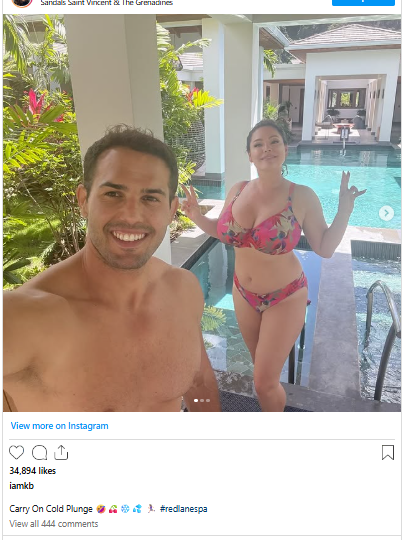
Parallel to her professional endurance has been the media’s enduring fascination with her personal life. The paparazzi lenses that tracked her youth eventually gave way to a quieter chapter; in 2022, she married her long-term partner, Jeremy Parisi. The transition marked a milestone achieved largely away from the frantic energy of the tabloid press, illustrating the delicate balancing act required of public figures who wish to maintain a private life while keeping a foot firmly planted in the public sphere.
The Double-Edged Sword of the Digital Age
The democratization of media via social platforms has fundamentally rewired the celebrity ecosystem, a shift Brook has navigated firsthand. In the traditional media eras of her youth, the relationship between a public figure and the audience was strictly mediated by editors, photographers, and television executives.
Today, social media offers a direct line of communication. For Brook, this digital shift has provided an unprecedented autonomy, allowing her to speak directly to her audience, counter tabloid narratives, and share her perspective on aging and body image in real-time.
However, this democratization comes at a steep price. The same platforms that offer a voice also amplify toxicity, exposing public figures to a relentless stream of unsolicited opinions and hyper-criticism. The comment section has become the new coliseum, where debates over a woman’s appearance, lifestyle choices, and natural aging process are conducted in perpetuity.

Beyond the Individual: Deconstructing the “Perfect Body”
When academic researchers and cultural commentators analyze the concept of physical perfection, they invariably arrive at the same conclusion: the “perfect body” is a cultural mirage.
| Era / Context | Dominant Aesthetic Ideal | Cultural Driver |
| Mid-20th Century | Hourglass, softer silhouettes | Cinema, traditional femininity |
| Late 20th Century | Ultra-lean, angular minimalism | High fashion, print media |
| Contemporary | Diverse shapes, body neutrality | Digital media, inclusivity movements |
What is deemed highly desirable in one geographical pocket or historical epoch can be entirely disregarded in another. Because these standards are heavily dictated by transient fashion trends and media agendas, they lack any permanent, universal meaning.
Consequently, contemporary thought has moved toward a model of broad subjectivity. Beauty is no longer viewed as a fixed metric or a competitive hierarchy, but as a diverse spectrum. This ideological shift acknowledges that human variance is not a flaw to be corrected, but a natural reality to be accommodated.
A Reference Point for an Evolving Culture
Ultimately, Kelly Brook’s enduring presence in the media spotlight is emblematic of a broader cultural transition. Whether by design or by default, her career has served as a reference point for how society’s expectations of women have shifted over the last quarter-century.
Her story is not an isolated phenomenon, but rather a single, highly visible thread in a much larger tapestry of societal change. As cultural values continue to migrate away from rigid, exclusionary definitions of beauty and toward authenticity and self-expression, the public perception of figures like Brook evolves in tandem. Her legacy is not defined by a singular aesthetic ideal, but by her survival and adaptation within a media landscape that is finally learning to celebrate the spectrum of human individuality.