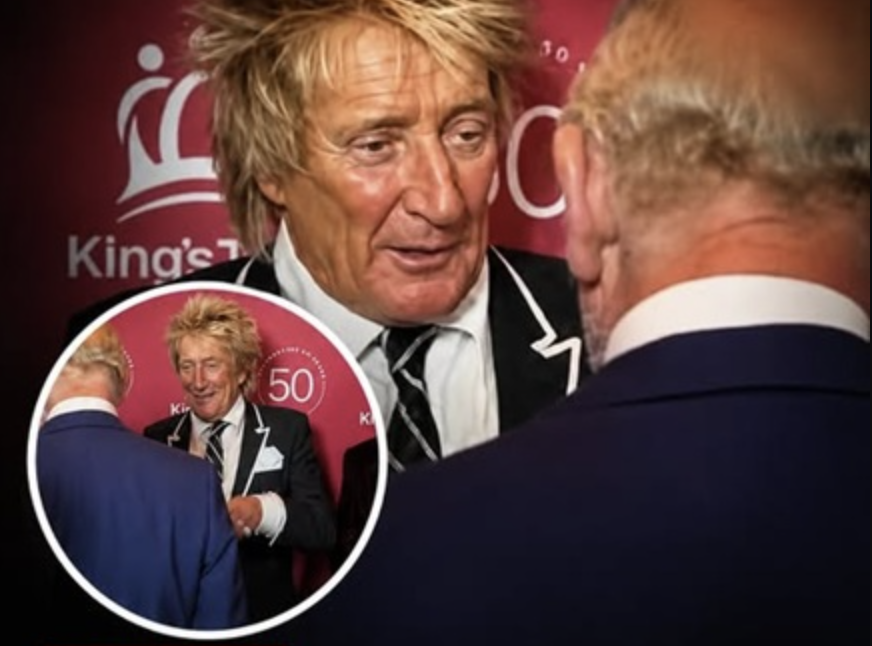
The air inside the room was thick with the scent of lilies and the stifling weight of centuries-old protocol. In the high-stakes theater of a London royal engagement, the script is usually written in invisible ink: every nod is calculated, every smile is measured, and the silence is as structured as the architecture. Here, diplomacy isn’t just a practice; it’s the very atmosphere. The guest list was a curated tapestry of the elite—individuals who navigate the subtle currents of royal etiquette with the practiced ease of seasoned mariners.
But even the most carefully choreographed ballet can be upended by a single, unscripted note.
Among the polished ranks stood Sir Rod Stewart. With his signature feathered hair and a wardrobe that has always winked at rebellion, Stewart remains the quintessential rock-and-roll icon. For five decades, he has thrived on a reputation for being refreshingly—and sometimes perilously—outspoken. He is a man who has spent his life under the neon glow of center stage, far removed from the hushed, velvet-lined restraint required of those in the orbit of the British monarchy.
Opposite him was King Charles III, a man whose entire existence has been a masterclass in the “delicate balance.” As monarch, Charles is the human embodiment of the state—a role that demands a total eclipse of personal political opinion in favor of a neutral, unifying front. His every flicker of an eyelid is a potential headline; his every sigh is a subject for socio-political forensic analysis.
The Spark in the Silence
The equilibrium of the evening reportedly fractured during a brief encounter between the King and the Musician. According to accounts vibrating through the grapevine of the event, Stewart bypassed the weather and the pleasantries, opting instead for a spontaneous, sharply-edged remark regarding former U.S. President Donald Trump.
The comment, delivered with Stewart’s trademark gravelly emphasis, was described as “highly informal” and “bluntly critical.” In a pub in Essex, it wouldn’t have raised an eyebrow; in a royal drawing room, it landed with the weight of a percussion cap hitting a marble floor. It was a jarring juxtaposition: the unfiltered vernacular of a rock legend cutting through the crystalline formality of the Crown.
Observers were less captivated by the remark itself—Stewart’s disdain for Trump is well-documented—than they were by the King’s reaction. Reports suggest Charles maintained his legendary diplomatic composure, offering a reserved expression that acted as a Rorschach test for those watching.
-
To some, it was a polite acknowledgment—the practiced “gray man” defense of a seasoned royal.
-
To others, it betrayed a flicker of restrained amusement or perhaps the briefest shadow of diplomatic discomfort.
A Study in Contrast
This moment serves as a vivid reminder of the navigational hazards faced by modern royals. They exist in a world where they are frequently cornered by the uninhibited. For King Charles, such interactions are the “occupational hazards” of a life lived behind a shield of institutional neutrality. He must remain the “blank canvas” upon which the public projects its expectations, even when confronted with the raw, colorful opinions of a cultural firebrand.
For Stewart, the exchange was simply “on brand.” His supporters see this penchant for candidness as a badge of authenticity—a refusal to let the tuxedo change the man. To his critics, it is an impulsive breach of a sacred social contract. Yet, within the context of his career, the comment wasn’t a calculated political manifesto; it was a quintessential “Rod moment,” born of a life lived out loud.
The Trump Echo and the Media Lens
The fact that Donald Trump’s name was the catalyst for this friction speaks to his enduring status as a global lightning rod. Even years after his presidency, Trump remains a spectral presence in international discourse, capable of haunting conversations in the most unlikely of places—including the inner sanctums of the British elite.
However, the true story here isn’t necessarily what was said, but how the modern media machine processes such a spark. In 2026, there is no such thing as a “private” royal exchange. A single sentence, an arched eyebrow, or a shared smirk is immediately harvested and expanded into a sprawling narrative about power, personality, and the clash of civilizations.
“The interaction reflects a broader tension in our era: the collision between the unbridled culture of celebrity and the disciplined tradition of the monarchy.”
Ultimately, the tale of the Rocker and the Regent is a parable of the contemporary age. It highlights a world where perception is often more influential than the underlying facts. Whether the exchange was a moment of genuine humor or a breach of decorum, it captivated the public imagination because it brought two irreconcilable worlds into a single frame: the rigid, silent architecture of the past and the loud, unfiltered voice of the present.
In the end, the exact words may fade, but the image remains—a King bound by duty, a Rockstar bound by nothing, and the narrow, electric space where they met.