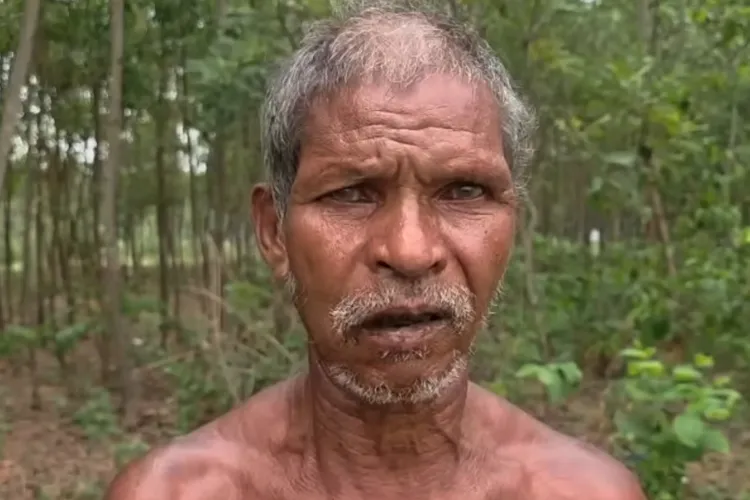
In a harrowing intersection of bureaucratic rigidity and desperate poverty, a 52-year-old man in eastern India resorted to the unthinkable to claim a meager inheritance: he exhumed his sister’s body and carried her remains directly into a local bank.
The incident, which took place in the tribal heartlands of Odisha state, was captured in a chilling video that has since gone viral across South Asia. The footage shows Jitu Munda, a member of a local tribal community, arriving at a branch of the Indian Overseas Bank with the remains of his sister, Kalara Munda.
The Burden of Proof
The macabre procession was sparked by a dispute over documentation. According to reports from CBS News, the BBC, and The Times of India, Munda had been struggling to withdraw funds left behind by his deceased sibling. Bank officials allegedly told him that without a formal death certificate—a document Munda did not possess—there was no proof she had passed away.
“I was asked to prove whether my sister was alive or dead,” Munda told The Times of India. “Since I had no papers, I brought her remains to show that she was dead.”
The Bank Responds
The Indian Overseas Bank has moved quickly to distance itself from the optics of the crisis. In a formal statement released via social media, the institution categorically denied that any staff member instructed Munda to produce a physical body for claim settlement, calling such allegations “incorrect and not based on facts.”
Instead, the bank attributed the incident to a “lack of awareness of the claim settlement process” and Munda’s “unwillingness” to comply with standard procedures, such as providing official government records. Bank officials further alleged that Munda was in an “inebriated condition” when he left the branch, only to return later with the remains.
“This created a highly distressing situation at the premises,” bank officials stated, noting that local police were called to handle the matter under official supervision.
A Systemic Failure
By Tuesday, April 28, the wheels of bureaucracy—previously at a standstill—began to turn with sudden urgency. Government officials fast-tracked the issuance of the required death and legal heir certificates. The claim, totaling 19,402 rupees (approximately $200 USD), was finally released to the family.
However, the resolution has not silenced a growing chorus of critics. The incident has cast a harsh spotlight on the barriers faced by India’s rural and tribal populations. Under current Indian banking regulations, if an account holder dies without a named nominee, survivors must navigate a labyrinth of paperwork that can take months—or years—to resolve in remote regions.
Accountability and Aftermath
The fallout has reached the highest levels of the state government. Suresh Pujari, Odisha’s Revenue Minister, informed the BBC that a formal investigation is underway. Pujari indicated that disciplinary action would be taken against the branch manager for their alleged conduct during the dispute.
While the Revenue Minister’s office and the Indian Overseas Bank did not immediately provide further comment, local authorities have since intervened to provide a semblance of dignity to the tragedy. Officials reportedly spoke with Munda to ensure his sister’s remains were returned to their resting place.
As a gesture of restitution, Munda has been offered 30,000 rupees (roughly $316 USD) in additional financial assistance—a sum that exceeds the original inheritance he went to such gruesome lengths to secure.