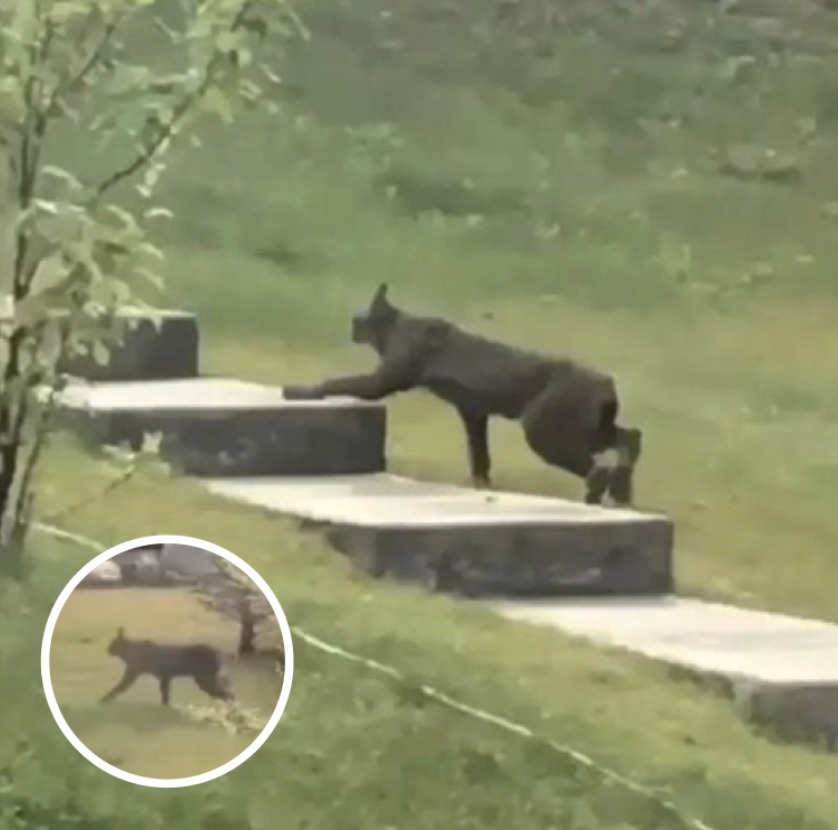
Rare Melanistic Canada Lynx Captured on Film for the First Time — A Once-in-a-Lifetime Discovery
Note: This story was originally published in December 2022 and is being republished in full detail.
It began like any other winter day in northern Canada — snow drifting lazily across an endless horizon, pine trees whispering in the cold wind. But for one group of scientists, the quiet was broken by a moment that would rewrite what they thought they knew about an iconic species. On a cell phone camera, for the first time in history, a melanistic Canada Lynx — a creature so rare it had never been filmed before — came into view.

*Rare Canada Lynx captured on video sitting. Photo Credit: The Weather Channel*
To the untrained eye, it might have simply looked like a large, dark-furred cat in the snow. But to the researchers who saw it, this was history unfolding. The Canada Lynx, Lynx canadensis, is normally known for its silvery-gray or reddish-brown coat — colors that serve as perfect camouflage in its snowy, forested domain. The lynx in this video, however, possessed a coat so deep and shadowy it seemed to swallow light. This phenomenon, called melanism, is caused by a rare genetic mutation that produces excess dark pigment in the fur.
The implications are both fascinating and concerning. In the lynx’s typical environment — thick forests blanketed in white for much of the year — its pale coat is a survival tool, blending in seamlessly while stalking snowshoe hares, its primary prey. A dark coat, though striking to human eyes, could make it harder for the melanistic lynx to hunt without being spotted. This could mean greater difficulty finding food, especially during the harsh Canadian winters.
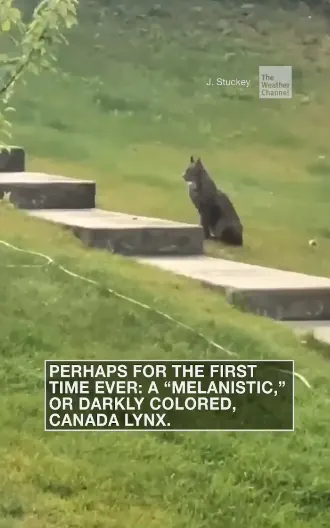
*Rare Canada Lynx captured on video sitting. Photo Credit: The Weather Channel*
For biologists, the sighting has prompted new questions about how such rare coloration comes to be — and whether climate change may play a role. In 2014, a study suggested that warming global temperatures could influence coat color adaptations in wildlife, with some species developing darker pigmentation as snow cover decreases over time. In that context, this lynx may not just be a genetic curiosity, but a living clue to the way climate shifts are influencing the survival strategies of northern species.
What makes this encounter even more remarkable is that it almost didn’t happen. The lynx wasn’t found during an organized field expedition, but in an unexpected, fleeting moment when a group happened to be nearby with a camera. The resulting video has since traveled far beyond the research community, captivating millions online — not just because of the animal’s rarity, but because it serves as a reminder of how much of the natural world remains mysterious.
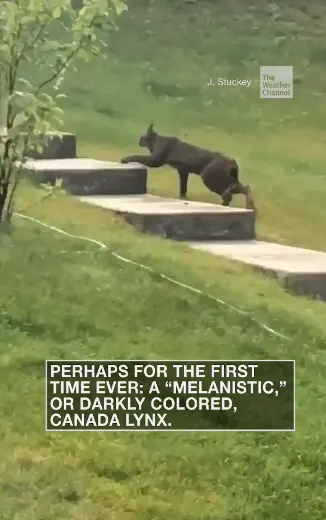
*Rare Canada Lynx captured on video walking up stairs. Photo Credit: The Weather Channel*
Still, awe has been tempered with urgency. The sighting is a stark reminder of the fragility of wildlife populations in the face of habitat loss, climate disruption, and human encroachment. The Canada Lynx itself, while not currently endangered in Canada, is considered threatened in the contiguous United States due to shrinking habitat ranges. For a melanistic variant — likely representing a tiny fraction of the population — the risks are even greater.
The footage has now become a valuable resource for wildlife researchers, who hope to learn more about the genetic factors behind melanism in lynx, its potential advantages or disadvantages, and whether such traits might become more common as environmental conditions evolve. Each second of the recording provides data points — the sheen of the coat under different light, the lynx’s movement patterns, and even subtle behavioral cues.
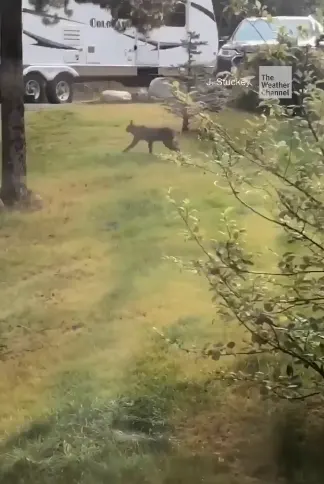
*Rare Canada Lynx captured on video traversing over grass. Photo Credit: The Weather Channel*
For the public, though, the appeal is more emotional than scientific. There’s something almost mythical about seeing such a creature — a shadow moving against the snow, embodying both strength and rarity. It sparks the same wonder that early explorers must have felt upon encountering unknown animals for the first time. And in an age when high-definition cameras capture almost every corner of the planet, moments of pure discovery have become increasingly rare.
The melanistic Canada Lynx now stands as both a marvel and a messenger. It reminds us that nature’s capacity to surprise us has not diminished, even in a world where information moves at the speed of a swipe. It also challenges us to think about our role as stewards of the environment — to protect the conditions that allow such extraordinary animals to exist in the first place.
Because in the end, this isn’t just about one lynx. It’s about biodiversity, adaptability, and the resilience of life in the face of rapid change. And it’s about the truth that some of nature’s most extraordinary wonders will only reveal themselves to us if we make the effort — both to look, and to preserve what we find.