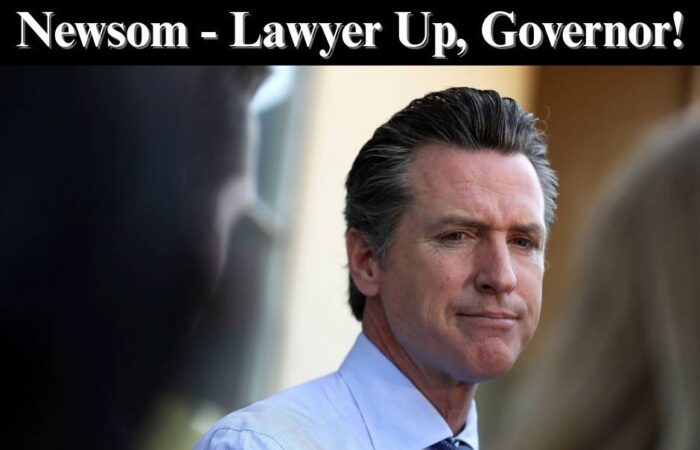
Constitutional law scholar Alan Dershowitz weighed in Monday on California Governor Gavin Newsom’s lawsuit aimed at halting President Donald Trump’s deployment of the National Guard to Los Angeles, predicting that the challenge is unlikely to survive in the courts—especially not before the U.S. Supreme Court.
Appearing on The Dershow, Dershowitz dismissed the legal basis of Newsom’s case, saying the courts traditionally do not interfere with a president’s decision to deploy military forces in response to civil unrest.
“The Supreme Court will not second-guess the President of the United States on this matter,” Dershowitz said. “Whether you agree with it or not, the president had the authority to make this decision—even without the governor’s consent.”
The lawsuit, filed by Newsom and California Attorney General Rob Bonta, comes in response to Trump’s deployment of troops following violent riots that broke out after an ICE operation at a Home Depot in Los Angeles. According to Dershowitz, the severity of the violence justifies Trump’s actions under federal law.
“There were bombings, Molotov cocktails, Teslas set ablaze, ICE officers assaulted, and even threats against their families,” Dershowitz noted. “Was it a full-blown insurrection? No. But it was undeniably violent.”
In light of the escalating unrest, Trump ordered an additional 700 active-duty Marines to support National Guard efforts in the city. Social media footage from the weekend showed a protester in a motorcycle helmet smashing ICE transport vehicles with rocks, prompting the FBI to offer a $50,000 reward for information leading to an arrest.
The Legal Question: Posse Comitatus and Federal Authority
Newsom’s legal argument focuses on limiting Trump’s use of troops in immigration enforcement—potentially violating the Posse Comitatus Act of 1878, which bars military involvement in civilian law enforcement. However, Dershowitz argued that Trump and Defense Secretary Pete Hegseth—also named in the suit—have not assigned the military to law enforcement duties, but rather to protect federal property and agents, which is a constitutionally sound role for the military.
“The president is the commander-in-chief. Deploying troops to protect federal personnel and property is well within his authority,” Dershowitz explained. “The courts have upheld similar federal interventions before—especially during the civil rights era.”
A Predictable Legal Outcome?
While Newsom may find some temporary legal success in lower courts, Dershowitz predicted any victory would be short-lived.
“He’ll likely find a friendly judge at the district level—perhaps one he helped appoint—who could issue an injunction,” Dershowitz said. “But once the case makes its way to the Supreme Court, the justices will almost certainly uphold the president’s discretionary authority to deploy troops in situations of civil unrest.”
Dershowitz concluded that the Supreme Court will ultimately defer to the executive branch, especially in matters involving national security or public order.
“The judiciary is not equipped to micromanage the president’s decision on when troops are necessary. That discretion rests with the commander-in-chief.”
As tensions escalate on the ground and in the courts, the case underscores a deeper constitutional battle over the limits of federal power, state sovereignty, and the executive’s authority to use military force within the United States.