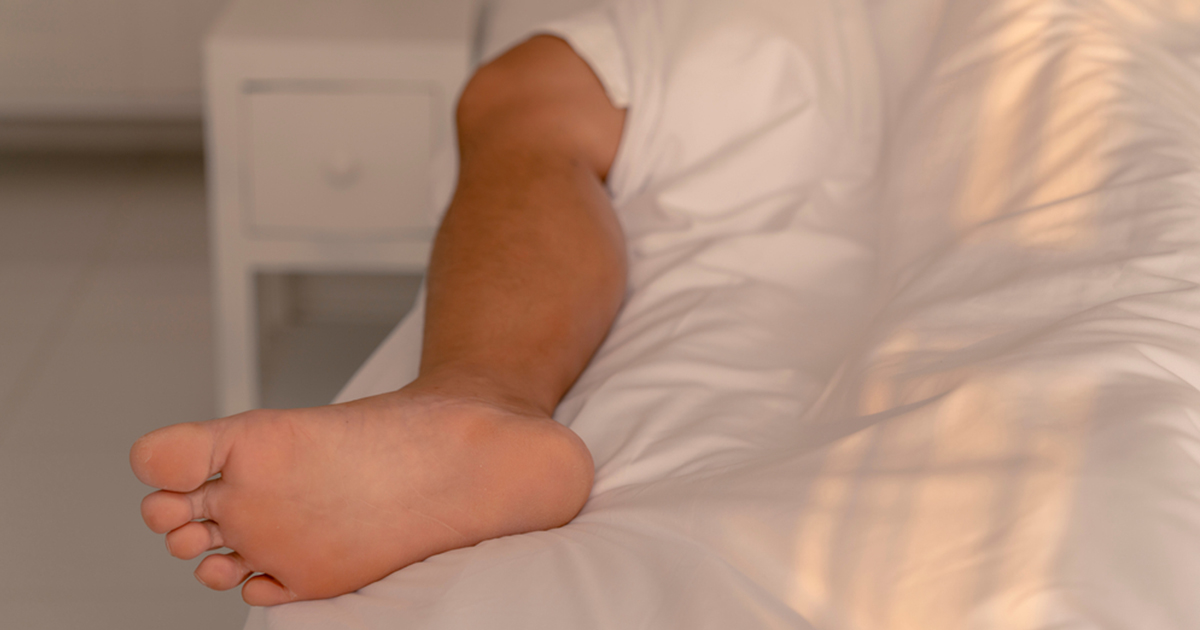
It is a late-night ritual performed by millions, often without a second thought: that instinctive, half-conscious kick that sends one foot out from beneath the duvet into the cool night air. While it might seem like nothing more than a restless quirk, sleep science suggests this “dangling foot” maneuver is actually a sophisticated biological hack. Far from being a mere comfort preference, it is one of the most efficient ways to signal to your brain that it’s time to shut down.
The efficacy of the exposed limb isn’t magic—it’s thermoregulation. The secret lies in a fascinating intersection of circadian rhythms, vascular anatomy, and the precise way our bodies shed heat to bridge the gap between wakefulness and deep rest.
The Thermodynamics of Slumber
As the sun sets, your internal clock initiates a complex physiological cooldown. This drop in core temperature is not a byproduct of sleep; it is a prerequisite for it. According to the Sleep Foundation, this cooling phase begins roughly two hours before you drift off, moving in tandem with the surge of melatonin.
“The drop in temperature starts about two hours before you go to sleep… During sleep, body temperature continues to fall, reaching a low point in the early morning,” the Foundation notes.
To achieve this internal chill, the body must offload heat. It does this by dilating blood vessels and shunting warm blood away from the vital organs and toward the skin’s surface—specifically to the extremities. When your feet hit the cool air outside the blankets, they act as high-efficiency heat vents, accelerating the transition into “sleep mode.”
Anatomy of a Heat Vent
Why the feet? Nature has uniquely engineered our extremities for climate control. Unlike the insulated torso, our hands and feet contain specialized vascular structures known as arteriovenous anastomoses. These are essentially high-speed bypass valves that allow blood to skip the tiny capillaries and head straight to the surface of the skin.
By exposing a single foot, you are essentially cracking a window in a stuffy room. It provides a passive, adjustable outlet for excess thermal energy.
Natalie Dautovitch, a sleep health researcher at Virginia Commonwealth University, explained the phenomenon to New York Magazine:
“I think it’s likely in service of trying to cool our bodies down because we’ve gotten too warm to sleep. Sticking your toe out or your foot out could bring you to a more restorative sleep.”
Measuring the ‘Sleep Gradient’
In the world of sleep research, the effectiveness of this cooling is measured by the distal-to-proximal gradient (DPG). This is the temperature difference between your extremities (distal) and your core (proximal). A high DPG—meaning your hands and feet are significantly warmer than your core—is one of the strongest physiological predictors of falling asleep quickly.
A landmark study published in the Journal of Physiology confirmed that individuals with a higher DPG reached sleep onset significantly faster than those with cooler hands and feet. By “venting” through one foot, you are manually boosting this gradient, tricking the body into a state of readiness without needing to overhaul your thermostat.
Beyond the Foot: Strategies for a Cooler Night
While the “one-foot-out” method is a powerful tool, it works best when integrated into a broader cooling strategy. Journalists and sleep experts alike point to several evidence-based habits:
-
The Warm Bath Paradox: Taking a warm bath 90 minutes before bed actually aids cooling. The hot water draws blood to the skin’s surface; once you step out, the rapid evaporation helps your core temperature plummet.
-
The 65-Degree Standard: The Sleep Foundation suggests maintaining a bedroom temperature between 65°F and 68°F to support the body’s natural dip.
-
The Pre-Warm: If you suffer from chronically cold feet, wear socks initially. Warming the feet dilates the vessels, which—paradoxically—later helps the body dump core heat once the socks are removed.
When to Stay Under the Covers
Despite its benefits, the dangling foot isn’t a universal panacea. For those with poor circulation, Raynaud’s disease, or those sleeping in exceptionally frigid environments, exposing a limb may cause discomfort or even keep the body in a state of alert. Children and the elderly, who may struggle more with heat conservation, should also prioritize comfort over “hacks.”
Ultimately, the goal is restorative rest, not rigid adherence to a technique. However, the next time you find yourself tossing and turning, remember that the solution might not be more sheep-counting, but a simple shift in your bedding. By letting one foot breathe, you are tapping into a primal cooling system designed to lead you straight to the Land of Nod.
Better sleep, it seems, truly is just a step away.