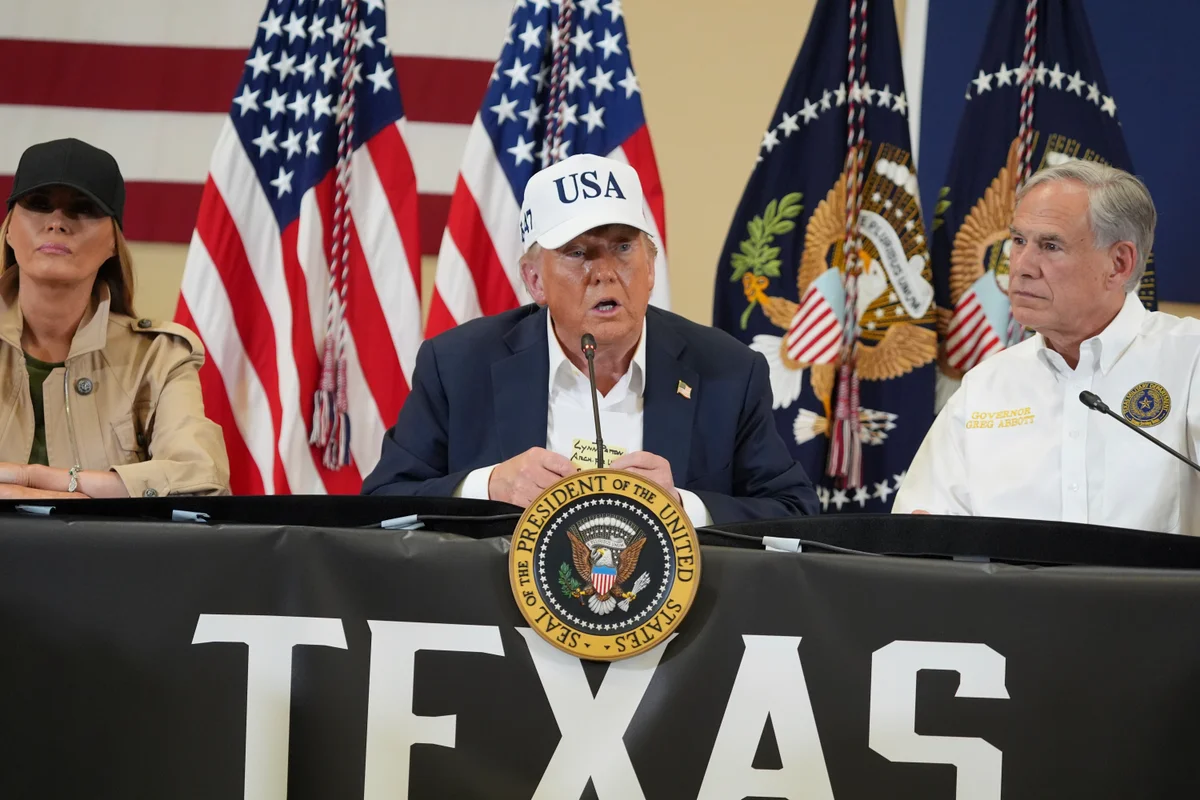
Over the Fourth of July holiday weekend, catastrophe struck central Texas as the Guadalupe River surged more than 26 feet in under an hour, submerging towns, sweeping away homes and businesses, and tearing through summer camps. More than 120 people are confirmed dead, and nearly 200 remain missing—a toll that continues to rise.
But as families mourned and rescue teams combed through wreckage, the federal response lagged. And critics say that what has unfolded since the floods is not only a failure of urgency—but a chilling preview of what disaster response may look like under the Trump administration’s evolving emergency policies.
Delayed FEMA Response and Bureaucratic Bottlenecks
In most disasters of this magnitude, FEMA acts swiftly—deploying search-and-rescue teams, establishing mobile recovery centers, and coordinating closely with local officials. But in this case, the agency’s teams were not dispatched until the Monday after the floods began—three days too late, according to a CNN report.
One possible reason: a policy change by Homeland Security Secretary Kristi Noem, who now reportedly requires personal approval for any FEMA expenditure exceeding $100,000. That delay, driven by paperwork and administrative controls, may have cost lives, critics warn.
“Kids in Texas died as a direct result of Kristi Noem’s negligence,” wrote Sen. Ron Wyden (D-Ore.) on BlueSky. “She should be removed from office before her incompetence gets Oregonians killed in a wildfire.”
A Pattern of Undermining Federal Disaster Infrastructure
The Texas flood response fits a broader pattern of dismantling federal disaster-readiness infrastructure. Since returning to office, President Trump has consistently pushed to shift the burden of disaster relief from the federal government to the states—arguing FEMA has become too large and inefficient.
“We want to wean off of FEMA,” Trump said at a June press briefing. “A governor should be able to handle it. And frankly, if they can’t, maybe they shouldn’t be governor.”
But the Texas tragedy may have already forced a soft retreat. According to a Washington Post report, the White House is reconsidering plans to phase out FEMA’s central role—though a spokesperson quickly denied any reversal.
“The Post headline does not accurately reflect the Trump Administration’s commitment to reforming FEMA,” White House spokesperson Abigail Jackson said in a statement. “FEMA is a bloated bureaucracy that discourages state investment in resilience. President Trump remains committed to right-sizing the federal government.”
Staffing Shortages and Expertise Gaps
Behind the delays lies a deeper problem: a hollowing out of federal disaster agencies. Since January 2025, FEMA has lost nearly 25% of its workforce, part of broader layoffs pushed by the administration in partnership with Elon Musk’s federal workforce reduction initiative. NOAA, the federal agency responsible for weather forecasting and early warning systems, has shed 600 employees, including hundreds at the National Weather Service.
“These organizations keep us safe,” said Tom Di Liberto, a former NOAA climate scientist fired earlier this year. “Now they’re being told to do the same job with half the people.”
Even FEMA’s leadership has been in flux. In May, the agency’s director Cameron Hamilton, a former Navy SEAL, was abruptly fired and replaced by David Richardson—a former counter-terrorism official with no background in emergency management. Richardson has yet to comment publicly on the Texas disaster.
Warning Signs Were Missed — and Funding Denied
While state and federal officials have pointed fingers at one another, the problems were years in the making. In Kerr County, the epicenter of the flooding, local officials had for years requested FEMA funding to install a regional flood warning system. But the state of Texas, which administers those grants under Trump-era rules, repeatedly denied the applications.
NPR reported that the county also failed to qualify for any state-level emergency preparedness grants. So when the river rose, local emergency teams were caught off guard—and in some cases, stranded themselves.
Criticism also fell on the National Weather Service, with some state officials claiming they failed to issue proper warnings. But NWS records show multiple alerts were sent before the floodwaters arrived. The problem, experts say, wasn’t the warnings—but the communication breakdown between underfunded agencies and overburdened local responders.
“Coordination wasn’t there because positions weren’t filled,” said Margaret Cooney, a disaster policy expert at the Center for American Progress.
A Dangerous Future Under New FEMA Rules
A recent report by the Urban Institute offers a sobering look at where the Trump administration is headed. Under the new FEMA eligibility thresholds proposed by the White House, 71% of past storms and floods—between 2008 and 2024—would not have qualified for federal disaster declarations.
That includes disasters in large states like Florida, New York, California, and Texas—states that have historically relied on FEMA for swift financial and logistical support after hurricanes, wildfires, and floods.
Without that support, states and municipalities would be forced to shoulder recovery costs on their own—often while simultaneously trying to manage the crisis itself. Experts say it’s a recipe for slower recoveries, more chaos, and greater long-term suffering.
“The bigger the catastrophe, the more first responders there are who are also victims,” said Elaine Kamarck, a senior fellow at the Brookings Institution. “The Trump administration just doesn’t get that.”
Record-Breaking Disasters, Shrinking Safety Nets
The Texas floods are not an isolated event. According to NOAA, 2024 saw 27 billion-dollar climate disasters—just one shy of the record set in 2023. A 2021 World Meteorological Organization report found that weather-related disasters have increased fivefold over the past 50 years.
And yet, even as disasters grow more frequent and more severe, the infrastructure meant to protect Americans is being dismantled or pushed back onto already overstretched local agencies.
“These agencies give communities a fighting chance,” Cooney said. “Without them, we are flying blind.”
Conclusion: A System on the Brink
The response to the Texas floods reveals the consequences of a federal government retreating from its role in disaster management. While ideological shifts toward “state sovereignty” may play well in political circles, the real-world effects—delayed rescues, underfunded warnings, uncoordinated response—are already proving deadly.
“There will be more disasters,” Kamarck warned. “And they’ll be worse. So the government better get serious before the next one hits.”