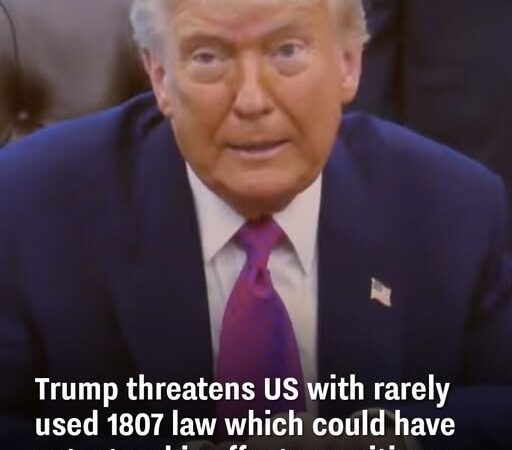
Former President Donald Trump may soon invoke the Insurrection Act, a centuries-old law allowing military intervention on U.S. soil—marking a turning point in the current wave of political unrest. With Los Angeles and other cities in turmoil, Trump has already deployed active-duty troops and assumed control of California’s National Guard, triggering a storm of opposition from governors, civil rights groups, and the judiciary. But this confrontation is about more than just Los Angeles—it’s a high-stakes test of how far presidential power can stretch.
What Is the Insurrection Act—and Why It’s So Powerful
Enacted in 1807, the Insurrection Act gives presidents sweeping authority to send military forces into states during rebellions, riots, or when laws can no longer be enforced. It overrides the Posse Comitatus Act, which typically bans military involvement in civilian policing. Although it’s been used sparingly in U.S. history, Trump’s recent maneuvers suggest he may invoke it soon—without official declaration yet, but with actions that closely mirror its use.
If triggered, the Insurrection Act would hand the president extraordinary powers with minimal oversight, raising fears that it could be used for political purposes under the guise of restoring order.
Trump Federalizes the California National Guard
By invoking Title 10 of the U.S. Code, Trump seized control of the California National Guard—without Governor Gavin Newsom’s consent—citing a federal emergency. This unilateral move stripped the state of command over its forces and sparked immediate legal backlash.
Critics argue that Title 10 does not allow such circumvention of state authority unless there is an undeniable national threat. Many see it as a dramatic overreach that pushes constitutional limits.
Legal Showdown: California Pushes Back
Governor Newsom quickly filed a lawsuit challenging Trump’s action, claiming it violates the Tenth Amendment, which protects states’ rights. On June 12, 2025, U.S. District Judge Charles Breyer sided with California, ruling that Trump’s move was unconstitutional and ordering control of the Guard returned to the state.
But Trump refused to comply. The 9th Circuit Court of Appeals then granted a temporary stay, allowing Trump to maintain control of the Guard—at least until a full hearing scheduled for later this month.
Marines on the Ground: Testing the Boundaries
In a further escalation, Trump deployed 700 active-duty Marines to Los Angeles, arguing that their role is limited to protecting federal buildings. While such deployment can be legally defensible, civil liberties advocates warn that it blurs the line between military support and domestic law enforcement—a line the Posse Comitatus Act exists to enforce.
By avoiding a formal Insurrection Act declaration, Trump is walking a legal tightrope—pushing presidential power to the edge while daring courts and states to stop him.
Rarely Used, But Always Controversial
The Insurrection Act has only been invoked in exceptional situations: Eisenhower used it in 1957 to enforce desegregation in Little Rock, and George H.W. Bush relied on it during the 1992 Rodney King riots. Trump, however, appears ready to use it as a political weapon in the context of protest and dissent—lowering the bar for when future presidents might resort to military force.
Governors Sound the Alarm
Governors across the country are deeply concerned. Newsom condemned Trump’s actions as authoritarian, while others fear that the military could one day be turned against political opponents in their own states.
“This is not just about California,” one governor warned. “If Trump can do this here, it sets a dangerous precedent for what any president could do anywhere.”
Civil Liberties Under Threat
Groups like the ACLU warn that military deployments in cities can quickly turn peaceful demonstrations into scenes of fear and confrontation. The threat of soldiers in the streets, they argue, chills free speech and undermines the right to protest.
Critics also contend that Trump’s aggressive posture is less about security and more about intimidating dissent.
Federal Courts Now Hold the Line
The courts are now central to the outcome. Judge Breyer ruled that Trump had overstepped his authority, but the 9th Circuit’s stay gives Trump a temporary win. A final ruling could redefine how—and when—military power can be used on American soil.
Legal scholars agree: this case could become a landmark in constitutional law and civil-military relations.
The Public Is Deeply Divided
Americans are split. Some see Trump’s actions as necessary and bold, while others believe they’re dangerously authoritarian. Public confusion over the Insurrection Act’s scope only adds to the tension. With trust in government already fragile, this standoff is worsening the national divide.
Where’s Congress?
So far, Congress has been largely silent. A few lawmakers have called for reining in presidential emergency powers, but no legislation has emerged. Without clear boundaries, critics fear future presidents—of either party—could exploit this gray area even more aggressively.
A Fork in the Road for American Democracy
Trump’s maneuvers have sparked a nationwide debate over the limits of executive power. The Insurrection Act was never meant to be a political bludgeon, yet its vague language leaves it vulnerable to abuse.
As courts deliberate and governors resist, the U.S. faces a critical question: Should the president have unilateral authority to deploy the military on domestic soil—or must that power be restrained to protect democracy itself?
The answer may shape not just the outcome of today’s unrest—but the very future of American governance.