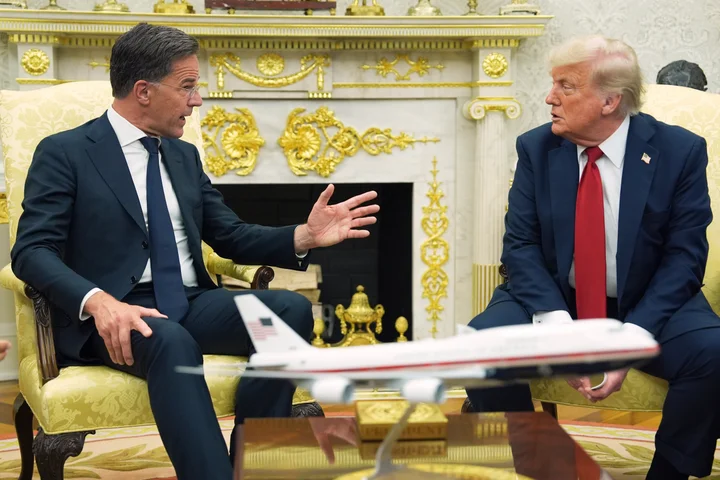
President Donald Trump made a bold declaration Monday, insisting that Russian President Vladimir Putin has “never fooled” him — mere seconds after describing in detail how Putin repeatedly misleads him before launching deadly missile strikes on Ukrainian cities.
Speaking from the Oval Office alongside NATO Secretary-General Mark Rutte, Trump recounted his frequent conversations with the Russian leader:
“I speak to him a lot about getting this thing done and I always hang up and say, ‘Well, that was a nice phone call,’ and then missiles launch into Kyiv or some other city,” Trump said.
“I go home, I tell the first lady, ‘I spoke to Vladimir today, we had a wonderful conversation.’ She says, ‘Oh really? Another city was just hit.’”
Despite acknowledging this pattern of deception, Trump quickly pivoted to claim Putin has never fooled him — unlike former presidents Bill Clinton, George W. Bush, Barack Obama, and Joe Biden.
“He fooled Clinton, Bush, Obama, Biden. He didn’t fool me,” Trump insisted. “He’s fooled a lot of people… just not me.”
The press appearance was meant to outline Trump’s latest Ukraine policy: a new threat of “secondary tariffs” on nations that continue doing business with Russia unless Putin agrees to a ceasefire within 50 days. Trump also announced U.S. approval of advanced military aid to Ukraine — including Patriot missile systems — which he said would be paid for by NATO allies.
Later, Commerce Secretary Howard Lutnick clarified that Trump meant to say “secondary sanctions,” not tariffs, referring to penalties on individuals and nations supporting Russia’s war economy.
Still, Trump repeated the “100% tariffs” threat several times, incorrectly citing a bipartisan sanctions bill that does include tariff authority — but only as one of many tools. The broader legislation, introduced by GOP Sen. Lindsey Graham and Democratic Sen. Richard Blumenthal, focuses on banking restrictions and penalties for foreign nationals aiding the Kremlin.
Monday’s comments reflect Trump’s shifting tone on the Ukraine war. In 2019, he was impeached for withholding military aid from Ukraine in an attempt to pressure President Volodymyr Zelenskyy into announcing an investigation into then-candidate Joe Biden. When Russia invaded in 2022, Trump called Putin “savvy” and “genius.” For much of the war, Trump has deflected blame from Putin and placed it on Biden — and even Zelenskyy.
While Trump now admits Putin shares responsibility, he still downplays it.
“It was Biden’s war,” Trump repeated, falsely claiming once again that the 2020 election was rigged. “The election was stolen.”
At one point, Trump appeared to drift back toward admiring Putin’s aggressiveness:
“Russia has really taken a very positive, very, very strong — I mean, what they’ve done the last couple of weeks…”
Rutte, appearing visibly uncomfortable, cut in to re-center the conversation on the human toll.
“This is not about military goals. It is just creating panic, waking people up in the middle of the night, hitting towns,” the NATO chief said. “It’s really terrible — and a lot of people are losing their lives.”
The remarks underscore the ongoing contradictions in Trump’s rhetoric: while claiming strength and clarity on foreign policy, he continues to send mixed signals about one of the most consequential conflicts of this century — and about the man he claims has never fooled him.