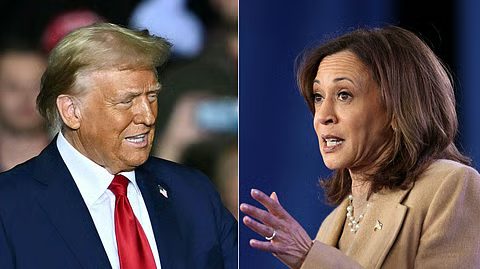
President Donald Trump renewed his explosive accusation Saturday night that former Vice President Kamala Harris paid major celebrities for endorsements during the 2024 presidential campaign — and insisted that those involved “should all be prosecuted.”
Trump made the claim in a lengthy post on Truth Social, again offering no supporting evidence. His allegation — previously denied by both Harris’s campaign and the celebrities involved — comes amid mounting scrutiny of Trump’s own connections to the late sex offender Jeffrey Epstein.
“I’m looking at the large amount of money owed by the Democrats after the Presidential Election,” Trump wrote, “and the fact that they admit to paying, probably illegally, Eleven Million Dollars to singer Beyoncé for an ENDORSEMENT (she never sang, not one note, and left the stage to a booing and angry audience!), Three Million Dollars for ‘expenses,’ to Oprah, Six Hundred Thousand Dollars to very low rated TV ‘anchor,’ Al Sharpton (a total lightweight!), and others to be named for doing absolutely NOTHING!”
“These ridiculous fees were incorrectly stated in the books and records,” he continued. “YOU ARE NOT ALLOWED TO PAY FOR AN ENDORSEMENT. IT IS TOTALLY ILLEGAL TO DO SO… Kamala, and all of those that received Endorsement money, BROKE THE LAW. They should all be prosecuted!”
No Evidence and No Legal Basis
Despite Trump’s outrage, campaign finance experts say there’s nothing illegal about paying public figures for their time or participation in events — so long as the expenses are disclosed. The Federal Election Commission (FEC) has no specific prohibition against paid endorsements by celebrities.
In fact, Harris’ 2024 campaign did disclose payments for event production — not personal fees.
According to public records, Harris’ campaign paid $165,000 to Beyoncé’s production company, Parkwood Entertainment, for her appearance at an October rally in Houston, where she delivered a speech but did not perform. The campaign also sent $1 million to Oprah Winfrey’s production company for her involvement in a livestreamed Michigan event.
Winfrey later clarified on Instagram that she “did not take any personal fee” and explained that the production team she worked with was compensated, as is standard.
Adrienne Elrod, a Harris campaign spokesperson, said in November that the campaign is obligated to cover “ancillary costs” for any large-scale event involving talent or production services.
The campaign also paid $500,000 to Sharpton’s National Action Network — ahead of an interview he conducted with Harris on MSNBC. Again, no personal fee was disclosed.
Harris’ team has not responded to Trump’s most recent allegations.
Part of a Broader Barrage
Trump’s celebrity payment accusations are the latest in a string of outbursts since early July, when the Department of Justice clarified that it has no active “client list” tied to Epstein — contradicting earlier claims by Attorney General Pam Bondi that sensitive documents were “sitting on [her] desk.”
In the days since, Trump has also called for the NFL’s Washington Commanders to change their name again, accused Coca-Cola of altering its formula due to his influence, and leveled fresh claims of treason against former President Barack Obama.
Though the White House and FEC have yet to comment on Trump’s new posts, legal experts say his assertion that paid endorsements are inherently illegal misrepresents both the law and standard campaign practice.
As political rhetoric heats up and the Epstein scandal looms in the background, Trump appears eager to shift focus toward his rivals — even if his claims don’t hold up to scrutiny.