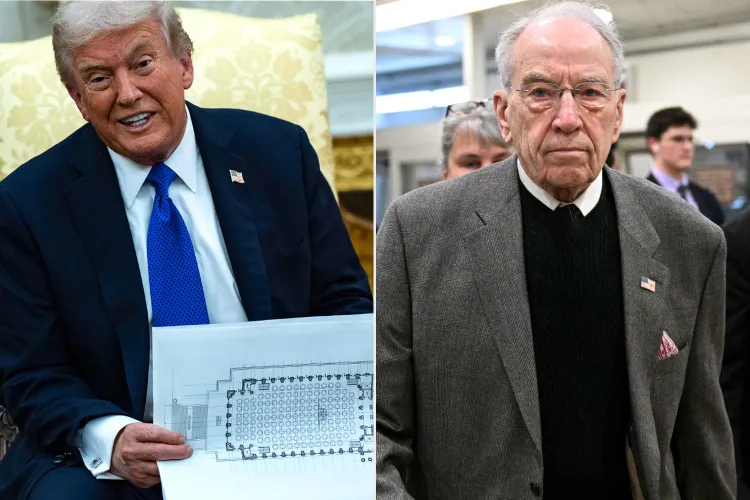
In the wake of a chilling assassination attempt against President Donald Trump, a high-stakes legislative battle has erupted on Capitol Hill. A leading Senate Republican is moving to inject a staggering $1 billion into security enhancements for the President’s controversial—and currently stalled—White House ballroom project.
Senator Chuck Grassley (R-Iowa), Chairman of the Senate Judiciary Committee, is spearheading the proposal. While Grassley maintains the funds are strictly for “hardening” the complex, the move has ignited a firestorm of criticism from Democrats, who are framing the request as an out-of-touch vanity project at a time when American voters are reeling from a cost-of-living crisis.
A Fortress for the East Wing
The proposed legislation seeks to bolster the “East Wing Modernization Project,” a venture the White House claims is long overdue. According to White House spokesperson Davis Ingle, the recent attempt on the President’s life during the White House Correspondents’ Dinner has made the “complete hardening” of the complex a non-negotiable priority.
“The White House must be a safe and secure complex that generations of future presidents and visitors to the People’s house can enjoy,” Ingle stated.
However, the line between structural integrity and luxury remains blurred. While the bill explicitly mandates that funds cannot be used for “non-security elements,” Grassley’s office and the White House have yet to clarify where “security features” end and “ballroom aesthetics” begin.
Political Firepower and “Marie Antoinette” Comparisons
The optics of a billion-dollar ballroom upgrade—even under the guise of security—have provided Democrats with potent political ammunition. With gas prices and grocery bills soaring, Senate Minority Leader Chuck Schumer (D-N.Y.) wasted no time in casting the GOP as detached from the struggles of the average household.
“Republicans are on a different planet than American families,” Schumer declared on Tuesday. “Republicans looked at families drowning in bills and decided what they really needed was more raids and a Trump ballroom.”
The digital front of the battle grew even sharper as Democratic members of the Judiciary Committee circulated an AI-generated image of President Trump reimagined as Marie Antoinette, the ill-fated French queen synonymous with royal excess. The caption read: “$1 BILLION for ballroom funding? Marie Antoinette would be proud.”
$1 BILLION for ballroom funding? Marie Antoinette would be proud. pic.twitter.com/oKbc2Vt4rX
— Senate Judiciary Democrats 🇺🇸 (@JudiciaryDems) May 5, 2026
The ICE Factor and Private Funding Claims
The ballroom is not the only heavy-hitter in this legislative package. The bill also earmarks more than $30 billion in additional funding for Immigration and Customs Enforcement (ICE), a move Grassley framed as a defensive play against a “radical, anti-law enforcement agenda.”
“The Senate Judiciary Committee is taking action to help provide certainty for federal law enforcement and safer streets for American families,” Grassley said.
For his part, President Trump has maintained that the actual construction of the ballroom—which he estimates at roughly $400 million—would be covered by private donations from himself and corporate partners, rather than the public purse.
A Divided Senate
As the bill moves toward a vote, the rhetoric from the left continues to focus on the economic disconnect. Senator Elizabeth Warren (D-Mass.) noted that on “Day 471” of the current administration, the focus remains on “wine and dining corporate donors” in a “gold-encrusted ballroom.”
Trump promised to lower costs on “Day 1.”
It’s Day 471 and costs are up for everything from gas to groceries.
So what’s the President and Republicans in control of Congress focused on?
Trump’s gold-encrusted ballroom to wine and dine corporate donors and Washington elites.
— Elizabeth Warren (@SenWarren) May 5, 2026
Meanwhile, Senator Brian Schatz (D-Hawaii) appeared to welcome the confrontation, noting that the legislation will finally force every lawmaker to take a public stand on the project.
As the Secret Service remains silent on the pending legislation, the American public is left to watch a familiar Washington drama: a debate over whether a billion-dollar price tag represents a necessary shield for the Commander-in-Chief or a monument to excess in an era of inflation.
Despite the White House’s insistence on the necessity of the East Wing’s expansion, the American public remains deeply skeptical. According to a recent Washington Post-ABC News-Ipsos poll, the divide is stark: 56% of Americans oppose the ballroom’s construction, while a mere 28% offer any level of support for the project.
This resistance comes as President Trump faces a punishing political climate. The New York Times’ polling average indicates the President is cratering toward an all-time low approval rating of 38%, shadowed by a record-high 58% disapproval.
The economic outlook is equally grim. Only 34% of citizens approve of the President’s economic management—a sentiment largely fueled by the volatile conflict in Iran. The war has sent shockwaves through the energy market, with AAA reporting national gas price averages soaring to nearly $4.50 a gallon.
A President Preoccupied
While families grapple with rising costs at the pump, President Trump has remained singularly focused on the architectural minutiae of his signature project. On April 29, the President admitted that his preoccupation with the ballroom led him to miss a landmark Supreme Court ruling on the Voting Rights Act.
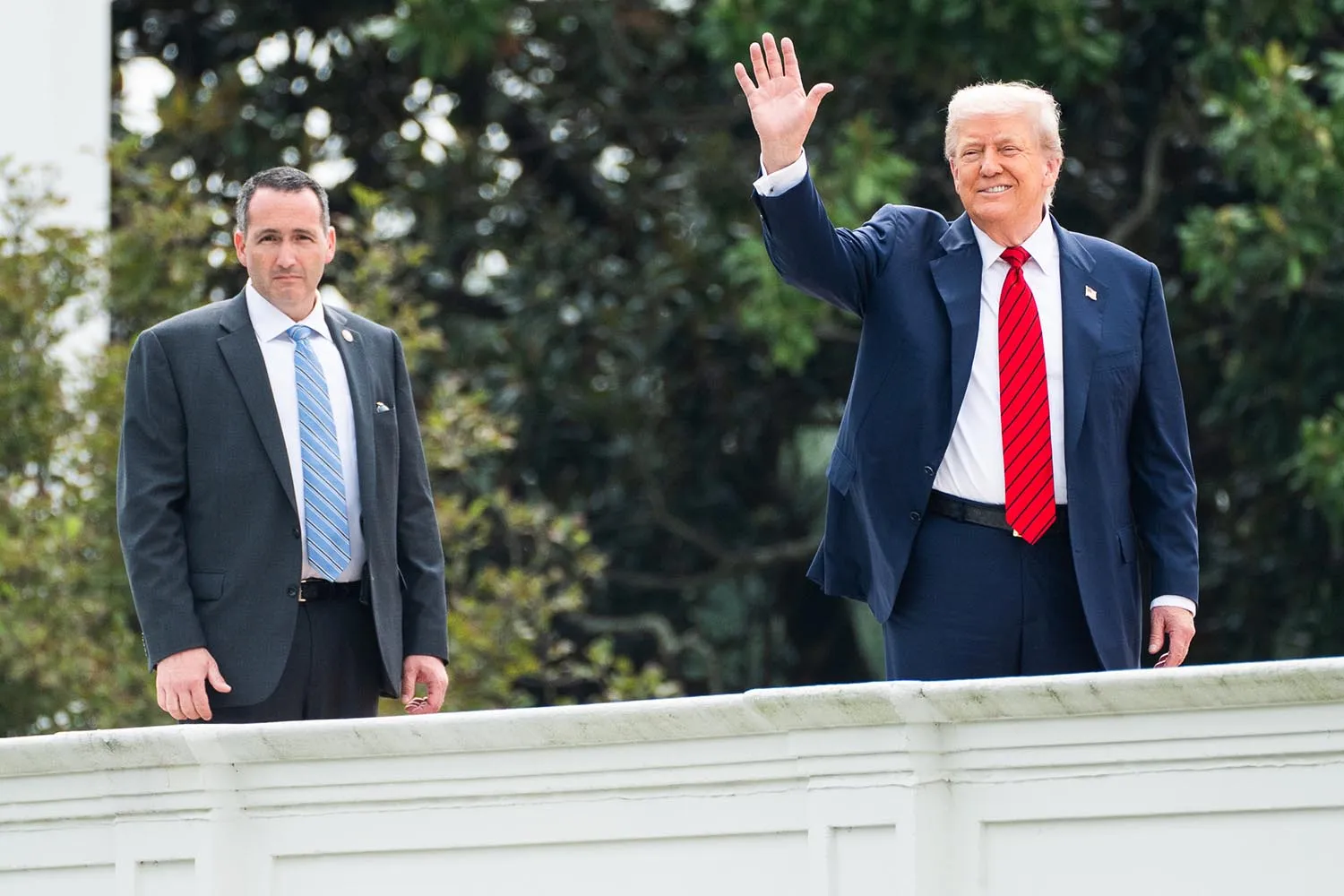
“I’ve been with contractors because we’re trying to get the ballroom built ahead of schedule,” Trump told reporters, underscoring his personal investment in the project. “It’s right on schedule, it’s ahead of schedule now, I want to keep it that way.”
As the administration pushes for billion-dollar security “hardening” and celebrates construction milestones, the data suggests a growing chasm between the President’s priorities and the pocketbooks of the American people.
The funding map for the President’s ballroom has revealed a “who’s who” of the American industrial complex. According to The Washington Post, the project’s donor roll features titans like Amazon, Google, Lockheed Martin, and Palantir—conglomerates that currently hold billions of dollars in active federal contracts with the Trump administration.
While Senator Grassley and the White House have worked to firewall the $1 billion “security” request from the actual construction costs, a faction of Republican lawmakers is now pushing to put taxpayers on the hook for the entire bill.
From Private Gift to Public Tab
In a sharp pivot from the President’s original promise of private funding, Senators Lindsey Graham (R-S.C.), Katie Britt (R-Ala.), and Eric Schmitt (R-Mo.) introduced legislation on the Monday following the Correspondents’ Dinner shooting to authorize $400 million in federal spending for the ballroom’s primary construction.
The move effectively ignores the previous pledges from both the billionaire President and his corporate benefactors.
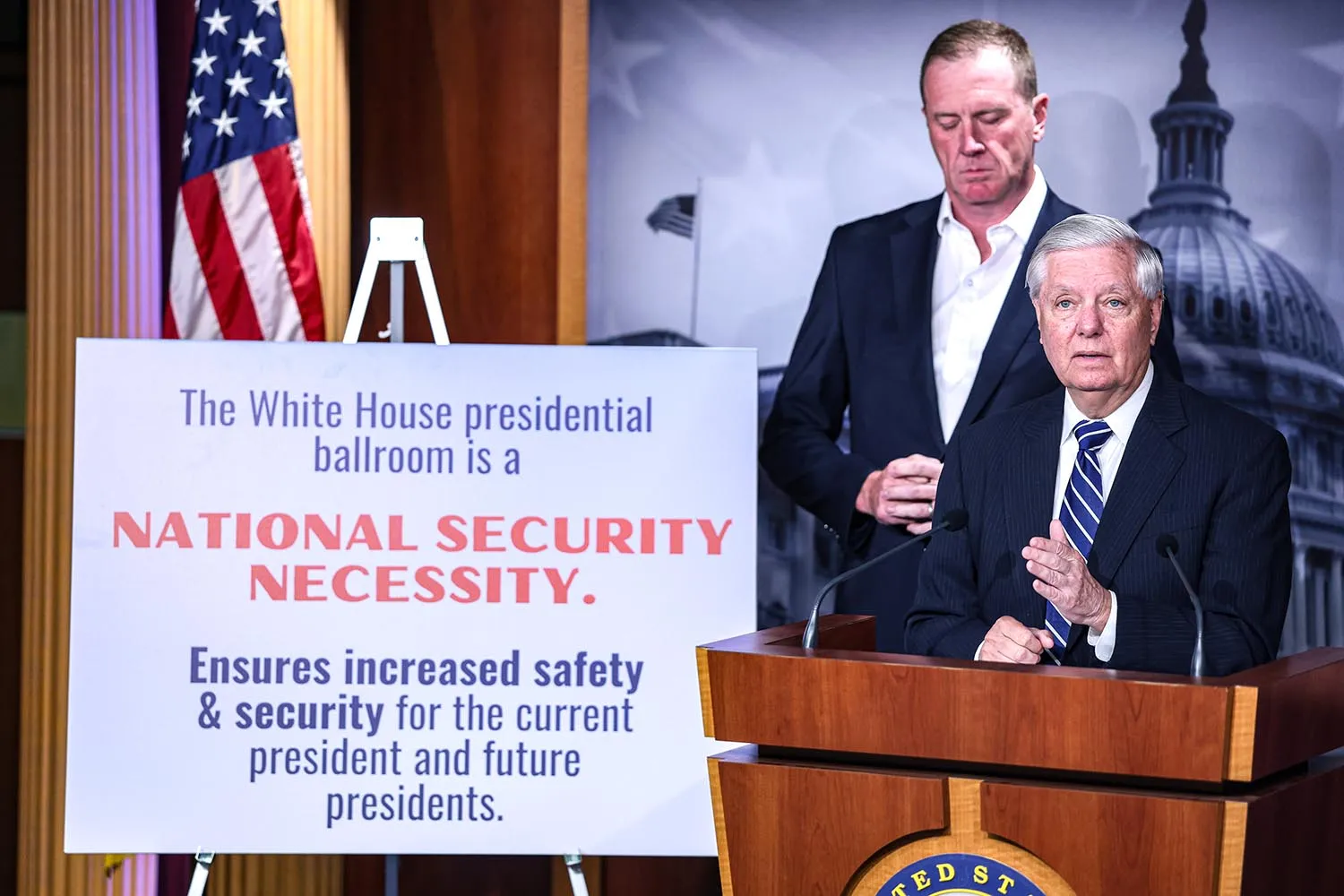
“Many people, I think, originally saw it as a vanity project,” Senator Graham conceded during an April 27 press conference. “We’re going to introduce legislation that would authorize $400 million to be spent to… build the presidential ballroom.” When asked about the promised private donations, Graham suggested a different utility for those funds: “Private donations can be used, but I think they should be used for buying china and stuff like that.”
“They Love My Ballroom”
President Trump has leaned into the controversy, framing the recent attempt on his life as a catalyst for the project’s popularity. Addressing a crowd at a West Palm Beach social club on May 1, the President linked his personal safety to the architectural venture.
“Consequential people get in a lot of danger. You know what I’m talking about: Saturday night,” Trump told the audience. “It was good for one thing, people are loving my ballroom now. That’s the only thing. They love my ballroom. They love my ballroom. It’s going to be the best in the world.”
A Question of Scale
Despite the political and financial capital being poured into the project, the venue’s actual utility remains under scrutiny. While the ballroom is being marketed in the context of the White House Correspondents’ Dinner (WHCD) security, the math doesn’t quite add up for the event itself.
The WHCD is hosted by an independent nonprofit of journalists—not the executive branch— and traditionally favors off-site neutral ground. Furthermore, the proposed Trump ballroom is designed for a capacity of roughly 1,000 guests, a far cry from the 2,500-plus attendees that the Washington Hilton currently accommodates for the “Nerd Prom.” Whether the structure is finished or not, the gala that sparked the security conversation appears unlikely to ever call the new ballroom home.