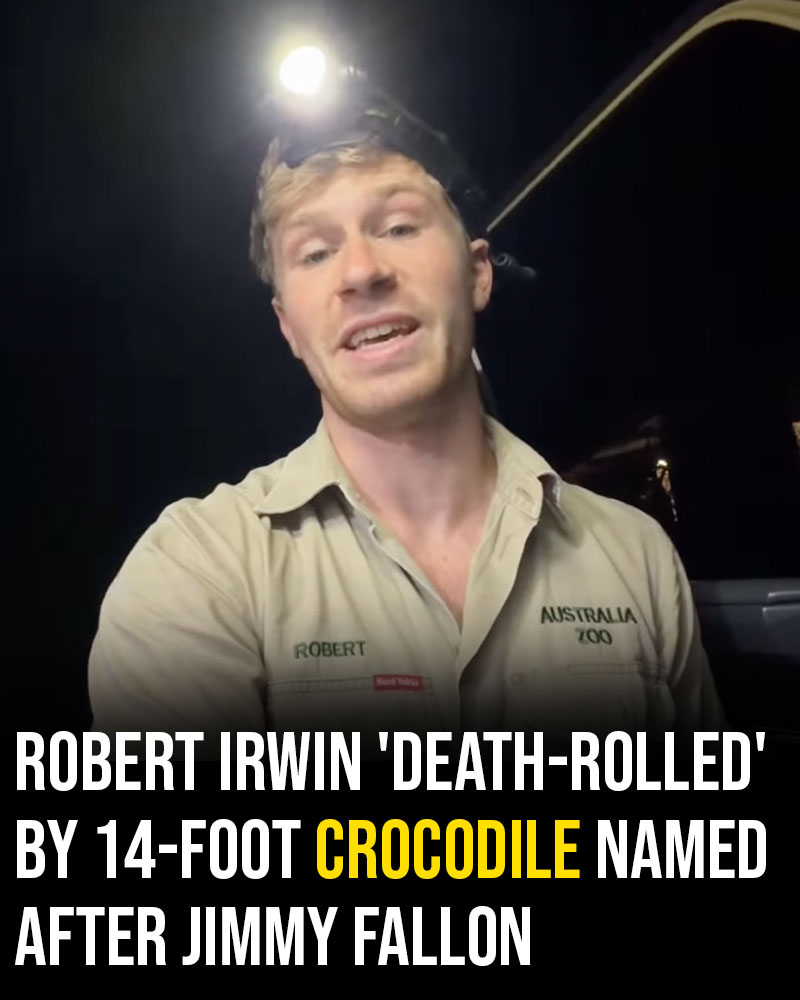
For Robert Irwin, the boundary between a routine afternoon and a life-altering catastrophe is often measured in inches. He stepped into the enclosure thinking he held the upper hand, but the wild has a way of reminding us that control is an illusion. Waiting for him was “Jimmy Fallon,” a 14-foot apex predator named after a late-night icon, harboring an intensity that was anything but comedic. In a blur of prehistoric reflex, the crocodile latched on and initiated a “death roll,” dragging Robert into a vortex of muddy water and 700 pounds of unrelenting, raw power. For a fleeting, suffocating second, the young conservationist faced a terrifying realization: he might not make it out.
This wasn’t some choreographed spectacle designed to chase trending hashtags; it was the brutal, visceral reality of a life lived on the same jagged frontier that claimed his father. As Robert was pinned beneath the weight of muscle and reptilian instinct, the stakes shifted from a conservation exercise to a desperate fight for survival. He didn’t have the luxury of a retake—only his training, his instincts, and a crucial stroke of luck allowed him to break free when the reptile rolled back. He emerged from the water not just with his life, but with a narrative that felt hauntingly familiar, echoing the white-knuckle tales his father, Steve Irwin, once shared with a captivated world.
More Than a Shadow
What truly resonates after the adrenaline fades isn’t just the proximity to tragedy, but the unmistakable presence of Steve Irwin reflected in his son’s composure. When Robert speaks, the cadence, the humor, and the unflinching courage aren’t mere imitations; they are an evolution. He isn’t simply walking in his father’s footsteps—he is expanding the path Steve carved out of the bush.
“The Irwin legacy isn’t a stagnant memory preserved in old film grain; it is a living, breathing force of nature.”
By leveraging modern science and global platforms, Robert ensures that conservation remains at the forefront of the cultural conversation. Every close call, every charismatic appearance on a late-night couch, and every tireless effort in the field serves as a reminder: the fearless spirit of the “Crocodile Hunter” hasn’t vanished. It has simply taken a new form, charging forward on its own terms, as bold and relentless as the animals the family seeks to protect.