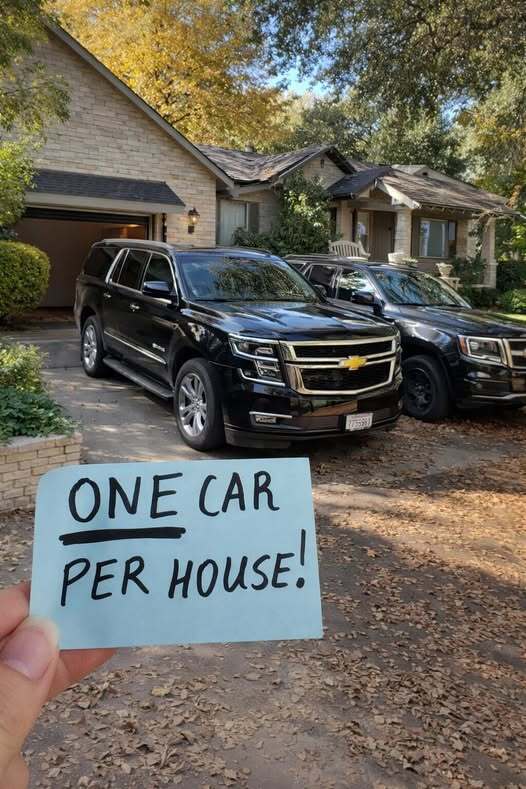
The suburbs are often a landscape of manicured lawns and quiet understandings, but in my ten years covering the friction of modern living, I’ve learned that the most volatile borders aren’t between nations—they are between driveways. What began as a standard move into a new neighborhood quickly devolved into a masterclass in petty tyranny, orchestrated by a woman who mistook a pastel cardigan for a badge of office.
The first volley arrived via a handwritten note tucked under a windshield wiper, vibrating with the energy of a self-appointed sheriff: “One car per house!”
The author of the ultimatum appeared shortly thereafter, a vision of suburban discipline in a matching pink headband and white capri pants. She didn’t come to offer a fruit basket; she came to enforce a fiction.
The Fiction of the “One-Car Rule”
“Our HOA—very friendly, but firm—has rules,” she declared, her voice carrying that specific strain of nasal authority. “Only one car per household in the driveway.”
I looked at my driveway, then back at her. “One car? For an entire household?”
“No exceptions,” she replied, her posture stiffening. “It keeps us all… orderly.”
My partner, Jack, pointed out the obvious: both vehicles were neatly contained within our property line, not spilling onto the public street. It didn’t matter. With a tilt of her head—a gesture of finality usually reserved for sentencing hearings—she reiterated the decree: “One house, one driveway, one car. The rule is for everyone.”
We chose to ignore the warning. In our defense, we had read the actual bylaws, which contained no such restriction. We assumed her threat was as hollow as her “friendly” demeanor. We were wrong.
The Three-Day Escalation
At dawn three days later, the peaceful silence of the cul-de-sac was shattered by the rhythmic clanking of chains and the hydraulic whine of a flatbed. We rushed to the window to see our driveway being cleared by force. Outside, our neighbor stood like a conquering general, a wide, triumphant smile plastered across her face.
I stepped onto the porch, and to her visible confusion, I started laughing.
“What’s so funny?” she snapped, her smugness beginning to fray at the edges.
“Nothing,” I said, leaning against the doorframe. “Just the fact that you owe us $25,000 now.”
The triumphant grin didn’t just fade; it collapsed. “What—what do you mean?” she stammered, a nervous gulp punctuating her words.
The $25,000 Oversight
I walked toward the lead tow truck and pointed to the specific symbol displayed on the vehicle tags. In her rush to play judge, jury, and executioner, she had overlooked a critical detail: both cars were registered under a specialized government program for classic and specialty vehicles.
Under state statutes, these aren’t just “extra cars.” They are protected assets. To initiate a predatory tow on a vehicle with this specific classification—especially when no actual HOA violation exists—carries a mandatory penalty that can reach $25,000 per incident. By placing the call and signing the complaint, she hadn’t just cleared the driveway; she had personally underwritten a massive legal liability.
The Turning Tide: The tow truck drivers, realizing they had been misled into an illegal impoundment of protected property, didn’t even wait for a police escort. They unhooked the vehicles on the spot, the clatter of the chains sounding a lot like a victory march.
The color drained from her face, leaving her the same shade as her white capris. The “stern but firm” enforcer vanished, replaced by a woman who realized her arrogance had just written a check her bank account couldn’t settle.
“I didn’t know…” she muttered, retreating toward her own property.
“Maybe next time,” I called out as she reached her door, “you’ll think twice before making up your own rules.”
Since that morning, the silence from across the driveway has been absolute. She no longer monitors the pavement or dictates the “order” of the street. In the end, it wasn’t a lawsuit or a shouting match that restored the peace—it was the simple, expensive reality that the law doesn’t care about your pastel color coordination.