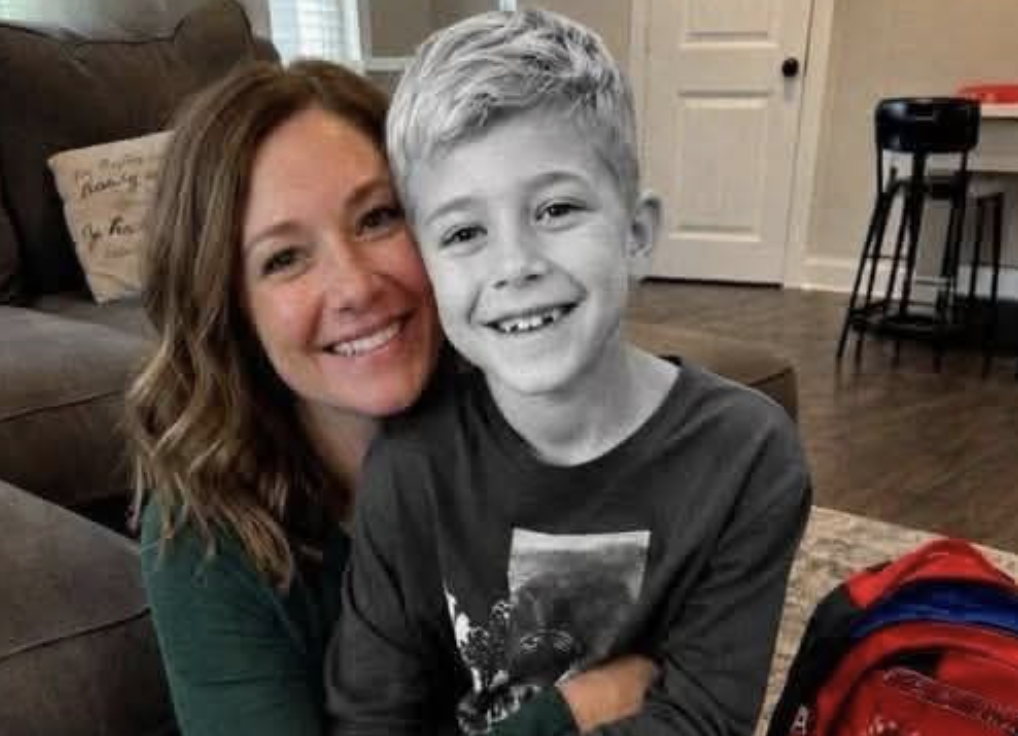
They call it an unforeseen tragedy. When a tractor-trailer or a sudden illness or a freak misstep snatches an eight-year-old boy from the world exactly seven days before Mother’s Day, the community retreats into the safe, rehearsed vocabulary of comfort. A sudden loss. An unpredictable twist of fate. A beautiful angel gone too soon.
For a mother standing in the quiet wreckage of her own life, those words do not land; they float. They sound like a report on someone else’s evening news, a distant dispatch from a country she never intended to visit. I tried to wear those words like a blanket because rejecting them meant standing naked before a gale-force wind of grief. But any investigative reporter will tell you that the truth rarely resides in the grand, sweeping statements. It hides in the corners. It lingers in the small, jagged details that the rest of the world sweeps away in the name of moving on.
While the neighbors focused on the immense, unfathomable void left in our home, my mind became obsessively fixed on a single, tangible object: a bright red Spider-Man backpack.
To anyone else, it was consumer nylon, mass-produced and disposable. To my son, Randy, it was an extension of his own body. He didn’t just carry it; he lived in it. At night, he wouldn’t dare leave it downstairs or tucked in a closet; it sat like a small, vigilant sentinel right beside his bed, ensuring that the morning routine would not be disrupted by a frantic search. Yet, in the chaotic aftermath of the accident—amid the flashing sirens, the hurried voices, and the heavy plastic sheets—that red backpack vanished. It was as if it had evaporated into the same thin air that took my son.
In those first few numb days, I tried to practice the logic of the well-meaning. What does a bag matter when your child is gone? I told myself it was trivial, a foolish thing to mourn amidst a catastrophic loss. But grief operates on its own emotional physics. The larger the tragedy, the more the human heart anchors itself to the small things it can still comprehend. The absence of that backpack began to take on a physical weight, pressing down on my chest every time I passed his room.
The Wall of Official Silence
The search began with quiet inquiries, the kind of polite questions a grieving mother asks when she doesn’t want to seem unhinged. I called his teacher, Ms. Bell. She remembered the bag, of course—she saw it resting by his desk just before the world fractured and the emergency responders flooded the building. The school principal was empathetic, assuring me that the custodial staff had combed the classroom, the hallways, and the lost-and-found bins. The result was always the same: a sympathetic shrug.
Then came the encounter with the responding officer. In my decade of reporting, I’ve learned to watch a source’s eyes when they encounter a question they aren’t prepared to answer. When I brought up the missing backpack, the officer didn’t look at me. He paused, his posture stiffening, shifting his weight from one boot to the other. He selected his words with the agonizing precision of a man walking through a minefield.
“Sometimes things get misplaced during emergencies,” he said, his voice dropping into that low, practiced timbre used by officials to de-escalate hysterical citizens. “In the chaos, items get moved. It’s unfortunate, but it happens.”
He meant it as a sedative. It functioned as an alarm.
That afternoon, I sat at my kitchen table, watching the dust motes dance in the slanting afternoon light. The house had developed a terrifying stillness, a silence so dense it felt as though the walls had forgotten how to expand and contract with the sound of a child’s life. It was in that moment of profound isolation that the truth hit me: I wasn’t embarking on a crusade for a piece of school gear. I was hunting for the final, unrecorded chapter of my son’s life. A piece of Randy had been left unaccounted for on the public record, and I could not let the file be closed.
The Sunday of Stillness
When Mother’s Day finally arrived, the silence inside the house transformed from an absence into a presence.
In the years before, this specific Sunday was defined by a beautiful, chaotic choreography. Randy was never a child for stealth; I would hear him tumbling out of bed hours before dawn, the unmistakable clatter of cereal bowls hitting the counter, the smell of spilled milk, and the scratch of a cheap crayon on construction paper. His gifts were masterclasses in glorious imperfection: cards with backwards ‘E’s, asymmetrical drawings, and wild dandelions ripped from the lawn with the roots still clinging to them. Those flaws were the very proof of his existence. They were the thumbprints of his love.
That morning, the hallway remained empty. The kitchen counter was clean and dry. There were no small, dirt-caked hands tucked behind a back, hiding a secret that was bursting to be told. There was only the heavy, suffocating reality of a May morning without a child. I sat on the living room sofa, my fingers knotted into the fabric of his favorite dinosaur blanket, paralyzed by the realization that time was moving forward while I was entirely stuck.
The grief wasn’t just a psychological state; it was an atmospheric pressure. The air in the living room felt thick, holding onto his memory like a breath it refused to exhale.
A Knock at the Door
The doorbell broke the silence at mid-morning.
My immediate instinct was to ignore it. When you are deep in the trenches of fresh loss, the last thing you want is the well-meaning intrusion of neighbors bearing casseroles and fragile, pitying smiles. I didn’t want to perform my grief for anyone. But the knocking didn’t stop. It wasn’t the aggressive thump of a delivery driver or the confident ring of a friend; it was a soft, rhythmic, persistent tapping, like a bird fluttering against a windowpane.
When I pulled the door open, the anger evaporated. Standing on the porch was a little girl, no older than Randy. Her eyes were swollen and traced with vivid red veins, the universal marker of a child who has been crying for hours in secret. In her arms, clutched so tightly against her chest that her knuckles were white, was the missing red Spider-Man backpack.
For a long beat, my brain refused to process the image. It felt like a hallucination born of sleep deprivation and sorrow.
“Are you Randy’s mom?” she whispered.
The words were so quiet I almost had to read her lips. I couldn’t speak; I merely nodded, a tight, jerky movement of my chin. With a trembling effort, she extended her arms, offering the bag to me like a sacred relic.
The Secrets of the Craft Room
The fabric was scuffed with schoolyard dirt, the zipper pull slightly bent, but it was undeniably his. As I took it from her, my chest tightened so hard it felt like a physical blow.
The girl introduced herself as Sarah. She spoke with a strange, rehearsed gravity, her small voice steadying itself as if she had spent the entire morning reciting this speech in front of a bedroom mirror to keep from falling apart.
“Randy told me to keep it safe,” she said, looking down at her shoes. “He told me it was the most important thing, and he trusted me not to let anyone take it.”
The narrative didn’t make sense. Why would my son hand his lifeline—the bag he never let out of his sight—to a classmate before an accident no one saw coming?
Without waiting for an invitation, Sarah stepped past me into the hallway. She walked with a strange purpose straight to the kitchen table, placing the backpack down on the wood with an immense, delicate care, as if she were handling unexploded ordnance.
“Open it,” she whispered.
My fingers felt thick and useless against the metal teeth of the zipper. When the track parted, the contents inside revealed a world I knew nothing about. There were no textbooks or half-eaten snacks. Instead, the bag was filled with craft supplies: tangled skeins of pastel yarn, a pair of blunt plastic knitting needles, and sheets of colored paper folded into precise squares.
And there, resting at the very bottom, was an object.
It was a small, hand-knit unicorn. It was a beautiful disaster of a toy—one leg was a stump shorter than the rest, the stuffing was bursting through loose purl stitches, and the horn sat at a comical, drunken angle on its forehead. It was clumsy, raw, and completely magnificent.
I stared at it, utterly bewildered. “Randy loved dinosaurs,” I murmured, more to myself than to her. “He never cared about unicorns.”
Sarah looked up at me, her eyes filling with fresh tears. “He didn’t make it for himself,” she said. “He told me he was making it for you. For Mother’s Day.”
The Unspoken Burden
Beneath the lumpy yarn of the unicorn lay a piece of lined school paper, folded into a tight square. I opened it with hands that could barely hold their own weight. Randy’s handwriting—untamed and heavy-handed—leaped off the page.
The note was a confession of love wrapped in the self-consciousness of an eight-year-old boy. He wrote that the gift wasn’t quite finished yet, and he begged me not to laugh at how bad the legs looked. He noted that Sarah had to help him with the trickiest stitches because his fingers kept getting tangled in the yarn. He ended it with a declaration of love so pure it felt like a transmission from beyond the veil.
My knees gave out. I sank into a kitchen chair, clutching the crooked unicorn to my chest, weeping for the boy who had spent his final days secretly learning how to knit just to surprise his mother.
But Sarah wasn’t finished. The real reason for her clandestine mission lay even deeper in the bag.
“There’s one more thing,” she said, her voice dropping an octave. “You need to see why he hid the bag.”
Reaching into the front pouch of the backpack, I pulled out a second sheet of paper. This wasn’t the colorful, hopeful note of a child making a holiday gift. This was a formal document of shame. It was an apology note, written in that same clumsy handwriting, addressed to the administration.
I am sorry for ruining the Mother’s Day display in the main hall, the note read. I did not mean to knock over the paint. I am not a bad boy.
The puzzle pieces began to slam into place with terrifying force. I had received no phone calls from the school about vandalism or property damage. Randy had never mentioned a word about a ruined display.
Sarah explained that the day before the accident, a large, elaborate Mother’s Day exhibit in the school’s lobby had been knocked over, defaced with spilled tempera paint. In the immediate aftermath, the blame had landed squarely on Randy—the boy who was always moving too fast, the boy who filled the room with noise.
“He didn’t do it,” Sarah said fiercely, her little fists clenching at her sides. “It was an accident by one of the older kids, but everyone thought it was Randy. He was so scared you would be mad at him. He kept saying, ‘If my mom sees the note, she’ll know I’m telling the truth. She’ll believe me.'”
He had hidden the backpack with Sarah because he was terrified the school would confiscate his unfinished gift, or that the apology note would reach me before he had a chance to explain himself. He had spent his final hours on this earth carrying a profound, unjust guilt—a weight that didn’t belong to him—defending his character in secret because he feared he would lose the one thing that mattered most to him: his mother’s belief in his goodness.
I sat there in the quiet kitchen, holding the crooked unicorn in one hand and the defense brief of my late son in the other. The tragedy of his death hadn’t changed, but the narrative had. He hadn’t just left; he had left fighting for his name, leaving behind a trail of yarn and truth that a frightened little girl had to cross town to deliver.