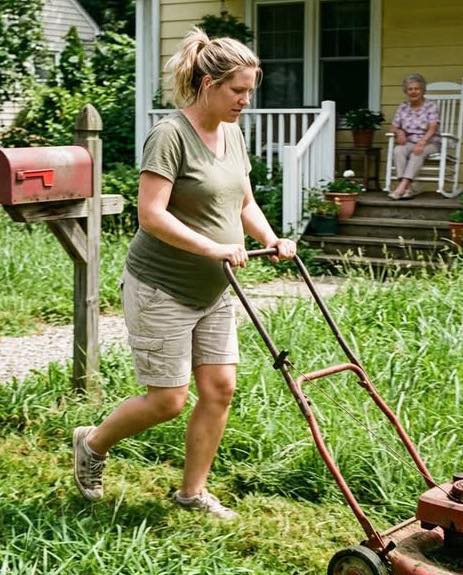
The heat didn’t just shimmer off the asphalt that Tuesday; it sat on your chest like a physical weight. At 34 weeks pregnant, with a mortgage slipping through my fingers and an ex-partner who had vanished the moment the line on the test turned blue, I was already suffocating. The foreclosure notice sitting on my kitchen table felt like a formal invitation to rock bottom.
I went outside just to find air. Instead, I found Mrs. Higgins.
She was 82, mourning a husband, and losing a war against a lawn that had grown knee-high. Watching her struggle with a rusted mower in 95-degree heat felt like looking into a mirror of my own exhaustion. I had every excuse to turn back to my own crumbling life, but I didn’t. For three grueling hours, I pushed that machine through the thick brush, my ankles swelling and my back screaming in protest.
When the last blade was cut, she gripped my hand with a strength that surprised me. “You’re a good girl,” she whispered. “Remember that.”
I went to bed thinking it was a quiet end to a loud day. I was wrong.
The dawn didn’t bring light; it brought sirens. The strobing blue and red fractured the morning shadows against my bedroom wall. When the heavy, rhythmic thud of a fist hit my front door, I opened it to find the Sheriff framing the porch, his expression unreadable and his posture rigid.
“Ma’am,” he said, his voice dropping into that flat, official tone that makes your blood turn to ice. “We need to talk to you about Mrs. Higgins.”
The air left the room. I stammered out that I had just seen her, just helped her.
“We know,” he countered, his eyes narrowing. “That’s exactly why we’re here. She was found dead this morning.”
The world tilted. I started to explain—the lawn, the heat, the simple act of a neighbor helping a neighbor—but he cut me off with a sharp gesture toward my own driveway.
“Then you won’t mind explaining what’s in there,” he said, pointing to my mailbox.
My hands were shaking so violently the lid clattered against the metal housing. I expected a summons, a piece of evidence, or perhaps something far more sinister. But as the lid fell open, the reality of Mrs. Higgins’ final act began to unfurl.
What I found inside wasn’t just a physical object; it was the final chapter of a story I hadn’t realized I was a part of. It turns out, when she told me to “remember” I was a good person, she wasn’t just giving me a compliment. She was leaving me a legacy.
In the eyes of the law, my presence at her house the day she died made me a person of interest. But in the eyes of Mrs. Higgins, I was the only one left worth trusting. As I pulled the contents from the box, the Sheriff didn’t move. He just watched as the “simple act of kindness” I thought I’d performed transformed into a life-altering complication.
Because in this town, nothing—not even a mowed lawn—is ever just what it seems.