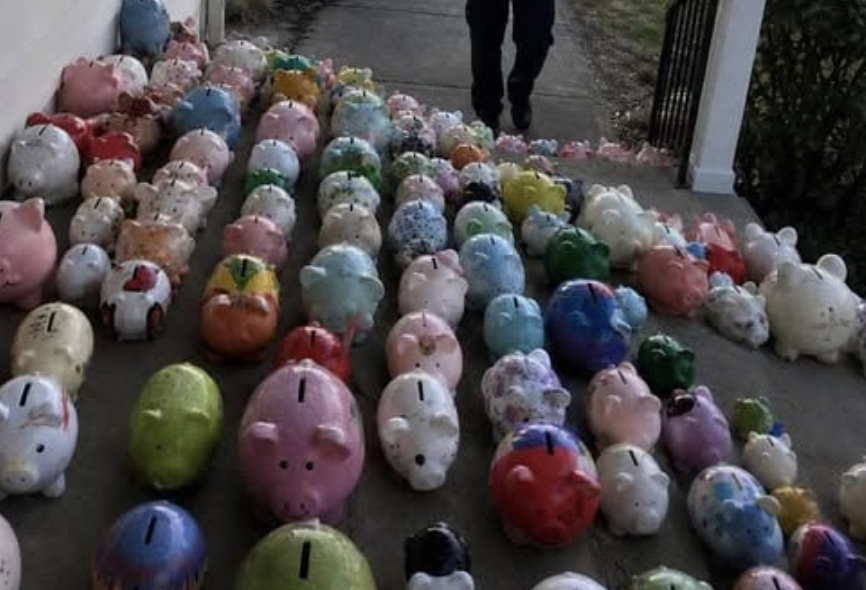
The small, cream-colored envelope was worn at the edges, stuffed with a crumpled handful of dollar bills and the metallic weight of carefully hoarded quarters. In the grand scheme of local economies, it wasn’t much. But context is everything. The hands holding it belonged to a six-year-old boy named Oliver, and the porch he was standing on belonged to Ms. Adele—an elderly woman who had spent months slowly fading into the background noise of an otherwise bustling suburban street.
As a journalist, you learn to look for the structural fractures in a community. You look at rising costs, shifting demographics, and social isolation. But sometimes, a story lands on your desk that reminds you that the most profound shifts don’t happen in city hall; they happen under the dim glow of a porch light, driven by the uncomplicated moral clarity of a child.
This isn’t a story about charity. It’s a story about the moment a child saw exactly what the adults around him had spent years learning to ignore.
The Architecture of Looking Away
We like to think of our neighborhoods as webs of mutual support, but the modern reality is often far more isolated. We develop a highly sophisticated vocabulary for minding our own business. We tell ourselves comforting little narratives to soothe our collective conscience: She’s probably just resting. She values her privacy. Surely, a relative is checking in on her.
Meanwhile, the mail piles up on the mat. The curtains stay drawn. The porch lights stay off.
Oliver hadn’t yet learned those adult escape routes. He hadn’t mastered the art of the polite excuse or the convenient blind spot. To his six-year-old mind, the math of human suffering was painfully simple: darkness meant something was wrong, and his own comfort was not a valid excuse to overlook someone else’s fear.
When he decided to empty his piggy bank—surrendering every cent of his savings—and push that small envelope into Ms. Adele’s weathered hands, he wasn’t just offering financial aid. He was executing a quiet, devastating rebellion against the status quo of our block. Watching him, I realized his small hands were carrying a specific kind of radical empathy that most of us leave behind somewhere in childhood.
The Micro-Revolution on the Porch
What followed wasn’t a sudden, cinematic miracle, but a slow, organic awakening. Oliver’s singular act of sacrifice acted as a mirror, forcing a mirror up to the rest of the street. It shamed us, but more importantly, it mobilized us.
In the weeks that followed, the neighborhood began to reassemble itself around Ms. Adele’s porch. The silence that had enveloped her house for months was broken by a steady rhythm of footsteps.
-
The immediate response: A rotating calendar of hot casseroles and grocery runs.
-
The structural support: Neighbors sitting at her kitchen table, untangling years of intimidating bureaucracy and overdue paperwork.
-
The human element: Commuters offering rides to medical appointments, turning chore-bound errands into shared conversations.
Yet, the most significant transformation on our street didn’t come in the form of organized logistics. It was much quieter than that.
Redefining the Streets We Walk On
We started looking up again.
For the first time in years, people were actively scanning the block. We looked at the windows. We checked the porches. We actually looked at each other, rather than down at our phones or straight ahead toward our own driveways. Oliver’s gesture cracked open the pavement of our routine, allowing something genuine to grow back in its place.
I used to believe that community was a passive asset—something you automatically inherited simply by signing a lease or buying a house on a specific street. I thought proximity equaled connection.
Now, I see things through a different lens. Community isn’t a geographic guarantee; it’s an active, daily choice. It is a muscle that must be intentionally flexed over and over again. It is built entirely out of the moments when we choose to slow down, step across the property line, knock on a door, and ask the simplest, most necessary question we have: “Are you okay?”