The envelope possessed a gravitational pull that defied its physical dimensions. It felt weighted with a density that wasn’t born of paper and ink, but of the months of unsaid things that had been fermented inside its seal. Piper stood in the sterile, muted stillness of the hallway, a stark contrast to the emotional gale she had just weathered inside the office. Her fingers traced the familiar, rhythmic cadence of Jonathan’s cursive—letters that sliced through the day’s trauma with a precision that was simultaneously agonizing and profoundly restorative.
In the periphery, the school was attempting to recalibrate, its lockers clanging and bells ringing as it sought the safety of its mundane rhythm. But for Piper, the concept of “normal” had been permanently discarded. Not after the tableau of Letty standing as a sentinel beside Millie. Not after the arrival of the men from Jonathan’s old crew—rough-hewn men who carried his memory into the room like a physical presence, filling the gaps he had left behind. And certainly not after seeing his battered hard hat resting on the mahogany desk, a silent, yellowed relic that seemed to have captured and held a pocket of time where he was still breathing.
She breached the seal with a surgical slowness, haunted by the irrational fear that a sudden movement might shatter the fragile essence of what lay inside. The note was folded with the wear of a document that had been opened and closed in secret many times before it ever reached her. The script was Jonathan’s, yet the hand was different—less hurried, softer, devoid of the frantic energy of a man in the middle of a shift. It was the deliberate, reflective tone he reserved for the truths he feared might otherwise go unsaid.
The words were lean, stripped of artifice, yet they landed with a visceral impact. He wrote of the structural integrity of family, of the quiet architecture of strength, and of his recognition of the way Piper carried the world on her shoulders without ever asking for a lighter load. He had seen her clearly—perhaps more clearly than she had ever seen herself. The realization forced a sharp, stinging lump into her throat. She blinked rapidly, a desperate attempt to maintain her professional composure in a public corridor where any passerby might witness the cracks in her armor.
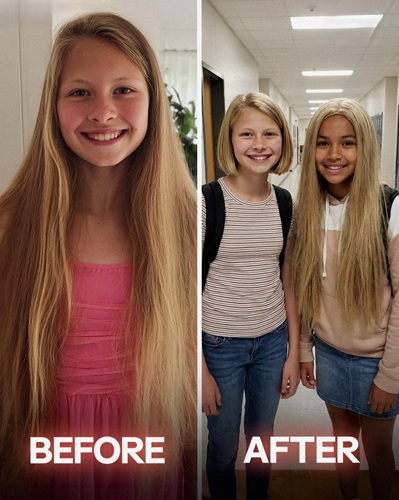
A soft percussion of footsteps echoed against the linoleum. Piper turned to see Letty approaching, her small hand still anchored to Millie’s. There was a subtle, tectonic shift in the way the two girls moved. It wasn’t their appearance that had altered, but their aura—a bond forged in the crucible of that office. It was a shared vulnerability that had, through some alchemy of grief and justice, transformed into a shared courage.
Letty came to a halt beside her mother, offering a silence that was more supportive than any sentence could be. Her eyes darted from the envelope to Piper’s face, navigating the complex emotional geography that children often map better than adults. She leaned into Piper’s arm, a grounding force that tethered them both to the earth.
“Is it from Dad?” the girl asked, her voice a mere vibration in the air.
Piper’s vocal chords felt like taut wire; she could only offer a nod. She passed the note down with a reverence usually reserved for ancient scripture. Letty unfolded it, her lips forming the silent shapes of the words as she traced her father’s legacy line by line. For a heartbeat, the hallway dissolved, the school disappeared, and they existed in a vacuum created by a dead man’s voice.
When she reached the end, Letty didn’t collapse into tears. Instead, she pressed the paper against her sternum, drawing in a long, shuddering breath. She looked up at Piper with a smile that was fragile but genuine.
“He still talks like he’s in the room,” she whispered.
Piper let out a jagged, watery laugh. “He always did that,” she whispered back. “Usually when he was supposed to be listening.”
In the background, the landscape shifted. Millie moved slightly, and Jenna stood nearby, her arms wrapped around her torso as if bracing for a cold wind, hesitant to intrude on the sacred space of another family’s grief. But the day had proven that pain is a universal solvent—it dissolves the boundaries we build to keep ourselves separate.
Letty was the first to bridge the gap. She stepped toward Millie and extended her hand again, a gesture of immense proportion in its simplicity.
“You don’t have to stay scared of school,” Letty said, her voice ringing with a newfound authority. “Not anymore.”
Millie’s hesitation lasted only a second before her fingers intertwined with Letty’s. It was the moment a retreat turned into a stand.
Back inside the office, the men from the job site were gathering their things, though their movements were heavy and unhurried. Marcus remained fixed by the desk, staring at the hard hat as if it were a reliquary. Luis leaned against the doorframe, arms crossed, his gaze fixed on the unfolding scene with a quiet, knowing intensity.
When Piper re-entered the room, the air grew still—a silence of profound respect. These men had known a version of Jonathan she hadn’t—the man in the dirt, the man in the heat—and yet, here they were, unified by the common denominator of his absence.
Marcus cleared his throat, the sound rough and gravelly. “He would’ve liked this,” he said, nodding toward the girls.
“Liked what?” Piper asked, her brow furrowed.
“This. The whole thing,” Marcus replied. “The fact that she didn’t wait for a foreman to tell her how to fix it. She just did it.”
Letty shifted her weight, still anchored to Millie. “I just didn’t want her to be alone,” she said.
Luis offered a slow, rhythmic nod. “That was his exact philosophy. ‘Nobody works alone.’ He said it every day.”
A moment of reflection hung in the air—the kind of stillness that occurs when several people realize they are all looking at different facets of the same diamond.
Mr. Brennan, the principal, stood by the door, the frantic bureaucracy of the morning having been replaced by a somber clarity. “We are going to have to address the systemic failures here,” he admitted, his voice measured. “It’s not just about the bullying. It’s about the silence that allowed it to grow.”
Piper’s response was immediate and firm. “An apology is a start, but it isn’t a solution. We need a fundamental change in the culture of this building.”
Jenna found her voice then, stepping forward with a quiet, steely resolve. “My daughter didn’t stop attending because of an illness,” she stated. “She stopped because this ceased to be a safe place for her.”
The weight of that sentence lingered, undeniable and heavy.
Letty tightened her grip on Millie’s hand. “That shouldn’t happen,” she insisted.
“No,” Piper agreed, her voice a soft vow. “It shouldn’t.”
Outside, the afternoon sun had begun to mellow, casting a golden, amber hue over the brickwork. The world continued its indifferent spin, but within this small circle, a permanent transformation had taken root. It wasn’t loud or cinematic; it was the subtle sound of a long-locked door finally creaking open.
Before they parted, Marcus placed a calloused hand on the desk near the hard hat. “We’re keeping the fund active,” he told Piper. “Exactly the way he envisioned it.”
Piper nodded. “Then we’ll make sure it goes where it’s needed most. To the kids who are falling through the cracks.”
Letty looked up, her eyes searching her mother’s. “Dad would like that, wouldn’t he?”
Piper smiled through the exhaustion that threatened to pull her under. “He would have demanded it.”
As the group finally exited the building, the air felt scrubbed clean. Jenna walked in stride with Piper, Millie with Letty, and the men trailed behind like a rearguard—a living testament to the fact that grief, while a solitary journey, often builds the most resilient bridges.
Letty looked down at the yellow hard hat she now carried under her arm. “Do you think Dad would be proud of today?”
Piper didn’t pause. “He already is,” she said. “He’s just waiting for us to catch up to him.”
Letty’s smile broadened slightly. “Then I’ll tell the world for him.”
As they moved toward the parking lot, the heaviness didn’t vanish—it simply distributed. It was no longer a burden for one, but a weight shared by many. And in the world of heavy things, that is where the healing begins.