The Trump administration’s claim that there are no additional Jeffrey Epstein-related documents left to release has come under renewed scrutiny following the discovery of previously released—but heavily redacted—files from the Department of Justice itself.
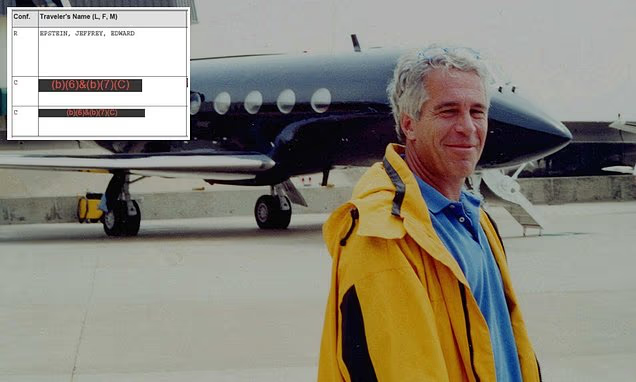
Hundreds of pages of Epstein’s private flight logs—records long linked to speculation about the “Lolita Express,” his infamous private jet—were obtained by DailyMail.com via a Freedom of Information Act (FOIA) request. The documents, which span flights between 2010 and 2019, detail trips to Epstein’s various properties, including his private island in the Caribbean, his ranch in New Mexico, and his Manhattan townhouse.
While the documents do confirm the names of pilots and flight patterns, the identities of most passengers remain blacked out, sparking renewed accusations that the government is continuing to shield high-profile individuals who may have been associated with Epstein.
Despite official assertions from Attorney General Pam Bondi’s DOJ that the case is closed and that no further disclosures will be made, the existence of these redacted records casts doubt on claims of transparency. Critics argue that the files clearly show more material exists—material that has not been fully released to the public.
Epstein, a disgraced multimillionaire financier with a long history of sexual abuse allegations involving underage girls, was arrested in July 2019 on federal sex trafficking charges. A month later, he was found dead in his jail cell at the Metropolitan Correctional Center in Manhattan. The official cause of death was ruled a suicide—a conclusion that has fueled years of conspiracy theories, especially among Trump’s political base.
His longtime associate and former girlfriend, Ghislaine Maxwell, was later convicted on multiple charges of trafficking and grooming minors and is currently serving a 20-year prison sentence.
The Epstein-Maxwell saga drew global headlines not only for the disturbing allegations at its core, but also because of the pair’s deep ties to powerful elites, including presidents, royals, tech moguls, and business titans. These associations have been central to theories suggesting a broader conspiracy to cover up crimes committed by the rich and connected.
In recent months, the Department of Justice and FBI released a memo reaffirming that Epstein died by suicide, which only reignited suspicion online. MAGA-aligned conservatives, including prominent figures in Donald Trump’s orbit, have repeatedly claimed—without presenting evidence—that Epstein was murdered to prevent him from revealing damaging information about elite clients.
Some allege the existence of unreleased “client lists,” hidden surveillance footage, or sealed depositions that could expose a larger web of abuse. Trump himself has suggested that the circumstances of Epstein’s death warrant deeper scrutiny, hinting at a possible cover-up within what he refers to as the “deep state.”
Despite these claims, the DOJ maintains that its investigation is complete. Yet the release of the redacted flight logs under FOIA raises a critical question: If no further files exist, why are names and destinations still being shielded from public view?
For many Americans still seeking answers, the lack of full disclosure fuels a belief that powerful figures are being protected at the expense of transparency and justice.